THE CLASSIC COLLECTION✦An outlaw’s diary: the CommuneCLASSIC FREE BOOKS
An outlaw’s diary: the Commune
Cécile Tormay
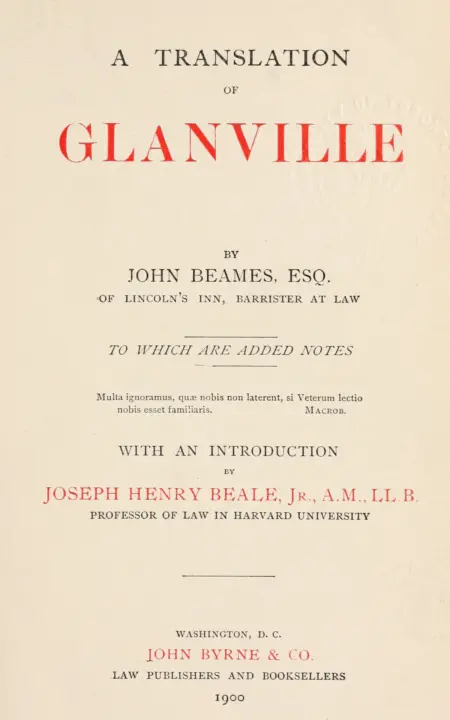
THE CLASSIC COLLECTION · 1900
"A translation of Glanville" by Ranulf de Glanville is a legal treatise written between 1187-1189. This groundbreaking work systematically codified English law for the first time, defining legal processes and introducing writs that remain influential today. Written for Henry II after years of chaos, it served as the foundation of English common law. The treatise consists of fourteen books covering jurisdictions and procedures in the King's Court, fundamentally transforming how justice was administered throughout the kingdom.
Introduction adapted from the source catalogue; source summaries may be automatically generated.
Free to read · English · 91,270 words · No account needed
MAKE TIME FOR A GOOD BOOK
On by default. Untick to stop anonymous reading totals. Each page counts after 10 seconds in view. How this works.
Anonymous counting is on unless you have switched it off.
“The King to the Sheriff, Health.[481] N. complains to me, that R., unjustly, and without a Judgment, has raised a certain Dyke in such a Vill, or thrown it down, to the nuisance of his Freehold, in the same Vill, since my last Voyage into Normandy—And, therefore, I command you, if the aforesaid N. should make you secure of prosecuting his claim, then, that you cause twelve free, &c. to view such Dyke and Tenement, and cause their names to be imbreviated. And summon, by good Summoners, &c.” as before.
[Footnote 481: Vide F.N.B. 408. 409.]
“The King to the Sheriff, Health.[482] N. has complained to me that R., unjustly and without a Judgment, has raised the Pond of his Mill, in such a Vill, to the nuisance[483] of his Freehold, in such Vill, or in another Vill, since my last Voyage into Normandy. And, therefore, I command you, that if the aforesaid N. should make you secure of prosecuting his claim, then, you cause twelve free, &c. to view that Pond and Tenement, &c.” as before.
[Footnote 482: Vide F.N.B. 407.]
[Footnote 483: See Bl. Com. 3. 220.]
If, however, the Disseisin concern Common of Pasture, then, the Writ
shall be as follows——
“The King to the Sheriff, Health.[484] N. complains to me, that R., unjustly and without a Judgment, has disseised him of his Common of Pasture, in such a Vill, which belongs to his Freehold, in such Vill, or in that other Vill, since my last Voyage into Normandy. And, therefore, I command you, that if the aforesaid N., has made you secure of prosecuting his claim, then, you cause twelve free, &c. to view that Pasture and Tenement, and their names, &c.”
[Footnote 484: Vide F.N.B. 399.]
In this species of Recognition no Essoin is permitted.[485]
[Footnote 485: But one Essoin, and one default allowed by the Norman Code! (Grand Custum. c. 94.)]
For, on the first day, and that whether the party committing the Disseisin should appear or not, the Recognition shall proceed,[486] because it spares no person, neither one of full age, nor a Minor, nor will await even a Warrantor. But, if a party should acknowledge such Disseisin in Court, naming, at the same time, a Warrantor, the Recognition shall thereby cease, and the person who has so acknowledged shall be amerced to the King.
Your reading position is saved on this browser. Take it to another device with a library code. Reading pages adapt to text, rather than matching a printed edition.
BEHIND THE BOOK
This eBook is for the use of anyone anywhere in the United States and most other parts of the world at no cost and with almost no restrictions whatsoever. You may copy it, give it away or re-use it under the terms of the Project Gutenberg License included with this eBook or online at www.gutenberg.org. If you are not located in the United States, you will have to check the laws of the country where you are located before using this eBook. Read the source licence.
The original source file, including credits and licence, is retained by this library. Request an original-format copy at no charge. Please include the book title and Project Gutenberg identifier #71142.
KEEP YOUR CURIOSITY GOING
Cécile Tormay

Moritz Busch
John L. Ransom
Frances Wright
Cécile Tormay

Mabel Potter Daggett