THE CLASSIC COLLECTION✦An outlaw’s diary: the CommuneCLASSIC FREE BOOKS
An outlaw’s diary: the Commune
Cécile Tormay
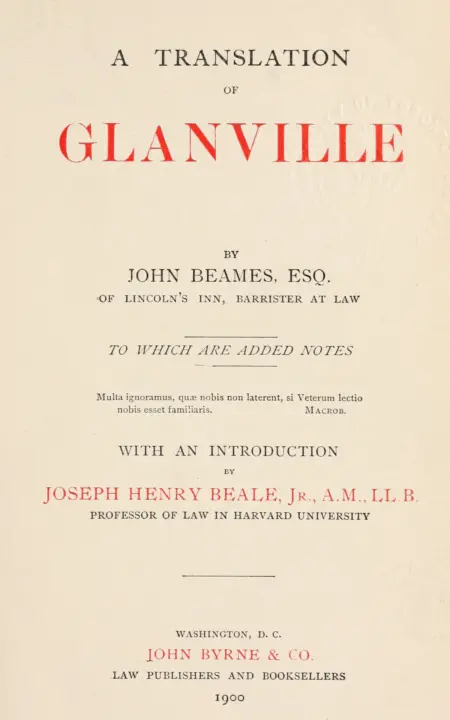
THE CLASSIC COLLECTION · 1900
"A translation of Glanville" by Ranulf de Glanville is a legal treatise written between 1187-1189. This groundbreaking work systematically codified English law for the first time, defining legal processes and introducing writs that remain influential today. Written for Henry II after years of chaos, it served as the foundation of English common law. The treatise consists of fourteen books covering jurisdictions and procedures in the King's Court, fundamentally transforming how justice was administered throughout the kingdom.
Introduction adapted from the source catalogue; source summaries may be automatically generated.
Free to read · English · 91,270 words · No account needed
MAKE TIME FOR A GOOD BOOK
On by default. Untick to stop anonymous reading totals. Each page counts after 10 seconds in view. How this works.
Anonymous counting is on unless you have switched it off.
Upon the Debtor’s appearing on the day appointed in Court, if the Creditor has neither Pledge, nor Sureties, nor any other proof, unless the mere faith of the other, this will not be received as any proof in the King’s Court.[384] Yet, he may proceed for the breach or violation of faith in the Court Christian. But, though the Ecclesiastical Judge can hold cognizance of such crime, and either impose penance on the convicted party, or enjoin him to make satisfaction, yet, with respect to Pleas concerning the Debts of the Laity, or affecting Tenements, the Court Christian cannot by a Law of the Realm hold or decide them, under the pretence of the party having pledged his promise.[385] The Creditor ought, therefore, to adduce other proof, if the Debtor deny the Debt in question.
[Footnote 384: Vide LL. Gul. Norman. c. 28. (Al. MS.) The Law here alluded to, the Reader has already been put in possession of. See p. 170. note 1.]
[Footnote 385: Vide Constitutions of Clarendon. (Anglo-Sax. LL. Ed.
Wilkins. 324.)]
For if he admit it, then, he is bound to discharge it, in manner similar to that we have already explained, in speaking of Pledges, confessing their suretyship.[386] Should he, however, deny it, the Creditor may prove his demand, either by a proper Witness, or by the Duel, or by a Charter. When, therefore, any one offer in Court, as proof of the Debt, the Charter of his Adversary, or his Ancestor, the Defendant will either admit such Charter, or deny it. In the latter case, he may deny or controvert it in two ways: thus, he may acknowledge in Court the seal to be his own, but deny that the Charter was made either by him, or with his consent, or that of his Ancestor; or he may absolutely deny, both the Seal and the Charter. In the first case, when he has publicly in court acknowledged the Seal to be his own, he is bound to warrant the terms of the Charter, and, in all respects, to observe the compact expressed in the Charter as contained in it, without question, and to impute it to his own indiscretion, if he incur any loss by negligently preserving his own Seal. But in the latter case, the Charter may be proved in Court by the Duel by any proper Witness, especially if his name be inserted in the Charter itself. There is another mode by which the Credit of a Charter is accustomed to be established in Court, namely, by some certain and unquestionable signs. As, for Example, by other Charters, impressed with the same Seal, and concerning which it is clear, that they are the Charters of the party, who denies the present Charter, because he has openly warranted them in Court. If in such case the impressions coincide in every respect with one another, so that there is no suspicion of any difference between the Seals, it is usual to consider the fact as proved; and, whether by this, or by any other legal mode, the party should be overcome, he shall lose his suit on the occasion, whether it be a Plea of Debt, or concerning Land, or any other thing whatever; and he shall, in addition, be amerced to the King. For, it is a general Rule, that whenever a person has said any thing in Court or in a Plea which he afterwards denies, or of which he has neither suit, nor Warrantor, nor sufficient proof,[387] or has been distrained to assert the contrary, or to deny it by sufficient proof, he shall be amerced to the King. But, if the person, against whom the Charter is produced to prove a certain Debt, acknowledge it from the first, then he shall be compelled to satisfy the Creditor, according to the tenor of the Charter. When any thing is lent on the joint strength of many of the proceeding securities, then, from the moment the Debtor makes default, he is liable to be distrained by all the securities being put in force against him at the same time. It is on this account, therefore, that many securities are taken, that in case of the inability of the Debtor, the Creditor may more readily be satisfied, than if there exist but one security only.
Your reading position is saved on this browser. Take it to another device with a library code. Reading pages adapt to text, rather than matching a printed edition.
BEHIND THE BOOK
This eBook is for the use of anyone anywhere in the United States and most other parts of the world at no cost and with almost no restrictions whatsoever. You may copy it, give it away or re-use it under the terms of the Project Gutenberg License included with this eBook or online at www.gutenberg.org. If you are not located in the United States, you will have to check the laws of the country where you are located before using this eBook. Read the source licence.
The original source file, including credits and licence, is retained by this library. Request an original-format copy at no charge. Please include the book title and Project Gutenberg identifier #71142.
KEEP YOUR CURIOSITY GOING
Cécile Tormay

Moritz Busch
John L. Ransom
Frances Wright
Cécile Tormay

Mabel Potter Daggett