THE CLASSIC COLLECTION✦An outlaw’s diary: the CommuneCLASSIC FREE BOOKS
An outlaw’s diary: the Commune
Cécile Tormay
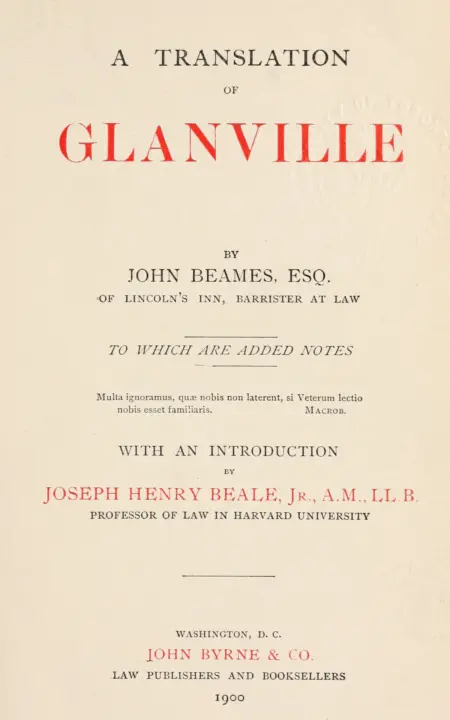
THE CLASSIC COLLECTION · 1900
"A translation of Glanville" by Ranulf de Glanville is a legal treatise written between 1187-1189. This groundbreaking work systematically codified English law for the first time, defining legal processes and introducing writs that remain influential today. Written for Henry II after years of chaos, it served as the foundation of English common law. The treatise consists of fourteen books covering jurisdictions and procedures in the King's Court, fundamentally transforming how justice was administered throughout the kingdom.
Introduction adapted from the source catalogue; source summaries may be automatically generated.
Free to read · English · 91,270 words · No account needed
MAKE TIME FOR A GOOD BOOK
On by default. Untick to stop anonymous reading totals. Each page counts after 10 seconds in view. How this works.
Anonymous counting is on unless you have switched it off.
[Footnote 380: Existente termino. This is a palpably false reading—it should be, elapso termino, the term being expired, an expression familiar to Glanville. This suggestion is sanctioned by the Reg. Maj. “the day being bygone,” (L. 3. c. 3.)—by the expression of the text ad terminum in the sentence immediately preceding—by the words of the Writ in the next chapter, “a term which is past”-and, lastly, by a passage in the Eighth Chapter of this Book, where our Author expressly lays it down, that, before the time fixed for payment, the Creditor cannot claim the Debt. Yet is the reading existente termino preserved in Mr. Houard’s Edition of Glanville, an Edition frequently, but not always, more correct than any of those printed in this Country.]
“The King to the Sheriff, Health. Command N., that justly and without delay, he redeem such a thing which he has pledged to R., for a hundred Marks, for a Term which is past, as he says, and of which he complains that he has not redeemed it; and, unless he does so, &c.”
[Footnote 381: Sir Edward Coke, having been led by his subject to treat of conditions, refers to the present Chapter of our Author. From such plain and simple materials did the complicated doctrine of conditions draw its primary principles!! (Co. Litt. 201. b.)]
In what manner the Debtor shall be distrained to appear in Court, whether by the Pledge itself, or by another mode, is doubtful. But that may be left to the discretion of the Court, as the matter can be sufficiently expedited whichever mode is resorted to. It is, however, sometimes requisite that he should be present in Court, before the thing in question be adjudged absolutely to the Creditor; since, were he present, he might alledge some reason, why the thing should not irrevocably belong to the Creditor. But when the Debtor appear in Court, he will either confess, that he pledged the thing in question for the Debt, or he will deny it. If he confess it, as he has in so doing confessed the Debt, he shall be commanded at a reasonable period to redeem his pledge; and, unless he should comply, liberty shall be given to the Creditor, from that time, to treat the pledge as his own property, and do whatever he chuses with it. Should the Debtor, however, deny it, he will then either acknowledge that the thing is his property, but that for some cause it happened to be out of his possession, and to have got into the hands of the other, as a Loan, or as being intrusted to him for Custody or from some other cause of this nature; or he will confess in Court, that the thing is not his property, which if he should do, liberty shall immediately be conceded to the Creditor, to dispose of the thing in question, as his own. But, if he alledge that the thing is his property, but denies as well the pledge as the Debt; then, the Creditor shall be obliged to prove against him, that he intrusted the other to the extent of the present demand, and that the Debtor in return pledged to him the specific object in dispute. The nature of this proof may be collected from what we formerly laid down, in treating of Pledges who deny their suretyship. But, previous to the period fixed for the payment, the Debt cannot be demanded; although, if a thing be pledged indefinitely, and without any period being fixed, the Creditor may, at any time he chuses, demand the Debt. The Debt being discharged by the person owing it, the Creditor is bound to restore to him the thing pledged, without its having suffered any deterioration; nor, if the thing should by any accident be lost or injured whilst in his Custody, is the Creditor from that circumstance liberated from the Debtor’s claim; because he is decidedly bound, either to restore the thing pledged or to make satisfaction for it, or to lose his Debt. When a Compact is entered into between a Debtor and Creditor, concerning the pledging of a particular thing, if the Debtor, after having received the Loan, should not deliver the pledge,[382] it may be asked, what step should the Creditor have recourse to in such a case, especially as the same thing may be pledged to many other Creditors, both previously and subsequently? Upon this subject, it should be remarked, that the King’s Court is not in the habit of giving protection to or warranting private Agreements of this description, concerning the giving or accepting things in pledge, or others of this kind, made out of Court, or even in any other Court than that of the King. If, therefore, such Compacts are not observed, the King’s Court does not interfere: and hence it is not bound to answer concerning the right of different Creditors, as prior or subsequent, or respecting their privileges. But, when an immoveable thing is put into pledge, and Seisin of it has been delivered to the Creditor for a definite term, it has either been agreed between the Creditor and Debtor, that the proceeds and rents shall in the mean time reduce the Debt, or that they shall in no measure be so applied. The former Agreement is just and binding: the other, unjust and dishonest, and is that called a Mortgage, but this is not prohibited by the King’s Court, although it considers such a pledge as a species of Usury.[383] Hence, if any one die having such pledge, and this be proved after his death, his property shall be disposed of no otherwise than as the Effects of a Usurer.
Your reading position is saved on this browser. Take it to another device with a library code. Reading pages adapt to text, rather than matching a printed edition.
BEHIND THE BOOK
This eBook is for the use of anyone anywhere in the United States and most other parts of the world at no cost and with almost no restrictions whatsoever. You may copy it, give it away or re-use it under the terms of the Project Gutenberg License included with this eBook or online at www.gutenberg.org. If you are not located in the United States, you will have to check the laws of the country where you are located before using this eBook. Read the source licence.
The original source file, including credits and licence, is retained by this library. Request an original-format copy at no charge. Please include the book title and Project Gutenberg identifier #71142.
KEEP YOUR CURIOSITY GOING
Cécile Tormay

Moritz Busch
John L. Ransom
Frances Wright
Cécile Tormay

Mabel Potter Daggett