THE CLASSIC COLLECTION✦An outlaw’s diary: the CommuneCLASSIC FREE BOOKS
An outlaw’s diary: the Commune
Cécile Tormay
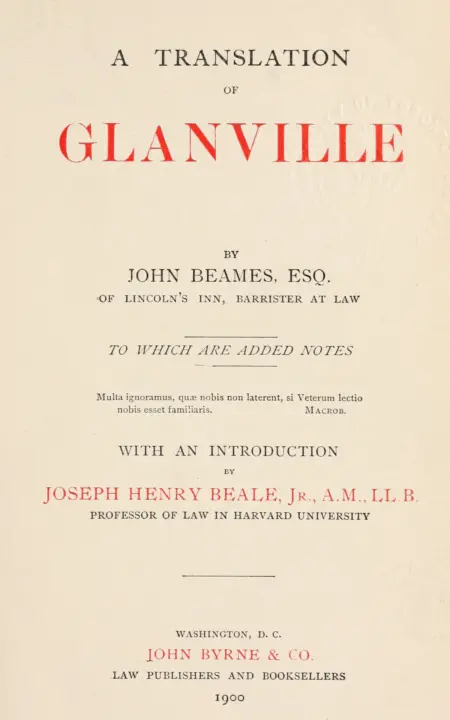
THE CLASSIC COLLECTION · 1900
"A translation of Glanville" by Ranulf de Glanville is a legal treatise written between 1187-1189. This groundbreaking work systematically codified English law for the first time, defining legal processes and introducing writs that remain influential today. Written for Henry II after years of chaos, it served as the foundation of English common law. The treatise consists of fourteen books covering jurisdictions and procedures in the King's Court, fundamentally transforming how justice was administered throughout the kingdom.
Introduction adapted from the source catalogue; source summaries may be automatically generated.
Free to read · English · 91,270 words · No account needed
MAKE TIME FOR A GOOD BOOK
On by default. Untick to stop anonymous reading totals. Each page counts after 10 seconds in view. How this works.
Anonymous counting is on unless you have switched it off.
[Footnote 377: The Regiam Majestatem, on the contrary, lays it down, that he can recover, (L. 3. c. 1.)—a rule that is certainly more consistent with Justice. On the other hand, the Mirror coincides with the text. (c. 2. s. 24.)]
Should, however, the Pledges deny in Court their Suretyship, then, if there were many Pledges, either all of them will deny such suretyship, or some will admit, and some deny it. But, if some admit, and some deny it, then, there may be a Suit, as well between the Creditor himself and the Pledges, as between those Pledges who confess, and those who deny their engagement, according to what we have previously observed.
But, what shall be the proof required of those, between whom the suit is to be conducted, is a question? Whether, for example, it should be made by the Duel, or by any other mode; or whether the Pledges can, by the oaths of such a number of men as the Court may require, deny their undertaking? With respect to this point, some persons assert, that the Creditor himself, by his own oath and that of lawful Witnesses, can by Law prove it against the Pledges, unless the Pledges will prevent him from the oath; and this may now be done when the Demandant appears prepared to take the oath, though formerly it ought to have been done before the Law was waged.
Thus in such case the Duel may be resorted to.
A Loan[378] is sometimes made, upon the Credit of a putting in Pledge. When a Loan of this description takes place, sometimes moveables, as Chattels, are put in pledge: sometimes immoveables, as Lands and Tenements, and Rents, whether consisting in Money, or in other things. When a Compact is made between a Creditor and Debtor, concerning the putting any thing in pledge, then, whatever be the mode of pledging, the Debtor upon his receiving the thing lent to him, either immediately delivers possession of the Pledge to the Creditor, or not. Sometimes also a thing is pledged for a certain period, sometimes indefinitely.
[Footnote 378: Mutuum—quia, ita a me tibi datur, ut ex meo tuum fiat. (Justin. Instit. L. 3. t. 15.) Vinnius terms this bella allusio, non vera vocis originatio. Dr. Wood observes, as to the Term itself, it hath no one particular name in the English language.]
Again, sometimes, a thing is pledged as a Mortgage, sometimes not. A pledge is designated by the Term Mortgage,[379] when the fruits and Rents, which are received in the interval, in no measure tend to reduce the demand for which the pledge has been given.
Your reading position is saved on this browser. Take it to another device with a library code. Reading pages adapt to text, rather than matching a printed edition.
BEHIND THE BOOK
This eBook is for the use of anyone anywhere in the United States and most other parts of the world at no cost and with almost no restrictions whatsoever. You may copy it, give it away or re-use it under the terms of the Project Gutenberg License included with this eBook or online at www.gutenberg.org. If you are not located in the United States, you will have to check the laws of the country where you are located before using this eBook. Read the source licence.
The original source file, including credits and licence, is retained by this library. Request an original-format copy at no charge. Please include the book title and Project Gutenberg identifier #71142.
KEEP YOUR CURIOSITY GOING
Cécile Tormay

Moritz Busch
John L. Ransom
Frances Wright
Cécile Tormay

Mabel Potter Daggett