THE CLASSIC COLLECTION✦An outlaw’s diary: the CommuneCLASSIC FREE BOOKS
An outlaw’s diary: the Commune
Cécile Tormay
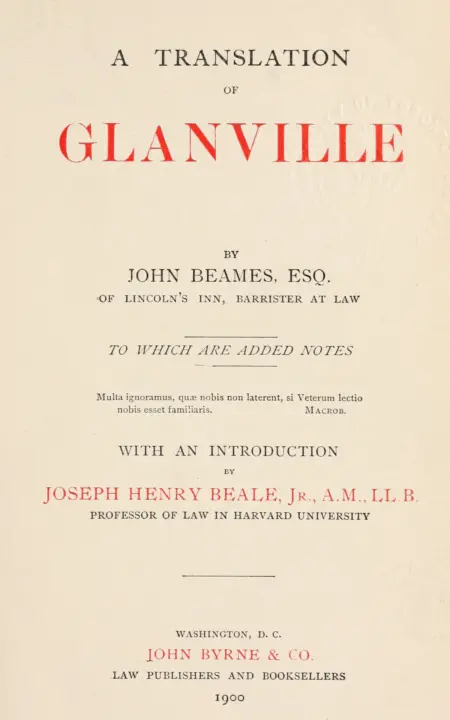
THE CLASSIC COLLECTION · 1900
"A translation of Glanville" by Ranulf de Glanville is a legal treatise written between 1187-1189. This groundbreaking work systematically codified English law for the first time, defining legal processes and introducing writs that remain influential today. Written for Henry II after years of chaos, it served as the foundation of English common law. The treatise consists of fourteen books covering jurisdictions and procedures in the King's Court, fundamentally transforming how justice was administered throughout the kingdom.
Introduction adapted from the source catalogue; source summaries may be automatically generated.
Free to read · English · 91,270 words · No account needed
MAKE TIME FOR A GOOD BOOK
On by default. Untick to stop anonymous reading totals. Each page counts after 10 seconds in view. How this works.
Anonymous counting is on unless you have switched it off.
[Footnote 347: Dr. Sullivan accounts for the advantage which the Knights had obtained, when compared to the great Barons, in having their Reliefs reduced to a certainty, from the number of the Knights who made the strength of the Kingdom and were not to be disobliged; and also from the precarious situation many of the great Lords were in, who had been attached to the cause of Stephen. (Lectures p. 109.)]
[Footnote 348: Statutum. “From the word statutum,” says Dr. Sullivan, commenting upon the Text, “I take it for granted, this change of Reliefs into money was by Act of Parliament.” (Lectures p. 290.)]
[Footnote 349: This was remedied by Magna Carta cap. 2. The Reader may consult Lord Coke’s comment on the words antiquum relevium, where he endeavours to prove, the ancient Relief was certain. (2 Inst. 7. and 8.) Lord Coke, in support of his position, cites a MS. in the Library of Archbishop Parker, which seems almost word for word to coincide with the Laws of the Conqueror. (LL. Gul. Conq. c. 22. 23. 24.) This is the more remarkable, as his Lordship cites from a MS. merely, without describing the nature of it.]
[Footnote 350: Vide Co. Litt. 105. b. and Bracton 84. a.]
“The King to the Sheriff, Health.[351] Command N. that, justly and without delay, he receive the Homage, and reasonable Relief of R. concerning the free Tenement which he holds, in such a Vill, and that he claims to hold of him; and, unless he does so, summon him by good Summoners, that he be before me or my Justices on such a day, to shew why he has not done it. And have there the Summoners, and this Writ. Witness &c.”
[Footnote 351: Vide Co. Litt. 101. a.]
As to the proceedings which are to be resorted to, in case the Lord should not obey this Summons, and the means by which he shall be distrained to appear in Court, they may be collected from the former part of this Treatise. When, at last, he appears in Court, he will either acknowledge that the Tenant is the right Heir, or deny that he is the Heir, or he will doubt, whether he is the right Heir or not. If he should acknowledge him to be the Heir, he will, then, either deny that the Tenant has tendered him the Homage and reasonable Relief, or he will admit it. If he confess both the one and the other, he shall either immediately receive the Tenant’s Homage and reasonable Relief in Court, or he shall appoint him a fit day for doing it. The same observation may be made, although he deny that the Tenant has proffered to him his Homage or Relief, provided he admit the Tenant to be the Heir. But if in decided terms he denies the Tenant to be the Heir, then, indeed, may the latter, if out of possession, require against his Lord an Assise de morte Antecessoris sui. Should the Tenant, however, happen to be in possession, he may hold himself in it, and patiently await, until it pleases his Lord to accept his Homage; because, no one is previously bound to answer his Lord as to the Relief, until the latter has received his Homage for the Fee, on account of which Homage is due to him. But if the Lord doubts, whether the person tendering the Homage be the right Heir or not,[352] being for example unknown to the Lord himself, or even to the Vicinage in the character of Heir, then the Lord of the Fee may take the Land into his own hands, and retain it, until the point be fully cleared up, a course of proceeding, which the King generally adopts with respect to all his Barons holding of him in Capite.
Your reading position is saved on this browser. Take it to another device with a library code. Reading pages adapt to text, rather than matching a printed edition.
BEHIND THE BOOK
This eBook is for the use of anyone anywhere in the United States and most other parts of the world at no cost and with almost no restrictions whatsoever. You may copy it, give it away or re-use it under the terms of the Project Gutenberg License included with this eBook or online at www.gutenberg.org. If you are not located in the United States, you will have to check the laws of the country where you are located before using this eBook. Read the source licence.
The original source file, including credits and licence, is retained by this library. Request an original-format copy at no charge. Please include the book title and Project Gutenberg identifier #71142.
KEEP YOUR CURIOSITY GOING
Cécile Tormay

Moritz Busch
John L. Ransom
Frances Wright
Cécile Tormay

Mabel Potter Daggett