THE CLASSIC COLLECTION✦An outlaw’s diary: the CommuneCLASSIC FREE BOOKS
An outlaw’s diary: the Commune
Cécile Tormay
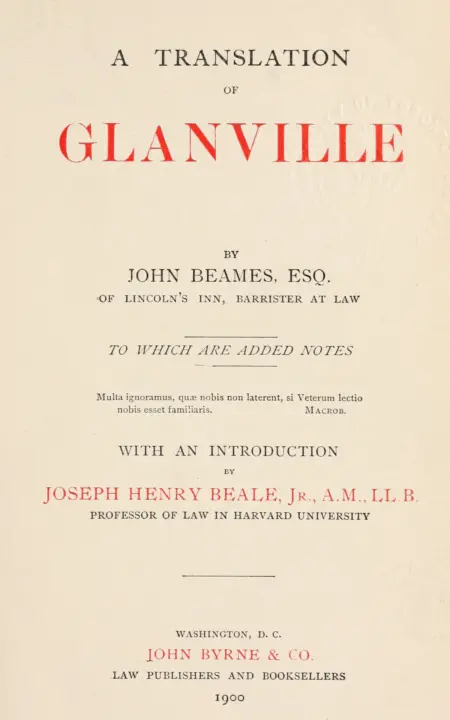
THE CLASSIC COLLECTION · 1900
"A translation of Glanville" by Ranulf de Glanville is a legal treatise written between 1187-1189. This groundbreaking work systematically codified English law for the first time, defining legal processes and introducing writs that remain influential today. Written for Henry II after years of chaos, it served as the foundation of English common law. The treatise consists of fourteen books covering jurisdictions and procedures in the King's Court, fundamentally transforming how justice was administered throughout the kingdom.
Introduction adapted from the source catalogue; source summaries may be automatically generated.
Free to read · English · 91,270 words · No account needed
MAKE TIME FOR A GOOD BOOK
On by default. Untick to stop anonymous reading totals. Each page counts after 10 seconds in view. How this works.
Anonymous counting is on unless you have switched it off.
“The King to the Sheriff, Health. Summon, by good Summoners, N. and R. that they appear before me, or my Justices, such a day, to record, with discreet Knights of that County, how the Plea of one Hyde of Land, which N. claimed against R., in that Vill, and of which there was a Suit before them, on their Eyre, ceased in my Court.” The Sheriff of the County, in which the Suit was decided before the Justices, shall also be commanded to transmit at the same time a Record of the Suit in question to the King, or his Justices, by the hands of discreet Knights of his County. This shall be done by the following Writ, for presenting such Record in Court——
“The King to the Sheriff, Health. I command you, that you cause to be recorded in your County Court, the plea which is between such and such person, concerning so much Land, in that Vill,” &c. as in the following Chapter but two.
The Justices being present in Court, and perfectly concurring as to the Record, it necessarily follows, that their Record must be abided by, neither party being allowed to deny it, as we have already observed.
But if the Justices entertain any doubt upon the subject, and it cannot be ascertained, then, the Plea must be again commenced and proceeded on in Court.
It should be understood, that no Court, generally speaking, has a Record, except the King’s Court.[314] For in other Courts, if a Man should say a thing, which he would afterwards retract, he may deny[315] it against the whole Court, by the oath of three witnesses, affirming that he had not said the thing imputed to him, or, indeed, by a greater or less number of witnesses, according to the custom of different Courts. Yet, in some cases, the County and other inferior Courts are by a particular Law of the Realm allowed to have Records; thus, if the Duel has been waged in any inferior Court, and the Suit should be afterwards transferred into the King’s Court; then, as to the claim of the Demandant, the defence of the Tenant, and the words in which such Duel was adjudged and waged, the former Court shall have its Record even in the King’s Court; but, in other respects, such inferior Court has no Record, unless concerning the change of a Champion. For if, after the suit has been transferred into the King’s Court, a different Champion should be produced, than the one who has waged the Duel in the inferior Court, and a dispute arise upon this point, the Record of the inferior Court shall by a Law of the Realm be conclusive upon the subject. It should also be understood, with respect to the Record of an inferior Court, that any one may add, that he had said more than is contained in such Record—and that he did in Court say it, he may prove against the whole Court, by the oaths of two or more lawful Men, according as the custom of different Courts vary; because no Court is bound, either to prove or defend its Record by the Duel. But it is not allowed to any one to take exceptions against one part, and admit the other; and this rule is grounded on a Law of the Realm: since he may from the first deny the whole Record, an oath being taken in the manner before mentioned. But, although a Court is not obliged to defend its Record by the Duel, yet is it bound to defend its Judgment by the Duel.[316] If, therefore, any one should declare against the Court for passing a false Judgment, and, therefore false, because when one party had said thus, and the other answered thus, the Court in question had judged falsely of their allegations by deciding in such words; and that the Court had given such false Judgment by the mouth of N.; and, if he were disposed to deny the present charge, the other was prepared to prove it against him, chiefly by such proper witness, who was ready to enter upon the proof. Thus may the matter, and that very properly, be decided by the Duel.[317] But, whether such Court is obliged to defend itself by one of its own members, or may have recourse to a stranger, may be questioned?
Your reading position is saved on this browser. Take it to another device with a library code. Reading pages adapt to text, rather than matching a printed edition.
BEHIND THE BOOK
This eBook is for the use of anyone anywhere in the United States and most other parts of the world at no cost and with almost no restrictions whatsoever. You may copy it, give it away or re-use it under the terms of the Project Gutenberg License included with this eBook or online at www.gutenberg.org. If you are not located in the United States, you will have to check the laws of the country where you are located before using this eBook. Read the source licence.
The original source file, including credits and licence, is retained by this library. Request an original-format copy at no charge. Please include the book title and Project Gutenberg identifier #71142.
KEEP YOUR CURIOSITY GOING
Cécile Tormay

Moritz Busch
John L. Ransom
Frances Wright
Cécile Tormay

Mabel Potter Daggett