THE CLASSIC COLLECTION✦An outlaw’s diary: the CommuneCLASSIC FREE BOOKS
An outlaw’s diary: the Commune
Cécile Tormay
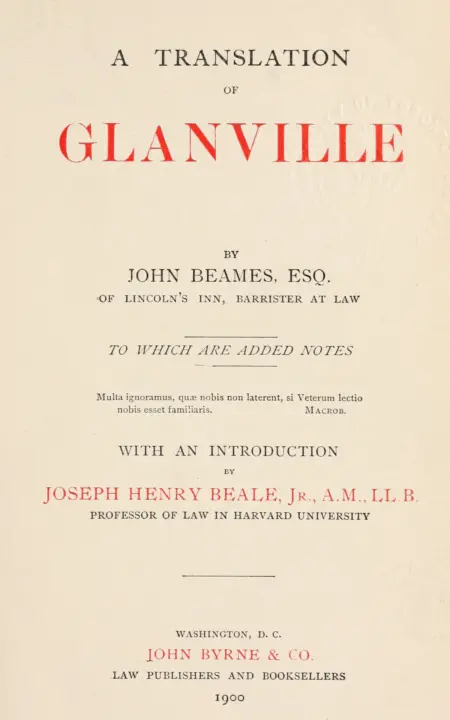
THE CLASSIC COLLECTION · 1900
"A translation of Glanville" by Ranulf de Glanville is a legal treatise written between 1187-1189. This groundbreaking work systematically codified English law for the first time, defining legal processes and introducing writs that remain influential today. Written for Henry II after years of chaos, it served as the foundation of English common law. The treatise consists of fourteen books covering jurisdictions and procedures in the King's Court, fundamentally transforming how justice was administered throughout the kingdom.
Introduction adapted from the source catalogue; source summaries may be automatically generated.
Free to read · English · 91,270 words · No account needed
MAKE TIME FOR A GOOD BOOK
On by default. Untick to stop anonymous reading totals. Each page counts after 10 seconds in view. How this works.
Anonymous counting is on unless you have switched it off.
[Footnote 278: Our Author alludes to the Inquisitions made under the Justices Itinerant, an institution generally ascribed to Henry the 2nd, and, as generally, imagined to have been first ordained in the Great Council at Northampton in the 22nd year of the Reign of that Monarch. Lord Coke, however, ascribes to them a much earlier origin; and from the Records in the Exchequer, it should seem, that there had been Justices Itinerant to hear and determine Civil and Criminal causes, so early as the 18th of Henry the first. Lord Littleton thinks, the first appointment of Justices Itinerant was made by Henry the first, in imitation of a similar Institution in France established by Louis le Gros. Justices Itinerant ad communia placita were continued until the 10th of Edw. the 3rd, when they seem to have given way to Justices of Assise, Nisi prius, Oyer and terminer, and Gaol delivery. (Vide Madox’s Excheq. 96. Litt. Hist. Hen. 2. Vol. 4. 271. Hale’s Hist. Com. Law 140. 168—2 Inst. 497.)]
[Footnote 279: The Mirror confines the punishment to those attainted of Usury after their decease, “but not, if they be attainted thereof in their lifetime, for then they lose but only their moveables; because, by penance and repentance, they may amend and have Heirs.” (Mirror c. 4. s. 12. See also Fleta L. 1. c. 20. s. 28. and Dial. de Scacc. L. 2. s. 10.)]
[Footnote 280: Vide Book 14. Note 2.]
The Ultimate Heir of any person is his Lord.[281] When, therefore, a Man dies without leaving any certain Heir, such, for example, as a Son, or Daughter, or without any such Heir of whom there can exist no doubt,[282] but that he is the nearer and right Heir, the Lords of the Fee may, and indeed, usually do, take the Vacant Inheritances into their hands, and retain them as Escheats,[283] whoever such Lord may be, whether the King, or any other person. But, if any one appear and assert himself to be the right Heir, if by the indulgence of his Lord, or by the King’s precept, he can effect it, he shall prosecute his claim; and thus he may establish his right, if he has any such; but, in the mean time, the Land in question shall remain in the hands of the Lord of the Fee: because, whenever a Lord entertains a doubt concerning the Heir of his Tenant, whether he be the right Heir or not, he may retain the Land until the fact be lawfully proved to him.[284] The same rule is laid down, in a former part of this Treatise, where a doubt arises with respect to the full age or Minority of the Heir. There is, however, this difference, that in the one case, the Inheritance itself is in the mean time to be considered as the Lord’s Escheat: but in the other case, it is not considered to be the Lord’s—nothing, indeed, but the Custody. But if no one should appear to claim the Inheritance in question as Heir, then it shall absolutely revert to the Lord as an Escheat; so that he may dispose of it at his pleasure as his own property. Besides, if a Female Heir, in the Custody of her Lord, be guilty of Incontinence, her Inheritance shall escheat to her Lord, on account of her crime. And if any person be convicted of Felony, or confess his Guilt in Court, deprived by the Law of the Realm of his Inheritance, his Land shall remain to the Lord, as an Escheat.[285] It is to be observed, that if any one hold of the King in Capite, then, as well his Land, as all his Moveables and Chattels, in whose-ever possession they may be found, shall be seised to the King’s use, and the Heir shall be for ever debarred from recovering them. But if an outlaw,[286] or one convicted of Felony, hold of any other person than the King, then also all his Moveables shall belong to the King; his Lands also shall remain in the King’s hands during one year, which period being expired, such Land shall revert to the right Lord, in other words, to him to whose Fee it belongs, the Houses, however, being thrown down, and the Trees extirpated.[287] And, generally speaking, whenever a person has done or said any thing in Court for which he has been, by a Judgment of the Court, disinherited, his Inheritance is accustomed to return as an Escheat to the Lord of the Fee of whom it is held. But a forfeiture, committed by the Son and Heir of any one, shall not disinherit the Father, nor the Brother, nor, indeed, any other person but himself. It should also be added, that when a Man has been condemned of Theft, all his Moveables and Chattels generally devolve on the Sheriff of the County; but his Land, if he has any, shall immediately revert to the Lord of the Fee, without awaiting the year.[288] When any one has been outlawed by the Law of the Land, and has afterwards, by the indulgence of the Prince, been restored to the Peace, he cannot on that account recover his Inheritance, supposing that he or his Heirs possess such, as against his Lord (unless by the mercy and indulgence of the Lord himself.) The King, indeed, is accustomed to remit the pains of Forfeiture and Outlawry, yet cannot he, under colour of this prerogative, infringe upon the rights of others.
Your reading position is saved on this browser. Take it to another device with a library code. Reading pages adapt to text, rather than matching a printed edition.
BEHIND THE BOOK
This eBook is for the use of anyone anywhere in the United States and most other parts of the world at no cost and with almost no restrictions whatsoever. You may copy it, give it away or re-use it under the terms of the Project Gutenberg License included with this eBook or online at www.gutenberg.org. If you are not located in the United States, you will have to check the laws of the country where you are located before using this eBook. Read the source licence.
The original source file, including credits and licence, is retained by this library. Request an original-format copy at no charge. Please include the book title and Project Gutenberg identifier #71142.
KEEP YOUR CURIOSITY GOING
Cécile Tormay

Moritz Busch
John L. Ransom
Frances Wright
Cécile Tormay

Mabel Potter Daggett