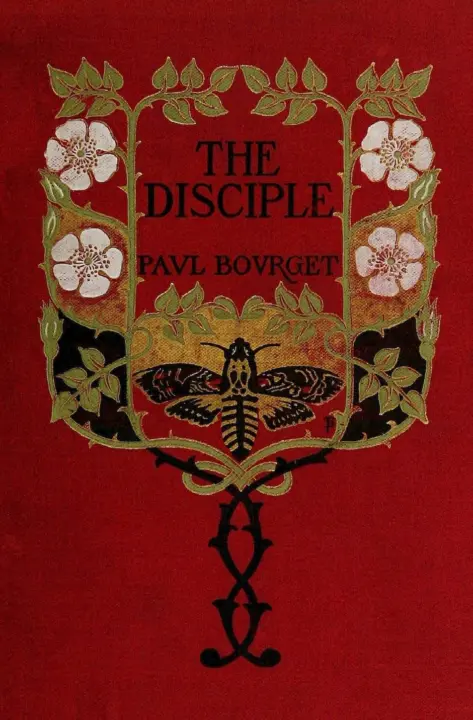
The disciple
Paul Bourget
THE CLASSIC COLLECTION · 1896
"A Tragic Idyl" by Paul Bourget is a novel written in the late 19th century. The book opens at the Casino of Monte Carlo during a bustling night, setting the stage for a rich tapestry of characters intertwined in a world of luxury, gambling, and social intrigue. Central to the story are a group of three individuals, including the Viscount de Corancez, who is orchestrating a secret marriage with the wealthy widow, Marquise Andryana Bonnacorsi, while a young man, Pierre Hautefeuille, is caught in a web of love and longing for another woman. The opening of "A Tragic Idyl" introduces readers to the chaotic and extravagant atmosphere of Monte Carlo's gaming houses, bustling with various characters from all walks of life, showcasing the contrasts of wealth and despair. The narrative cleverly weaves the plans for a clandestine marriage between Corancez and the Marquise amidst the bustling crowd, revealing the depth of their emotional stakes as well as Hautefeuille's hidden affection for the enchanting Baroness Ely de Carlsberg who remains oblivious to the turmoil her beauty inspires in him. As the story unfolds, the intricate dynamics and conflicts among these characters hint at the tragic idyls that will develop, juxtaposing their desires against the backdrop of societal expectations and personal ambitions.
Introduction adapted from the source catalogue; source summaries may be automatically generated.
Free to read · English · 110,968 words · No account needed
MAKE TIME FOR A GOOD BOOK
On by default. Untick to stop anonymous reading totals. Each page counts after 10 seconds in view. How this works.
Anonymous counting is on unless you have switched it off.
She spoke with a dryness that showed how deeply these memories were implanted. She paused a moment, and, plucking a rose from a bush near her, she began to bite the petals nervously, while Madame Brion sighed:--
"Need I pity you for that also,--for having sought happiness out of marriage, and for having met this man, this hard and capricious monster of egoism?"
"I do not judge of him," Madame de Carlsberg answered. "If I had been different myself, I should doubtless have changed him. But he had touched me in an irritable spot; I wished to control him, to master him, and I used a terrible weapon. I made him jealous. All that is a bitter story, and I spare you the details. It would be painful to recall it, and it does not matter. You will know enough when I say that after a day of intimacy, when he had been more tender than ever before, Olivier left Rome suddenly, without an explanation, without a word of adieu, without even writing a letter. I have never seen him again. I have never heard of him, except in a chance conversation this winter, when I learned that he was married. Now you will understand the strange emotions I felt when two months ago Chésy asked permission to present a son of a friend of his mother, who had come to Cannes to recover from a bad cold, a young man, rather solitary and very charming; his name was Pierre Hautefeuille. In the countless conversations that Olivier and I had together in the intervals of our quarrelling, this name had often been spoken. Here again I must explain to you a very peculiar thing,--the nature of this man's conversation and the extraordinary attraction it had for me. This self-absorbed and enigmatic being had sudden hours of absolute expansion which I have seen in no one else. It was as though he relived his life aloud for me, and I listened with an unparalleled curiosity. He used at these times a kind of implacable lucidity which almost made you cry out, like a surgical operation, and which at the same time hypnotized you with a potent fascination. It was a brutal yet delicate disrobing of his childhood and his youth, with characterizations of such vividness that certain individuals were presented to me as distinctly as though I had really met them. And he himself? Ah, what a strange soul, incomplete and yet superior, so noble and so degraded, so sensitive and so arid, in whom there seemed to be nothing but lassitude, failure, stain, and disillusionment--excepting one sentiment. This man who despised his family, who never spoke of his country without bitterness, who attributed the worst motive to every action, even his own, who denied the existence of God, of virtue, of love, this moral nihilist, in short, in so many ways like the Archduke, had one faith, one cult, one religion. He believed in friendship, that of man for man, denying that one woman could be the friend of another. He did not know you, dear friend. He pretended--I recall his very words--that between two men who had proved each other, who had lived, and thought, and suffered together, and who esteemed each other while loving each other, there arises a kind of affection so high, so profound, and so strong that nothing can be compared with it. He said that this sentiment was the only one he respected, the only one that time and change could not prevail against. He acknowledged that this friendship was rare; yet he declared that he had met with it several times, and that he himself had experienced one in his life. It was then that he evoked the image of Pierre Hautefeuille. His accent, his look, his whole expression changed while he lingered over the memory of his absent friend. He, the man of all the ironies, recounted with tenderness and respect the naïve details of their first meeting at school, their growing attachment, their boyish vacations. He related with enthusiasm their enlisting together in 1870, and the war, their adventures, their captivity in Germany. He was never tired of praising his friend's purity of soul, his delicacy, his nobility. I have already said that this man was an enigma to me. Such he was above all in his retrospective confidences, to which I listened with astonishment, almost stupor, to behold this anomaly in a heart so lamentably withered, in a land so sterile this flower of delicate sentiment, so young and rare that it made me think--and in spite of Olivier's paradox, it is the highest praise I could give--of our own friendship."
Your reading position is saved on this browser. Take it to another device with a library code. Reading pages adapt to text, rather than matching a printed edition.
Paul Bourget
Paul Bourget
Paul Bourget
Paul Bourget
BEHIND THE BOOK
This eBook is for the use of anyone anywhere in the United States and most other parts of the world at no cost and with almost no restrictions whatsoever. You may copy it, give it away or re-use it under the terms of the Project Gutenberg License included with this eBook or online at www.gutenberg.org. If you are not located in the United States, you will have to check the laws of the country where you are located before using this eBook. Read the source licence.
The original source file, including credits and licence, is retained by this library. Request an original-format copy at no charge. Please include the book title and Project Gutenberg identifier #66517.
KEEP YOUR CURIOSITY GOING
Coulson Kernahan

Maurice Baring
Frances Wright
Cécile Tormay

Frederic Jesup Stimson

W. H. P. (William Henry Pope) Jarvis