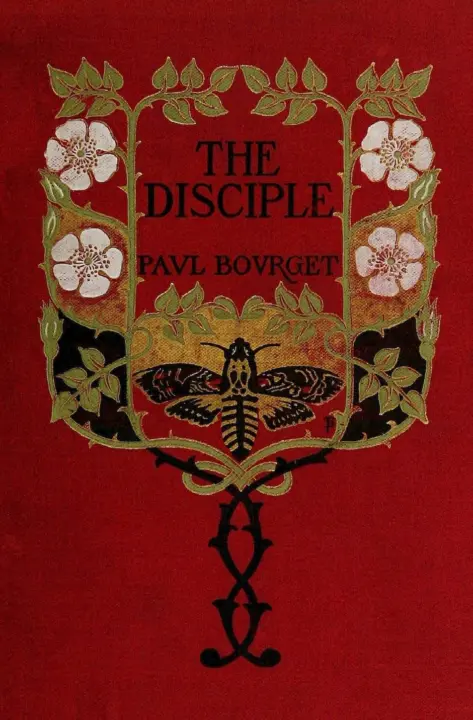
The disciple
Paul Bourget
THE CLASSIC COLLECTION · 1896
"A Tragic Idyl" by Paul Bourget is a novel written in the late 19th century. The book opens at the Casino of Monte Carlo during a bustling night, setting the stage for a rich tapestry of characters intertwined in a world of luxury, gambling, and social intrigue. Central to the story are a group of three individuals, including the Viscount de Corancez, who is orchestrating a secret marriage with the wealthy widow, Marquise Andryana Bonnacorsi, while a young man, Pierre Hautefeuille, is caught in a web of love and longing for another woman. The opening of "A Tragic Idyl" introduces readers to the chaotic and extravagant atmosphere of Monte Carlo's gaming houses, bustling with various characters from all walks of life, showcasing the contrasts of wealth and despair. The narrative cleverly weaves the plans for a clandestine marriage between Corancez and the Marquise amidst the bustling crowd, revealing the depth of their emotional stakes as well as Hautefeuille's hidden affection for the enchanting Baroness Ely de Carlsberg who remains oblivious to the turmoil her beauty inspires in him. As the story unfolds, the intricate dynamics and conflicts among these characters hint at the tragic idyls that will develop, juxtaposing their desires against the backdrop of societal expectations and personal ambitions.
Introduction adapted from the source catalogue; source summaries may be automatically generated.
Free to read · English · 110,968 words · No account needed
MAKE TIME FOR A GOOD BOOK
On by default. Untick to stop anonymous reading totals. Each page counts after 10 seconds in view. How this works.
Anonymous counting is on unless you have switched it off.
Certain confessions are so irremediable that their frankness gives to those who voluntarily make them something of grandeur and nobility even in their fall; and when the confession is made by some one whom we love, as Louise loved Ely, it fills us with a delirium of tenderness for the being who proves her nobility by her confession while the misery of her shame rends her heart. If a few hours before, in some house at Monte Carlo, the slightest word had been said against the honor of Madame de Carlsberg, what indignation would Madame Brion have not felt, and what pain! Pain she indeed had, agonizing pain, as Ely pronounced these unforgetable words; but of indignation there was not a trace in the heart which replied with these words, whose very reproach was a proof of tenderness, blind and indulgent to complicity:--
"Just God! How you must have suffered! But why did you not tell me before? Why did you not confide in me? Did you think that I would love you less? See, I have the courage to hear all."
And she added, in that thirst for the whole truth which we have for the faults of those who are dear to us, as though we looked to find a pardonable excuse in the cruel details:--
"I beg you, tell me all, all. And first, this man? Do I know him?"
"No," replied Madame de Carlsberg, "his name is Olivier du Prat. I met him at Rome two years ago when I was spending the winter there. That was the period of my life when I saw you least, and wrote to you least frequently. It was also the time when I was the most wicked, owing to solitude, inaction, unhappiness, and my disgust with everything, especially with myself. This man was the secretary of one of the two French embassies. He was much lionized because of the passion, he had inspired in two Roman ladies, who almost openly disputed his favors. It is very ignoble, what I am going to tell you, but such was the truth. It amused me to win him from them both. In that kind of an adventure, just as in play, one expects to find the emotions that others have found in it, and then the result is the same as in roulette. One is bored with it, and one throws one's self into the game from wilfulness and vanity, in the excitement of an absurd struggle. I know now," and her voice became graver, "that I never loved Olivier, but that I so persisted in this liaison that he would have the right to say that I wished him to love me, that I wished to be his mistress, and that I did all I could to retain him. He was a singular character, very different from those professional lovers, who are for the most part frightfully vulgar. He was so changeable, so protean, so full of contrasts, so intangible, that to this day I cannot tell whether he loved me or not. You hear me in a dream, and I am speaking as in a dream. I feel that there was something inexplicable in our relations, something unintelligible to a third person. I have never met a being so disconcerting, so irritating, from the endless uncertainty he kept you in, no matter what you did. One day he would be emotional, tremulous, passionate even to frenzy, and on the morrow, sometimes the same day, he would recoil within himself from confidence to suspicion, from tenderness to persiflage, from abandonment to irony, from love to cruelty, without it being possible either to doubt his sincerity or to discover the cause of this incredible alteration. He had these humors not only in his emotions, but even in his ideas. I have seen him moved to tears by a visit to the Catacombs, and on returning as outrageously atheistical as the Archduke. In society I have seen him hold twenty people enraptured by the charm of his brilliant fancy, and then pass weeks without speaking two words. In short, he was from head to foot a living enigma, which I penetrate better at a distance. He had been early left an orphan. His childhood had been unhappy, and his youth precociously disenchanted. He had been wounded and corrupted too soon. Thence came that insatiability of soul, that elusiveness of character which appeared as soon as I became interested in him in a kind of spasmodic force. When I was young at Sallach I loved to mount difficult horses and try to master them. I cannot better describe my relations with Olivier than by comparing them to a duel between a rider and his horse, when each tries to get the better of the other. I repeat it, I am sure I did not love him. I am not certain that I did not hate him."
Your reading position is saved on this browser. Take it to another device with a library code. Reading pages adapt to text, rather than matching a printed edition.
Paul Bourget
Paul Bourget
Paul Bourget
Paul Bourget
BEHIND THE BOOK
This eBook is for the use of anyone anywhere in the United States and most other parts of the world at no cost and with almost no restrictions whatsoever. You may copy it, give it away or re-use it under the terms of the Project Gutenberg License included with this eBook or online at www.gutenberg.org. If you are not located in the United States, you will have to check the laws of the country where you are located before using this eBook. Read the source licence.
The original source file, including credits and licence, is retained by this library. Request an original-format copy at no charge. Please include the book title and Project Gutenberg identifier #66517.
KEEP YOUR CURIOSITY GOING
Coulson Kernahan

Maurice Baring
Frances Wright
Cécile Tormay

Frederic Jesup Stimson

W. H. P. (William Henry Pope) Jarvis