
The Writing of News A Handbook with Chapters on Newspaper Correspondence and Copy Reading
Charles G. (Charles Griffith) Ross
THE CLASSIC COLLECTION · 1897
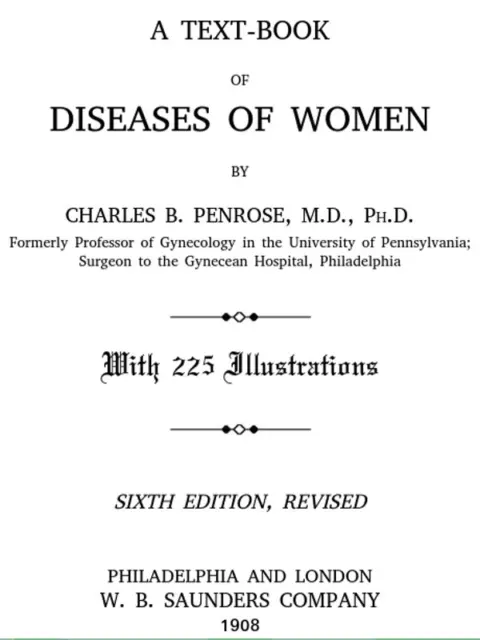
"A Text-book of Diseases of Women" by Charles B. Penrose is a scientific publication written in the early 20th century. This comprehensive text serves as a guide for medical students and practitioners, detailing various diseases specific to women, their causes, and recommended treatments. The book captures the complexities of gynecology, shedding light on the nuances of female anatomy, physiology, and the medical conditions that affect women differently than men. The opening of the text lays a firm foundation for understanding the diseases of women, categorizing gynecological issues by their origins, such as anatomical peculiarities and social factors. Penrose emphasizes that many afflictions arise from reproductive processes, especially childbirth, and factors such as venereal diseases, inadequate lifestyle practices, and neglect during menstrual cycles. He also notes the physical differences and societal roles that impact women's health, hinting at the overarching theme of how civilization influences the prevalence and severity of these conditions. The chapter sets up a framework for further exploration of specific diseases, diagnostic methods, and treatment modalities that follow.
Introduction adapted from the source catalogue; source summaries may be automatically generated.
Free to read · English · 139,638 words · No account needed
MAKE TIME FOR A GOOD BOOK
On by default. Untick to stop anonymous reading totals. Each page counts after 10 seconds in view. How this works.
Anonymous counting is on unless you have switched it off.
Removal of the tube and ovary upon one side has no effect upon menstruation or upon any of the other characteristics of the woman.
Removal of the tubes and ovaries upon both sides is followed within forty-eight hours by slight bleeding from the uterus, lasting for one or two days.
If the removal of the tubes and ovaries has been complete, menstruation, in the majority of cases, never reappears.
In a few cases menstruation appears for one, two, or three periods after the operation, usually in diminished amount, and then ceases for ever. In some other cases there is a period of a few months of amenorrhea, followed by two or three scanty menstrual flows, before the bleeding permanently ceases.
These phenomena, it will be observed, are similar to those of the
normal menopause.
The woman after double salpingo-oöphorectomy experiences the nervous and gastro-intestinal disturbances that so usually accompany the menopause. She, in fact, passes through a premature menopause, the phenomena of which may persist for one or two years.
The secondary sexual characteristics of the woman--the voice, the figure, and the growth of hair--are not altered if the appendages are removed during adult life. The case may be different if the appendages are removed in the undeveloped girl, in whom the ovarian influence is essential for complete development.
The woman loses none of her feminine attractions. She may, indeed, become better-looking if the operation has relieved chronic suffering. It is said that Gyges, king of Lydia, caused the removal of ovaries from women with a view to prolonging their charms.
Double oöphorectomy may be followed by obesity if the woman have a tendency to form fat. The relief of suffering and the consequent improved nutrition favor the development of obesity. There seems to be nothing inherent in the operation to cause it. Many women remain thin after the operation.
The emotions of the woman are unaltered by double oöphorectomy, with the exception of some cases in which the sexual desire is destroyed. Sexual desire is dependent upon such a variety of conditions, both within and without the woman, that it is difficult to determine the amount of influence that removal of the ovaries exerts upon this feeling.
It is undoubtedly true that sexual desire is sometimes destroyed by the operation. On the other hand, the sexual desire is very often restored by the operation, which relieves the former dyspareunia, or painful coitus.
Abdomen, binder for, 479
distention of, after celiotomy, 497
drainage of, 480, 482
enlargement of, 19
examination of, 19, 21, 22, 28
exploration of, 489
fluctuation in, 24
protection of contents of, during operation, 489
retentive power of, 99
sterilization of, for operation, 473
Your reading position is saved on this browser. Take it to another device with a library code. Reading pages adapt to text, rather than matching a printed edition.
BEHIND THE BOOK
This eBook is for the use of anyone anywhere in the United States and most other parts of the world at no cost and with almost no restrictions whatsoever. You may copy it, give it away or re-use it under the terms of the Project Gutenberg License included with this eBook or online at www.gutenberg.org. If you are not located in the United States, you will have to check the laws of the country where you are located before using this eBook. Read the source licence.
The original source file, including credits and licence, is retained by this library. Request an original-format copy at no charge. Please include the book title and Project Gutenberg identifier #54982.
KEEP YOUR CURIOSITY GOING
Charles G. (Charles Griffith) Ross
Hannah Webster Foster

Emily Lawless
Edwin Hamlin Carr

Charles De Lano Hine
Andrew Ure