
The Writing of News A Handbook with Chapters on Newspaper Correspondence and Copy Reading
Charles G. (Charles Griffith) Ross
THE CLASSIC COLLECTION · 1897
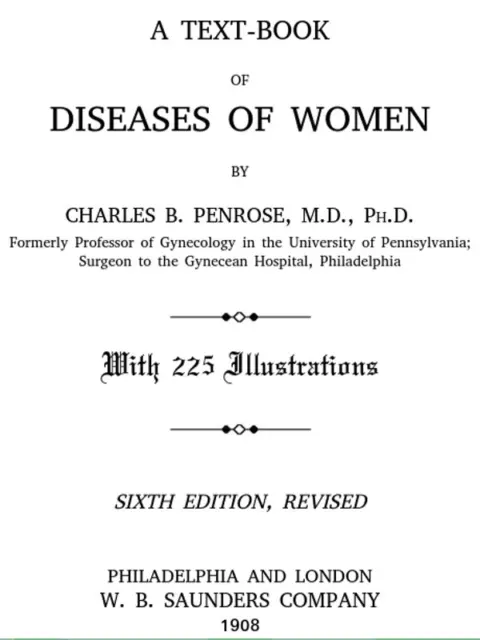
"A Text-book of Diseases of Women" by Charles B. Penrose is a scientific publication written in the early 20th century. This comprehensive text serves as a guide for medical students and practitioners, detailing various diseases specific to women, their causes, and recommended treatments. The book captures the complexities of gynecology, shedding light on the nuances of female anatomy, physiology, and the medical conditions that affect women differently than men. The opening of the text lays a firm foundation for understanding the diseases of women, categorizing gynecological issues by their origins, such as anatomical peculiarities and social factors. Penrose emphasizes that many afflictions arise from reproductive processes, especially childbirth, and factors such as venereal diseases, inadequate lifestyle practices, and neglect during menstrual cycles. He also notes the physical differences and societal roles that impact women's health, hinting at the overarching theme of how civilization influences the prevalence and severity of these conditions. The chapter sets up a framework for further exploration of specific diseases, diagnostic methods, and treatment modalities that follow.
Introduction adapted from the source catalogue; source summaries may be automatically generated.
Free to read · English · 139,638 words · No account needed
MAKE TIME FOR A GOOD BOOK
On by default. Untick to stop anonymous reading totals. Each page counts after 10 seconds in view. How this works.
Anonymous counting is on unless you have switched it off.
If the advice here given--to seek for the primary cause of the cervical catarrh and to cure it--is followed, it will be found that there are but very few cases that depend for cure upon local applications. Simple local treatment by douches, etc. may, however, be valuable aids in hastening the cure of the disease after the exciting cause has been removed.
The treatment may be considered under two heads, the general and the
local treatment.
General tonic treatment is required in most cases of protracted cervical catarrh. The preparations of iron are the most valuable in this condition.
The contraindication to the use of iron in uterine disease is menorrhagia or metrorrhagia--profuse bleeding from the uterus. If in any case this symptom is present, and it is found that the bleeding is increased after the administration of iron, then this drug should be discontinued.
The following are useful prescriptions in those cases in which iron is
indicated:
Bland’s pill, the prescription for which may be written:
℞. Pulv. ferri sulph. exsic.,
Potass, carb. puræ, āā. ʒij.
Ut fiat, massa dividenda in pilulas No. xlviii.
Sig. One pill three or four times a day.
Basham’s mixture, the formula for which is--
℞. Tinct. ferri chloridi, fʒiss;
Acidi acetici diluti, fʒij;
Liquor, ammoniæ acetat., fʒxiv;
Elix. aurantii, fʒvj;
Glycerin., f℥j;
Aquæ, f℥iv.
M. Sig. Tablespoonful after each meal.
The prescription which Professor Goodell called the “mixture of the
four chlorides” is--
℞. Hydrarg. chloridi corrosivi, gr. j-ij;
Liq. arsenici chloridi, gtt. xlviij;
Tinct. ferri chloridi,
Acidi hydrochlorici dil. āā. fʒiv;
Syrupi, f℥iij;
Aquæ, ad f℥vj.
M. Sig. One dessertspoonful in a wineglassful of
water after meals.
This prescription should not be given for more than two weeks at a time.
Careful attention should always be paid to the regularity of the bowels, in order to prevent pelvic congestion, which may result from constipation.
Two or three drams of Rochelle salts may be administered in a tumblerful of water every morning, one hour before breakfast.
A useful prescription, combining the saline purgative and the iron, is--
℞. Ferri sulph., gr. xij;
Magnes. sulph., ℥iss;
Sodii chloridi, gr. xij;
Acid. sulph. dil., ʒiss;
Infus. quassiæ, ad ℥vj.
M. Sig. One tablespoonful one hour before meals.
An excellent laxative pill is--
℞. Extract. colocynthidis,
Extract. hyoscyami, āā. gr. x;
Massæ hydrargyri, gr. xx.
M. Fiat massa dividenda in pilulas No. xx.
Sig. One pill three times a day.
Strychnine in addition to the iron is often a most useful medicine in
cervical catarrh.
Various medicines have been administered internally to control the hypersecretion from the cervical glands. Such therapeutics, however, is not to be relied upon.
Your reading position is saved on this browser. Take it to another device with a library code. Reading pages adapt to text, rather than matching a printed edition.
BEHIND THE BOOK
This eBook is for the use of anyone anywhere in the United States and most other parts of the world at no cost and with almost no restrictions whatsoever. You may copy it, give it away or re-use it under the terms of the Project Gutenberg License included with this eBook or online at www.gutenberg.org. If you are not located in the United States, you will have to check the laws of the country where you are located before using this eBook. Read the source licence.
The original source file, including credits and licence, is retained by this library. Request an original-format copy at no charge. Please include the book title and Project Gutenberg identifier #54982.
KEEP YOUR CURIOSITY GOING
Charles G. (Charles Griffith) Ross
Hannah Webster Foster

Emily Lawless
Edwin Hamlin Carr

Charles De Lano Hine
Andrew Ure