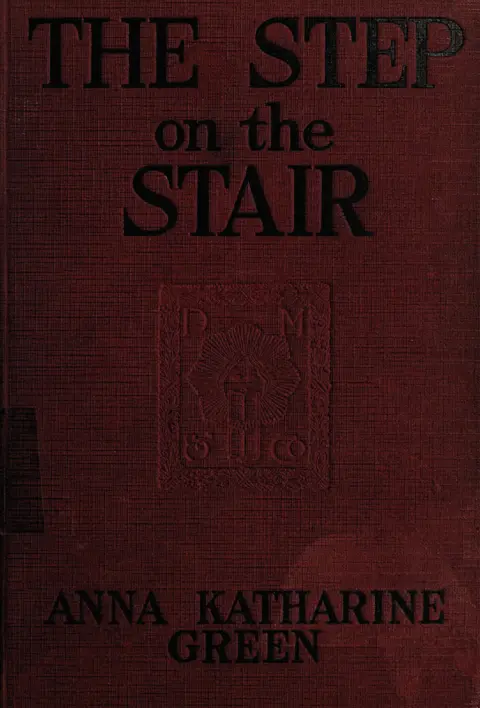
The step on the stair
Anna Katharine Green
THE CLASSIC COLLECTION · 1879
"A Strange Disappearance" by Anna Katharine Green is a detective novel written in the late 19th century. The book follows the astute detective, Mr. Gryce, as he investigates the mysterious disappearance of a young girl named Emily from the house of her employer, Mr. Blake. The novel delves into themes of abduction, secretive relationships, and the quest for truth. The opening of the story introduces readers to a detective's precinct where a woman, distressed and anxious, seeks help after Emily vanishes under suspicious circumstances. The woman, identified as Mrs. Daniels, the housekeeper, reveals that Emily was taken from her room in a manner that suggests foul play. As the detective and his colleague begin their investigation, they uncover several intriguing details that raise questions about Emily's character and her connection to Mr. Blake, all while hints of a potential romantic subplot between Mr. Blake and a mysterious figure who once was his cousin begin to surface. The narrative sets the stage for a tangled web of secrets, driving the plot forward as the search for Emily unfolds.
Introduction adapted from the source catalogue; source summaries may be automatically generated.
Free to read · English · 51,768 words · No account needed
MAKE TIME FOR A GOOD BOOK
On by default. Untick to stop anonymous reading totals. Each page counts after 10 seconds in view. How this works.
Anonymous counting is on unless you have switched it off.
It was about this time that I took up my residence in a sort of lodging-house that occupied the opposite corner to that of Mr. Blake. My room, as I took pains to have it, overlooked the avenue, and from its windows I could easily watch the goings and comings of the gentleman whose movements were daily becoming of more and more interest to me. For set it down to caprice--and men are often as capricious as women--or account for it as you will, his restlessness at this period was truly remarkable. Not a day that he did not spend his time in walking the streets, and that not in his usual aimless gentlemanly fashion, but eagerly and with an intent gaze that roamed here and there, like a bird seeking its prey. It would often be as late as five o’clock before he came in, and if, as now frequently happened, he did not have company to dinner, he was even known to start out again after seven o’clock and go over the same ground as in the morning, looking with strained gaze, that vainly endeavored to appear unconcerned, into the faces of the women that he passed. I not unfrequently followed him at these times as much for my own amusement as from any hope I had of coming upon anything that should aid me in the work before me. But when he suddenly changed his route of travel from a promenade in the fashionable thoroughfares of Broadway and Fourteenth Street to a walk through Chatham Square and the dark, narrow streets of the East side, I began to scent whom the prey might be that he was seeking, and putting every other consideration aside, regularly set myself to dog his steps, as only I, with my innumerable disguises, knew how to do. For three separate days I kept at his heels wherever he went, each day growing more and more astonished if not to say hopeful, as I found myself treading the narrowest and most disreputable streets of the city; halting at the shops of pawnbrokers; peering into the back-rooms of liquor shops; mixing with the crowds that infest the corner groceries at nightfall, and even slinking with hand on the trigger of the pistol I carried in my pocket, up dark alleys where every door that swung noiselessly to and fro as we passed, shut upon haunts of such villainy as only is known to us of the police, or to those good souls that for the sake of One whose example they follow, lay aside their fears and sensitiveness to carry light into the dim pits of this wretched world. At first I thought Mr. Blake might have some such reason for the peculiar course he took. But his indifference to all crowds where only men were collected, his silence where a word would have been well received, convinced me it was a woman he was seeking and that with an intentness which blinded him to the commonest needs of the hour. I even saw him once in his hurry and abstraction, step across the body of a child who had fallen face downward on the stones, and that with an expression showing he was utterly unconscious of anything but an obstacle in his path. The strangest part of it all was that he seemed to have no fear. To be sure he took pains to leave his watch at home; but with such a figure and carriage as he possessed, the absence of jewelry could never deceive the eye for a moment as to the fact of his being a man of wealth, and those he went among would do anything for money. Perhaps, like me, he carried a pistol. At all events he shunned no spot where either poverty lay hid or deviltry reigned, his proud stern head bending to enter the lowest doors without a tremble of the haughty lips that remained compressed as by an iron force; except when some poor forlorn creature with flaunting head-gear, and tremulous hands, attracted by his bearing would hastily brush against him, when he would turn and look, perhaps speak, though what he said I always failed to catch; after which he would hurry on as if possessed by seven devils. The evenings of those three days were notable also. Two of them he spent in the manner I have described; the third he went to the Windsor House--where the Countess De Mirac had taken rooms--going up to the ladies’ entrance and actually ringing the bell, only to start back and walk up and down on the opposite side of the way, with his hands behind his back, and his head bent, evidently deliberating as to whether he should or should not carry out his original intention of entering. The arrival of a carriage with the stately subject of his deliberations, who from her elaborate costume had seemingly been to some kettledrum or private reception, speedily put an end to his doubts. As the door opened to admit her, I saw him cast one look at her heavily draped person, with its snowy opera-cloak drawn tightly over the sweeping folds of her maize colored silk, and shrink back with what sounded like a sigh of anger or distrust, and without waiting for the closing of the door upon her, turn toward home with a step that hesitated no longer.
Your reading position is saved on this browser. Take it to another device with a library code. Reading pages adapt to text, rather than matching a printed edition.
Anna Katharine Green

Anna Katharine Green
Anna Katharine Green
Anna Katharine Green
BEHIND THE BOOK
This eBook is for the use of anyone anywhere in the United States and most other parts of the world at no cost and with almost no restrictions whatsoever. You may copy it, give it away or re-use it under the terms of the Project Gutenberg License included with this eBook or online at www.gutenberg.org. If you are not located in the United States, you will have to check the laws of the country where you are located before using this eBook. Read the source licence.
The original source file, including credits and licence, is retained by this library. Request an original-format copy at no charge. Please include the book title and Project Gutenberg identifier #1167.
KEEP YOUR CURIOSITY GOING
Coulson Kernahan

Maurice Baring
Frances Wright
Cécile Tormay

Frederic Jesup Stimson

W. H. P. (William Henry Pope) Jarvis