School Reading By Grades: Fifth Year
James Baldwin
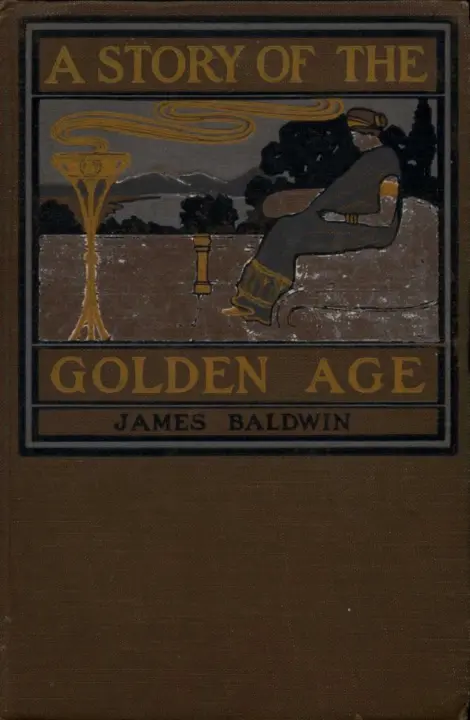
THE CLASSIC COLLECTION · 1887
"A Story of the Golden Age" by James Baldwin is a children's historical fiction book written in the late 19th century. The narrative focuses on the legendary hero Odysseus during his youth, exploring the myths and legends that surround the events leading up to the Trojan War while weaving a continuous story that introduces young readers to classical Greek mythology. The opening of the story sets the scene on the idyllic island of Ithaca, where young Odysseus lives with his parents, Laertes and Anticleia. As he gazes out over the world from Mount Neritus on his twelfth birthday, he becomes captivated by the grandeur of the lands beyond his home, sparking a desire to explore. His yearning leads him to express his wish to visit his grandfather at Mount Parnassus, and this is met with encouragement from his mother and father, highlighting the anticipation of adventure that fuels the tale. The narrative skillfully blends themes of family, exploration, and mythical elements, promising a captivating journey into the rich tapestry of Greek mythology for young readers.
Introduction adapted from the source catalogue; source summaries may be automatically generated.
Free to read · English · 72,216 words · No account needed
MAKE TIME FOR A GOOD BOOK
On by default. Untick to stop anonymous reading totals. Each page counts after 10 seconds in view. How this works.
Anonymous counting is on unless you have switched it off.
Pyrrhus (259-262), the son of Achilles, also called Neoptolemus.
Pythia (34), a name applied to the priestess of Apollo at Delphi.
Rhadamanthus (6, 56), son of Zeus and Europa, and judge and ruler in the
Islands of the Blest.
Scandia (164), a harbor in Cythera.
Scylla (155), a monster with six heads, which guarded one side of a
narrow strait.
Scyros (228, 259), a small island east of Euboea.
Sinon (265), a grandson of Autolycus, and cousin of Odysseus.
Sisyphus (49), son of AElus. He is said to have built the town of
Ephyra, afterward Corinth.
Sparta, see Lacedaemon.
Stymphalus (139), a town in the north-east of Arcadia.
Syma (151), a small island off the south-western coast of Caria in Asia
Minor.
Syria, or Syra (115), one of the Cyclades islands.
Talthybius (250), the herald of Agamemnon.
Taygetes (149, 185), a lofty range of mountains between Laconia and
Messene.
Telamon (214), son of AEacus and Endeis, and brother of Peleus, king of Salamis. He was the father of Ajax by Periboea, his second wife; after the death of Periboea, he married Hesione, the sister of Priam.
Telemachus (219), the son of Odysseus and Penelope.
Telephus (239, 241, 252), son of Heracles and Auge, and king of Mysia.
Theseus (147), the great hero of Attica, and king of Athens
Thessaly, the largest division of Hellas.
Thetis (95), a sea-nymph, wife of Peleus, and mother of Achilles.
Tilphussa (40), a nymph dwelling at Lake Copais.
Tiryns (143), a city in Argolis, not far from Mycenae.
Trachis (143, 171), a town of Thessaly.
Trophonius (41), one of the architects of the temple at Delphi.
Tyndareus (146-169, 184-188), king of Lacedaemon.
Zacynthus (183), an island west of Messene.
Zeus (182, 191), son of Cronus, "the ruler of gods and men." Jupiter.
Your reading position is saved on this browser. Take it to another device with a library code. Reading pages adapt to text, rather than matching a printed edition.
James Baldwin
James Baldwin
James Baldwin
James Baldwin
BEHIND THE BOOK
This eBook is for the use of anyone anywhere in the United States and most other parts of the world at no cost and with almost no restrictions whatsoever. You may copy it, give it away or re-use it under the terms of the Project Gutenberg License included with this eBook or online at www.gutenberg.org. If you are not located in the United States, you will have to check the laws of the country where you are located before using this eBook. Read the source licence.
The original source file, including credits and licence, is retained by this library. Request an original-format copy at no charge. Please include the book title and Project Gutenberg identifier #54214.
KEEP YOUR CURIOSITY GOING
Wilfrid Scawen Blunt
Wilfrid Scawen Blunt

E. W. (Edgar Watson) Howe
Cécile Tormay

Moritz Busch
Coulson Kernahan