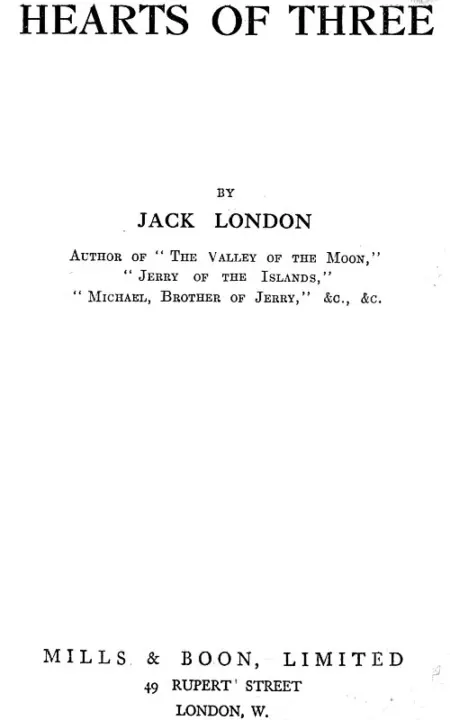
Hearts of three
Jack London
THE CLASSIC COLLECTION · 1900
"A Son of the Sun" by Jack London is a novel written in the early 20th century. Set in the lush, adventurous backdrop of the South Pacific, the story follows the life of David Grief, a wealthy trader in the region, as he navigates perilous encounters and the complexities of human relationships. The narrative promises themes of adventure, conflict, and the duality of civilization and savagery as it delves into Grief's interactions with various island inhabitants and other characters. The opening of the book introduces the "Willi-Waw", a trading vessel anchored in a secluded passage bordered by coral reefs. Here, we meet Griffiths, the ship's captain, and his mate Jacobsen, who express their frustration with the oppressive heat and a looming financial obligation to the enigmatic David Grief. The chapter sets a tone of tension as Griffiths prepares to confront his debts and the repercussions of his choices, notably foreshadowing conflict with Grief, who is noted for his shrewdness and financial acumen. Additionally, we encounter the vibrant and diverse imagery of the islanders, hinting at the rich tapestry of lives that impact Grief’s world. Overall, the beginning establishes an engaging narrative that intertwines adventure and intricate character dynamics, inviting readers into a world of sun-soaked intrigue.
Introduction adapted from the source catalogue; source summaries may be automatically generated.
Free to read · English · 56,684 words · No account needed
MAKE TIME FOR A GOOD BOOK
On by default. Untick to stop anonymous reading totals. Each page counts after 10 seconds in view. How this works.
Anonymous counting is on unless you have switched it off.
The defects of the position on the Big Rock were vital. There was neither food nor water. For several nights, accompanied by one of the Raiatea men, Mauriri swam to the head of the bay for supplies. Then came the night when lights flared on the water and shots were fired. After that the water-side of the Big Rock was invested as well.
“It's a funny situation,” Brown remarked, who was getting all the adventure he had been led to believe resided in the South Seas. “We've got hold and can't let go, and Raoul has hold and can't let go. He can't get away, and we're liable to starve to death holding him.”
“If the rain came, the rock-basins would fill,” said Mauriri. It was their first twenty-four hours without water. “Big Brother, to-night you and I will get water. It is the work of strong men.”
That night, with cocoanut calabashes, each of quart capacity and tightly stoppered, he led Grief down to the water from the peninsula side of the Big Rock. They swam out not more than a hundred feet. Beyond, they could hear the occasional click of an oar or the knock of a paddle against a canoe, and sometimes they saw the flare of matches as the men in the guarding boats lighted cigarettes or pipes.
“Wait here,” whispered Mauriri, “and hold the calabashes.”
Turning over, he swam down. Grief, face downward, watched his phosphorescent track glimmer, and dim, and vanish. A long minute afterward Mauriri broke surface noiselessly at Grief's side.
“Here! Drink!”
The calabash was full, and Grief drank sweet fresh water which had come up from the depths of the salt.
“It flows out from the land,” said Mauriri.
“On the bottom?”
“No. The bottom is as far below as the mountains are above. Fifty feet down it flows. Swim down until you feel its coolness.”
Several times filling and emptying his lungs in diver fashion, Grief turned over and went down through the water. Salt it was to his lips, and warm to his flesh; but at last, deep down, it perceptibly chilled and tasted brackish. Then, suddenly, his body entered the cold, subterranean stream. He removed the small stopper from the calabash, and, as the sweet water gurgled into it, he saw the phosphorescent glimmer of a big fish, like a sea ghost, drift sluggishly by.
Thereafter, holding the growing weight of the calabashes, he remained on the surface, while Mauriri took them down, one by one, and filled them.
“There are sharks,” Grief said, as they swam back to shore.
“Pooh!” was the answer. “They are fish sharks. We of Fuatino are brothers to the fish sharks.”
Your reading position is saved on this browser. Take it to another device with a library code. Reading pages adapt to text, rather than matching a printed edition.
Jack London
Jack London
Jack London
Jack London
BEHIND THE BOOK
This eBook is for the use of anyone anywhere in the United States and most other parts of the world at no cost and with almost no restrictions whatsoever. You may copy it, give it away or re-use it under the terms of the Project Gutenberg License included with this eBook or online at www.gutenberg.org. If you are not located in the United States, you will have to check the laws of the country where you are located before using this eBook. Read the source licence.
The original source file, including credits and licence, is retained by this library. Request an original-format copy at no charge. Please include the book title and Project Gutenberg identifier #21971.
KEEP YOUR CURIOSITY GOING
Coulson Kernahan

Maurice Baring
Frances Wright
Cécile Tormay

Frederic Jesup Stimson

W. H. P. (William Henry Pope) Jarvis