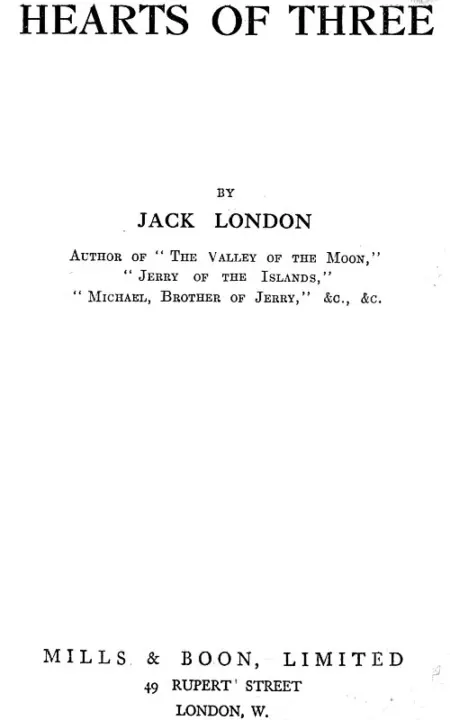
Hearts of three
Jack London
THE CLASSIC COLLECTION · 1900
"A Son of the Sun" by Jack London is a novel written in the early 20th century. Set in the lush, adventurous backdrop of the South Pacific, the story follows the life of David Grief, a wealthy trader in the region, as he navigates perilous encounters and the complexities of human relationships. The narrative promises themes of adventure, conflict, and the duality of civilization and savagery as it delves into Grief's interactions with various island inhabitants and other characters. The opening of the book introduces the "Willi-Waw", a trading vessel anchored in a secluded passage bordered by coral reefs. Here, we meet Griffiths, the ship's captain, and his mate Jacobsen, who express their frustration with the oppressive heat and a looming financial obligation to the enigmatic David Grief. The chapter sets a tone of tension as Griffiths prepares to confront his debts and the repercussions of his choices, notably foreshadowing conflict with Grief, who is noted for his shrewdness and financial acumen. Additionally, we encounter the vibrant and diverse imagery of the islanders, hinting at the rich tapestry of lives that impact Grief’s world. Overall, the beginning establishes an engaging narrative that intertwines adventure and intricate character dynamics, inviting readers into a world of sun-soaked intrigue.
Introduction adapted from the source catalogue; source summaries may be automatically generated.
Free to read · English · 56,684 words · No account needed
MAKE TIME FOR A GOOD BOOK
On by default. Untick to stop anonymous reading totals. Each page counts after 10 seconds in view. How this works.
Anonymous counting is on unless you have switched it off.
That was why the white traders fought the system of paper money, that he, the Feathers of the Sun, had brought. Why was he called the Feathers of the Sun? Because he was the Light-Bringer from the World Beyond the Sky. The paper money was the light. The robbing white traders could not flourish in the light. Therefore they fought the light.
He would prove it to the good people of Fitu-Iva, and he would prove it out of the mouths of his enemies. It was a well-known fact that all highly civilized countries had paper-money systems. He would ask Ieremia if this was not so.
Ieremia did not answer.
“You see,” Cornelius went on, “he makes no answer. He cannot deny what is true. England, France, Germany, America, all the great Papalangi countries, have the paper-money system. It works. From century to century it works. I challenge you, Ieremia, as an honest man, as one who was once a zealous worker in the Lord's vineyard, I challenge you to deny that in the great Papalangi countries the system works.”
Ieremia could not deny, and his fingers played nervously with the fastening of the basket on his knees.
“You see, it is as I have said,” Cornelius continued. “Ieremia agrees that it is so. Therefore, I ask you, all good people of Fitu-Iva, if a system is good for the Papalangi countries, why is it not good for Fitu-Iva?”
“It is not the same!” Ieremia cried. “The paper of the Feathers of the Sun is different from the paper of the great countries.”
That Cornelius had been prepared for this was evident. He held up a Fitu-Ivan note that was recognized by all.
“What is that?” he demanded.
“Paper, mere paper,” was Ieremia's reply.
“And that?”
This time Cornelius held up a Bank of England note.
“It is the paper money of the English,” he explained to the Council, at the same time extending it for Ieremia to examine. “Is it not true, Ieremia, that it is paper money of the English?”
Ieremia nodded reluctantly.
“You have said that the paper money of Fitu-Iva was paper, now how about this of the English? What is it?.... You must answer like a true man... All wait for your answer, Ieremia.”
“It is--it is----” the puzzled Ieremia began, then spluttered helplessly, the fallacy beyond his penetration.
“Paper, mere paper,” Cornelius concluded for him, imitating his halting
utterance.
Conviction sat on the faces of all. The king clapped his hands admiringly and murmured, “It is most clear, very clear.”
Your reading position is saved on this browser. Take it to another device with a library code. Reading pages adapt to text, rather than matching a printed edition.
Jack London
Jack London
Jack London
Jack London
BEHIND THE BOOK
This eBook is for the use of anyone anywhere in the United States and most other parts of the world at no cost and with almost no restrictions whatsoever. You may copy it, give it away or re-use it under the terms of the Project Gutenberg License included with this eBook or online at www.gutenberg.org. If you are not located in the United States, you will have to check the laws of the country where you are located before using this eBook. Read the source licence.
The original source file, including credits and licence, is retained by this library. Request an original-format copy at no charge. Please include the book title and Project Gutenberg identifier #21971.
KEEP YOUR CURIOSITY GOING
Coulson Kernahan

Maurice Baring
Frances Wright
Cécile Tormay

Frederic Jesup Stimson

W. H. P. (William Henry Pope) Jarvis