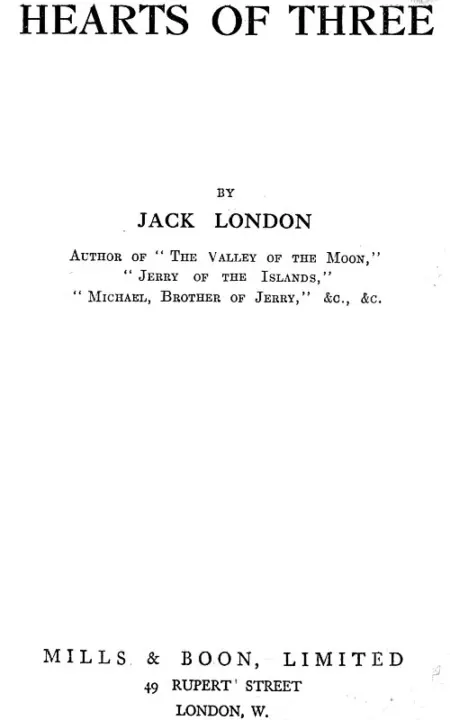
Hearts of three
Jack London
THE CLASSIC COLLECTION · 1900
"A Son of the Sun" by Jack London is a novel written in the early 20th century. Set in the lush, adventurous backdrop of the South Pacific, the story follows the life of David Grief, a wealthy trader in the region, as he navigates perilous encounters and the complexities of human relationships. The narrative promises themes of adventure, conflict, and the duality of civilization and savagery as it delves into Grief's interactions with various island inhabitants and other characters. The opening of the book introduces the "Willi-Waw", a trading vessel anchored in a secluded passage bordered by coral reefs. Here, we meet Griffiths, the ship's captain, and his mate Jacobsen, who express their frustration with the oppressive heat and a looming financial obligation to the enigmatic David Grief. The chapter sets a tone of tension as Griffiths prepares to confront his debts and the repercussions of his choices, notably foreshadowing conflict with Grief, who is noted for his shrewdness and financial acumen. Additionally, we encounter the vibrant and diverse imagery of the islanders, hinting at the rich tapestry of lives that impact Grief’s world. Overall, the beginning establishes an engaging narrative that intertwines adventure and intricate character dynamics, inviting readers into a world of sun-soaked intrigue.
Introduction adapted from the source catalogue; source summaries may be automatically generated.
Free to read · English · 56,684 words · No account needed
MAKE TIME FOR A GOOD BOOK
On by default. Untick to stop anonymous reading totals. Each page counts after 10 seconds in view. How this works.
Anonymous counting is on unless you have switched it off.
“Well, he's answered you,” McMurtrey laughed genially. “And I'll back his bet myself for a couple of sovereigns.”
“Bridge! Who's going to take a hand?” Eddy Little cried impatiently.
“Come on, Peter!”
“The rest of you play,” Deacon said. “He and I are going to play
piquet.”
“I'd prefer bridge,” Peter Gee said mildly.
“Don't you play piquet?”
The pearl-buyer nodded.
“Then come on. Maybe I can show I know more about that than I do about
anchors.”
“Oh, I say----” McMurtrey began.
“You can play bridge,” Deacon shut him off. “We prefer piquet.”
Reluctantly, Peter Gee was bullied into a game that he knew would be
unhappy.
“Only a rubber,” he said, as he cut for deal.
“For how much?” Deacon asked.
Peter Gee shrugged his shoulders. “As you please.”
“Hundred up--five pounds a game?”
Peter Gee agreed.
“With the lurch double, of course, ten pounds?”
“All right,” said Peter Gee.
At another table four of the others sat in at bridge. Captain Stapler, who was no card-player, looked on and replenished the long glasses of Scotch that stood at each man's right hand. McMurtrey, with poorly concealed apprehension, followed as well as he could what went on at the piquet table. His fellow Englishmen as well were shocked by the behaviour of the Australian, and all were troubled by fear of some untoward act on his part. That he was working up his animosity against the half-caste, and that the explosion might come any time, was apparent to all.
“I hope Peter loses,” McMurtrey said in an undertone.
“Not if he has any luck,” Andrews answered. “He's a wizard at piquet. I know by experience.”
That Peter Gee was lucky was patent from the continual badgering of Deacon, who filled his glass frequently. He had lost the first game, and, from his remarks, was losing the second, when the door opened and David Grief entered.
“In Guvutu they merely drink between drinks,” he remarked casually to the assembled company, ere he gripped the manager's hand. “Hello, Mac! Say, my skipper's down in the whaleboat. He's got a silk shirt, a tie, and tennis shoes, all complete, but he wants you to send a pair of pants down. Mine are too small, but yours will fit him. Hello, Eddy! How's that ngari-ngari? You up, Jock? The miracle has happened. No one down with fever, and no one remarkably drunk.” He sighed, “I suppose the night is young yet. Hello, Peter! Did you catch that big squall an hour after you left us? We had to let go the second anchor.”
Your reading position is saved on this browser. Take it to another device with a library code. Reading pages adapt to text, rather than matching a printed edition.
Jack London
Jack London
Jack London
Jack London
BEHIND THE BOOK
This eBook is for the use of anyone anywhere in the United States and most other parts of the world at no cost and with almost no restrictions whatsoever. You may copy it, give it away or re-use it under the terms of the Project Gutenberg License included with this eBook or online at www.gutenberg.org. If you are not located in the United States, you will have to check the laws of the country where you are located before using this eBook. Read the source licence.
The original source file, including credits and licence, is retained by this library. Request an original-format copy at no charge. Please include the book title and Project Gutenberg identifier #21971.
KEEP YOUR CURIOSITY GOING
Coulson Kernahan

Maurice Baring
Frances Wright
Cécile Tormay

Frederic Jesup Stimson

W. H. P. (William Henry Pope) Jarvis