
Last letters from the living dead man
David Patterson (Spirit) Hatch
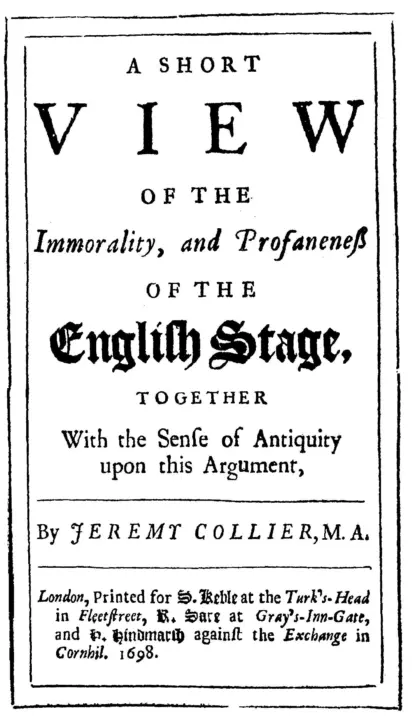
THE CLASSIC COLLECTION · 1698
"A Short View of the Immorality, and Profaneness of the English Stage" by Jeremy Collier is an anti-theatre pamphlet published in 1698. Collier launches a fierce attack on leading playwrights of Restoration comedy, accusing them of profanity, blasphemy, and undermining public morality. Through exhaustive analysis, he condemns their failure to punish vice and enforce poetic justice. His innovative critical approach sparked a pamphlet war lasting nearly three decades, as outraged playwrights defended their art while public sentiment shifted toward theatrical reform.
Introduction adapted from the source catalogue; source summaries may be automatically generated.
Free to read · English · 61,164 words · No account needed
MAKE TIME FOR A GOOD BOOK
On by default. Untick to stop anonymous reading totals. Each page counts after 10 seconds in view. How this works.
Anonymous counting is on unless you have switched it off.
Whether inspired with a diviner Lust,
His Father got him----[360]
This is down right Defiance of the Living God! Here you have the very Essence and Spirit of Blasphemy, and the Holy Ghost brought in upon the most hideous Occasion. I question whether the Torments and Despair of the Damn'd, dare venture at such Flights as these. They are beyond Description, I Pray God they may not be beyond Pardon too. I can't forbear saying, that the next bad Thing to the writing these Impieties, is to Suffer them. To return to Amphitryon. Phoebus and Mercury have Manners assign'd very disagreeable to their Condition. The later abating Propriety of Language, talks more like a Water-man than a Deity. They rail against the Gods, and call Mars and Vulcan the two Fools of Heaven. Mercury is pert upon his Father Jupiter, makes jests upon his Pleasures, and his Greatness, and is horribly smutty and profane.[361] And all this Misbehaviour comes from him in his own shape, and in the sublimity of his Character. Had He run Riot in the Disguise of Sofia, the Discourse and the Person had been better adjusted, and the Extravagance more Pardonable. But here the Decorum is quite lost. To see the Immortals play such Gambols, and the biggest Beings do the least Actions, is strangely unnatural. An Emperour in the Grimaces of an Ape, or the Diversions of a Kitten, would not be half so ridiculous. Now as Monsieur Rapin observes, without Decorum there can be no probability, nor without Probability any true Beauty. Nature must be minded, otherwise Things will look forced, tawdry, and chimerical. Mr. Dryden discourses very handsomly on this occasion in his Preface to Albion and Albanius.[362] He informs us, That Wit has been truly defin'd a propriety of Words and Thoughts.----That Propriety of Thought is that Fancy which arises naturally from the Subject. Why then without doubt, the Quality, of Characters should be taken care of, and great Persons appear like themselves. Yes, yes, all this is granted by implication, and Mr. Dryden comes still nearer to the present case. He tells us, that Propriety is to be observed, even in Machines; And that the Gods are all to manage their Peculiar Provinces. He instances in some of their respective Employments; but I don't find that any of them were to talk Lewdly. No. He plainly supposes the contrary. For as he goes on, If they were to speak upon the Stage it would follow of necessity, that the Expressions should be Lofty, Figurative, and Majestical. It seems then their Behaviour should be agreeable to their Greatness. Why then are not these Rules observ'd, in the Machines of Amphitrion? As I take it, Obscenity has not the Air of Majesty, nor any Alliance with the Sublime. And as for the Figurative Part, 'tis generally of the same Cut with the Lofty: The Smut shines clear, and strong, through the Metaphor, and is no better screen'd than the Sun by a Glass Window. To use Mercury thus ill, and make the God of Eloquence speak so unlike himself is somewhat strange! But tho' the Antients knew nothing of it, there are Considerations above those of Decency. And when this happens, A Rule must rather be trespass'd on, than a Beauty left out. 'Tis Mr. Dryden's opinion in his Cleomenes, where he breaks the Unity of Time, to describe the Beauty of a Famine.[363] Now Beauty is an arbitrary Advantage, and depends upon Custom and Fancy. With some People the Blackest Complexions are the handsomest. 'Tis to these African Criticks that Mr. Dryden seems to make his Appeal. And without doubt he bespeaks their Favour, and strikes their Imagination luckily enough. For to lodge Divinity and Scandal together; To make the Gods throw Stars, like Snow-balls at one another, but especially to Court in Smut, and rally in Blasphemy, is most admirably entertaining! This is much better than all the Niceties of Decorum. 'Tis handsomly contriv'd to slur the Notion of a Superiour Nature, to disarm the Terrors of Religion, and make the Court Above as Romantick as that of the Fairies. A Libertine when his Conscience is thus reliev'd, and Atheism sits easie upon his Spirits, can't help being grateful upon the Occasion. Meer Interest will oblige him to cry up the Performance, and solicit for the Poets Reputation! Before I take leave of these Machines, it may not be amiss to enquire why the Gods are brought into the Spiritual Court.[364] Now I suppose the Creditableness of the Business, and the Poets Kindness to those Places, are the principal Reasons of their coming. However. He might have a farther Design in his Head, and that is, to bring Thebes to London, and to show the Antiquity of Doctors Commons. For if you will believe Mercury, this Conference between him and Phoebus was held three thousand years ago.[365] Thus Shakespear makes Hector talk about Aristotles Philosophy,[366] and calls Sr. John Old Castle, Protestant.[367] I had not mention'd this Discovery in Chronology, but that Mr. Dryden falls upon Ben Johnson, for making Cataline give Fire at the Face of a Cloud, before Guns were invented.
Your reading position is saved on this browser. Take it to another device with a library code. Reading pages adapt to text, rather than matching a printed edition.
BEHIND THE BOOK
This eBook is for the use of anyone anywhere in the United States and most other parts of the world at no cost and with almost no restrictions whatsoever. You may copy it, give it away or re-use it under the terms of the Project Gutenberg License included with this eBook or online at www.gutenberg.org. If you are not located in the United States, you will have to check the laws of the country where you are located before using this eBook. Read the source licence.
The original source file, including credits and licence, is retained by this library. Request an original-format copy at no charge. Please include the book title and Project Gutenberg identifier #44645.
KEEP YOUR CURIOSITY GOING
David Patterson (Spirit) Hatch

David Patterson (Spirit) Hatch

David Patterson (Spirit) Hatch

Ralph Waldo Emerson

Maurice Baring

Oscar Wilde & James McNeill Whistler