
Last letters from the living dead man
David Patterson (Spirit) Hatch
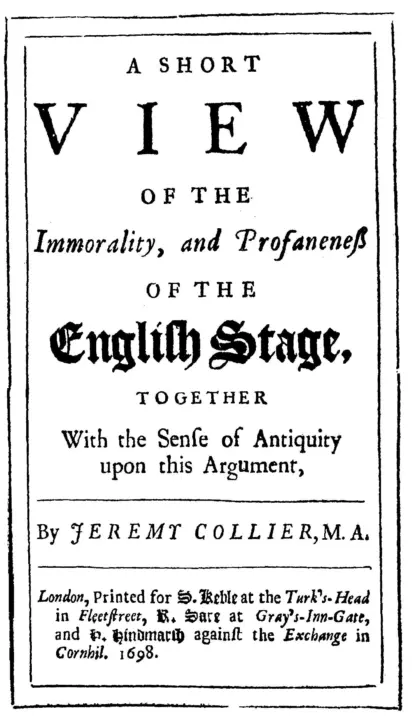
THE CLASSIC COLLECTION · 1698
"A Short View of the Immorality, and Profaneness of the English Stage" by Jeremy Collier is an anti-theatre pamphlet published in 1698. Collier launches a fierce attack on leading playwrights of Restoration comedy, accusing them of profanity, blasphemy, and undermining public morality. Through exhaustive analysis, he condemns their failure to punish vice and enforce poetic justice. His innovative critical approach sparked a pamphlet war lasting nearly three decades, as outraged playwrights defended their art while public sentiment shifted toward theatrical reform.
Introduction adapted from the source catalogue; source summaries may be automatically generated.
Free to read · English · 61,164 words · No account needed
MAKE TIME FOR A GOOD BOOK
On by default. Untick to stop anonymous reading totals. Each page counts after 10 seconds in view. How this works.
Anonymous counting is on unless you have switched it off.
To begin with Amphytrion. In this Play Mr. Dryden represents Jupiter with the Attributes of the supream Being: He furnishes him with Omnipotence, makes him the Creator of Nature, and the Arbiter of Fate, puts all the Functions of Providence in his Hand, and describes him with the Majesty of the true God.[353] And when he has put Him in this glorious Equipage, he brings him out for Diversion. He makes him express himself in the most intemperate Raptures:[354] He is willing to Renounce his Heaven for his Brutality, and employ a whole Eternity in Lewdness. He draws his Debauch at its full Length, with all the Art, and Heightings, and Foulness of Idea immaginable. This Jupiter is not contented with his success against Amphitrion, unless he brings Alcmena into the Confederacy, and makes her a Party ex post Facto. He would not have her think of her Husband, but her Lover, that is, her Whoremaster. 'Tis not the success, but the manner of gaining it which is all in all. 'Tis the Vice which is the charming Circumstance. Innocence and Regularity, are dangerous Companions; They spoil Satisfaction, and make every Thing insipid! Unless People take care to discharge their Virtue, and clear off their Conscience, their Senses will vanish immediately! For Jupiter, says he,[355] would owe nothing to a Name so dull as Husband. And in the next Page.
That very name of Wife And Marriage
Is poyson to the dearest sweets of Love.[356]
I would give the Reader some more of these fine Sentences, but that they are too much out of Order to appear. The truth is, Our Stage-Poets seem to fence against Censure by the excess of Lewdness; And to make the overgrown size of a Crime, a Ground for Impunity. As if a Malefactor should project his Escape by appearing too scandalous for Publick Tryal. However, This is their Armour of Proof, this is the Strength they retreat to. They are fortified in Smut, and almost impregnable in Stench, so that where they deserve most, there's no coming at them. To proceed. I desire to know what Authority Mr. Dryden has for this extraordinary Representation? His Original Plautus, is no President. Indeed Plautus is the only bold Heathen that ever made Jupiter tread the Stage. But then he stops far short of the Liberties of the English Amphitrion. Jupiter at Rome, and London, have the same unaccountable Design; but the Methods of pursuit are very different. The First, does not solicit in scandalous Language, nor flourish upon his Lewdness, nor endeavours to set it up for the Fashion. Plautus had some regard to the Height of the Character, and the Opinion of his Country, and the Restraints of Modesty. The Sallies of Aristophanes do not come up to the case; And if they did, I have cut off the Succours from that Quarter already. Terence's Chærea. is the next bold Man:[357] However, here the Fable of Jupiter and Danae are just glanced at, and the Expression is clean; and He that tells the Story, a Young Libertine. These are all circumstances of extenuation, and give quite another Complexion to the Thing. As for the Greek Tragedians and Seneca, there's no Prescription can be drawn from them. They mention Jupiter in Terms of Magnificence and Respect, and make his Actions, and his Nature of a piece. But it may be the Celebrated Homer, and Virgil may give Mr. Dryden some Countenance. Not at all. Virgil's Jupiter is alwaies great, and solemn, and keeps up the port of a Deity. 'Tis true, Homer does not guard the Idea with that exactness, but then He never sinks the Character into Obscenity. The most exceptionable passage is that where Jupiter relates his Love Adventures to Juno. Here this pretended Deity is charm'd with Venus's Girdle, is in the height of his Courtship, and under the Ascendant of his Passion. This 'tis confess'd was a slippery Place, and yet the Poet makes a shift to keep his Feet. His Jupiter is Little, but not nauseous; The Story, tho' improper, will bear the telling, and look Conversation in the Face. However; These Freedoms of Homer were counted intolerable: I shall not insist on the Censures of Justin Martyr, or Clemens Alexandrinus: Even the Heathen could not endure them. The Poets are lashed by Plato upon this Score; For planting Vice in Heaven, and making their Gods infectious; If Mr. Dryden answers that Jupiter can do us no Harm.[358] He is known to be an Idol of Lewd Memory, and therefore his Example can have no Force: Under Favour this is a mistake: For won't Pitch daub when a dirty Hand throws it; or can't a Toad spit Poyson because she's ugly? Ribaldry is dangerous under any Circumstances of Representation. And as Menander and St. Paul express it, Evil Communications corrupt good Manners. I mention them both, because if the Apostle should be dislik'd, the Comedian may pass. But after all, Mr. Dryden has not so much as a Heathen President for his Singularities. What then made him fall into them? Was it the Decency of the Thing, and the Propriety of Character, and Behaviour? By no means. For as I have observ'd before, Nature and Operations, ought to be proportion'd, and Behaviour suited to the Dignity of Being. To draw a Monkey in Royal Robes, and a Prince in Antick, would be Farce upon Colours, entertain like a Monster, and please only upon the score of Deformity. Why then does Mr. Dryden cross upon Nature and Authority, and go off as he Confesses, from the Plan of Plautus, and Moliere? Tho' by the way, the English Amphitryon has borrow'd most of the Libertine Thoughts of Moliere, and improv'd them. But to the former question. Why must the beaten Road be left? He tells us, That the difference of our Stage from the Roman and the French did so require it.[359] That is, our Stage must be much more Licentious. For you are to observe that Mr. Dryden, and his Fraternity, have help'd to debauch the Town, and Poyson their Pleasures to an unusal Degree: And therefore the Diet must be dress'd to the Palate of the Company. And since they are made Scepticks, they must be entertain'd as such. That the English Amphitryon was contriv'd with this View is too plain to be better interpreted. To what purpose else does Jupiter appear in the shape of Jehovah? Why are the incommunicable Attributes burlesqu'd, and Omnipotence applyed to Acts of Infamy? To what end can such Horrible stuff as this serve, unless to expose the Notion, and extinguish the Belief of a Deity? The Perfections of God, are Himself. To ridicule his Attributes and his Being, are but two words for the same Thing. These Attributes are bestow'd on Jupiter with great Prodigality, and afterwards execrably outrag'd. The Case being thus, the Cover of an Idol, is too thin a pretence to Screen the Blasphemy. Nothing but Mr. Dryden's Absolom and Achitophel can out-do This. Here I confess the Motion of his Pen is bolder, and the Strokes more Black'd. Here we have Blasphemy on the top of the Letter, without any trouble of Inference, or Construction. This Poem runs all upon Scripture Names, Upon Suppositions of the true Religion, and the right Object of Worship. Here Profaness is shut out from Defence, and lies open without Colour or Evasion. Here are no Pagan Divinities in the Scheme, so that all the Atheistick Raillery must point upon the true God. In the beginning we are told that Absalom was David's Natural Son: So then there's a blot in his Scutcheon and a Blemish upon his Birth. The Poet will make admirable use of this, remark presently! This Absalom it seems was very extraordinary in his Person and Performances. Mr. Dryden does not certainly know how this came about, and therefore enquires of himself in the first place,
Your reading position is saved on this browser. Take it to another device with a library code. Reading pages adapt to text, rather than matching a printed edition.
BEHIND THE BOOK
This eBook is for the use of anyone anywhere in the United States and most other parts of the world at no cost and with almost no restrictions whatsoever. You may copy it, give it away or re-use it under the terms of the Project Gutenberg License included with this eBook or online at www.gutenberg.org. If you are not located in the United States, you will have to check the laws of the country where you are located before using this eBook. Read the source licence.
The original source file, including credits and licence, is retained by this library. Request an original-format copy at no charge. Please include the book title and Project Gutenberg identifier #44645.
KEEP YOUR CURIOSITY GOING
David Patterson (Spirit) Hatch

David Patterson (Spirit) Hatch

David Patterson (Spirit) Hatch

Ralph Waldo Emerson

Maurice Baring

Oscar Wilde & James McNeill Whistler