
Recollections The Reminiscences of the Busy Life of One Who Has Played the Varied Parts of Sailor, Author & Lecturer
Frank Thomas Bullen
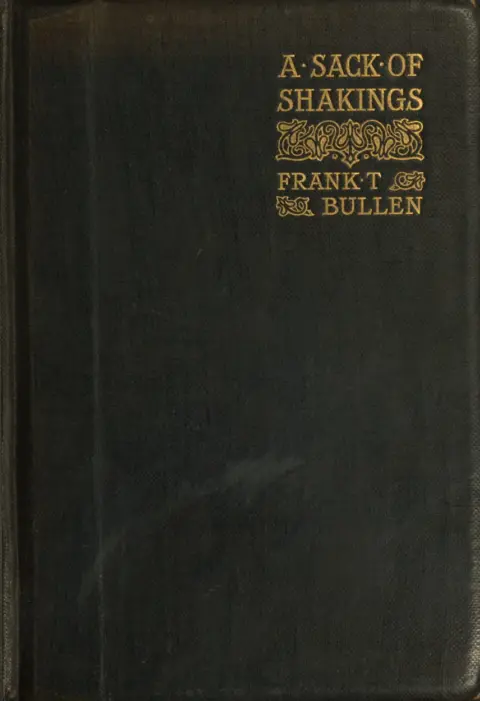
THE CLASSIC COLLECTION · 1901
"A Sack of Shakings" by Frank T. Bullen is a collection of essays written in the early 20th century. The essays draw on the author’s experiences at sea and explore various topics related to the ocean, its creatures, and maritime life. The opening portion introduces readers to an engaging narrative about a school of sperm whales, focusing on themes of family, survival, and the harsh realities of life beneath the waves. The beginning of the work captures a tranquil moment in the Pacific Ocean, where a troop of sperm whales enjoys a peaceful existence until they face an unexpected attack from whalers. As the scene unfolds, it vividly describes the majestic and delicate nature of these creatures, particularly the newly-born calf who becomes orphaned amidst the chaos of destruction. This opening sets the stage for a broader exploration of marine life, touched by the balance between the beauty of nature and the cruelty of survival at sea. Bullen’s descriptive style effectively immerses the reader in the ocean's depths, hinting at the complexities of the ecosystems and the challenges faced by its inhabitants.
Introduction adapted from the source catalogue; source summaries may be automatically generated.
Free to read · English · 103,431 words · No account needed
MAKE TIME FOR A GOOD BOOK
On by default. Untick to stop anonymous reading totals. Each page counts after 10 seconds in view. How this works.
Anonymous counting is on unless you have switched it off.
The men’s quarters, always called the forecastle, even when a more humane shipowner than usual has relegated the forecastle proper to its rightful use as lockers for non-perishable stores and housed his men in a building on deck, is always divided longitudinally in half. The port or mate’s watch live on the port side, the starboard or second mate’s watch on the starboard side. To this rule there is no exception. And here we have etiquette in excelsis. Although the barrier between the two sides is usually of the flimsiest and often quite imaginary in effect, it is a wall of separation with gates guarded and barred. The visitor from one side to the other, whatever his excuse, approaches humbly, feeling ill at ease until made welcome. And from dock to dock it is an unheard-of thing for any officer save the Captain to so much as look into the forecastle. Of course, exceptional circumstances do arise, such as a general outbreak of recalcitrancy, but the occasion must be abnormal for such a breach of etiquette to be made. Some Captains very wisely make it their duty to go the round of the ship each morning, seeing that everything is as it should be, and these enter the forecastle as a part of their examination. But this is quite the exception to the general rule, and is always felt to be more or less of an infringement of immemorial right.
In what must be called the social life of the forecastle, although it is commonly marked by an utter absence of social observances, there are several well-defined rules of etiquette which persist in spite of all other changes. One must not lock his chest at sea. As soon as the last landsman has left the ship, unlock the “donkey,” throw the key ostentatiously into the till, and, letting the lid fall, seat yourself upon it, and light your pipe. It is a Masonic sign of good-fellowship, known and read of all men, that you are a “Sou’ Spainer” indeed, at home again. The first time that the newly assembled crew sit down gipsy fashion to a meal (for tables are seldom supplied), there may be one, usually a boy, who fails to remove his cap. Then does the nearest man’s hand seek the “bread-barge” for a whole biscuit, generally of tile-like texture and consistency. Grasping it by spreading his fingers all over its circumference, the mentor brings it down crushingly upon the covered head of the offender, who is thus initiated, as it were, to the fact that he must “show respect to his grub,” as the term goes. But often when the commons have been exceptionally short or bad an old seaman will deliberately put on his cap again with the remark “’Tain’t wuth it.” If a man wants to smoke while a meal is in progress let him go outside, unless he desires deliberately to raise a storm. And when on the first day of serving out stores a man has been induced to undertake the onerous duty of dividing to each one his weekly portion--“whacking out”--gross indeed must be his carelessness or unfairness before any sufferer will raise a protest. It used to be the practice to load the boys or ordinary seamen (a grade between “A.B.” and boy) with all the menial service of the forecastle, such as food-fetching, washing up utensils, scrubbing, &c. But a juster and wiser plan has been borrowed from the Navy, whereby each man takes in rotation a week as “cook of the mess.” He cooks nothing, the “Doctor” will take care of that, but he is the servant of his house for that week, responsible for its due order and cleanliness. The boys are usually kept out of the forecastle altogether, and berthed with the petty officers, a plan which has with some advantages grave drawbacks. One curious old custom deserves passing notice. Upon a vessel’s arrival in ports where it is necessary to anchor, it is usual to set what is called an “anchor-watch” the first night. All hands take part in this for one hour each, or should do so, but that sometimes there are too few and sometimes too many. As soon as the order is given to “pick for anchor-watch” an old hand draws a rude circle on the deck, which he subdivides into as many sections as there are men. Then one man retires while all the rest come forward and make each man his private mark in a section. When all have contributed, the excluded one (whose mark has been made for him by deputy) is called in and solemnly rubs out mark after mark, the first to be rubbed out giving its owner the first hour’s watch, and so on.
Your reading position is saved on this browser. Take it to another device with a library code. Reading pages adapt to text, rather than matching a printed edition.
Frank Thomas Bullen

Frank Thomas Bullen

Frank Thomas Bullen

Frank Thomas Bullen
BEHIND THE BOOK
This eBook is for the use of anyone anywhere in the United States and most other parts of the world at no cost and with almost no restrictions whatsoever. You may copy it, give it away or re-use it under the terms of the Project Gutenberg License included with this eBook or online at www.gutenberg.org. If you are not located in the United States, you will have to check the laws of the country where you are located before using this eBook. Read the source licence.
The original source file, including credits and licence, is retained by this library. Request an original-format copy at no charge. Please include the book title and Project Gutenberg identifier #63559.
KEEP YOUR CURIOSITY GOING

David Patterson (Spirit) Hatch

David Patterson (Spirit) Hatch

David Patterson (Spirit) Hatch

Ralph Waldo Emerson

Maurice Baring

Oscar Wilde & James McNeill Whistler