
Recollections The Reminiscences of the Busy Life of One Who Has Played the Varied Parts of Sailor, Author & Lecturer
Frank Thomas Bullen
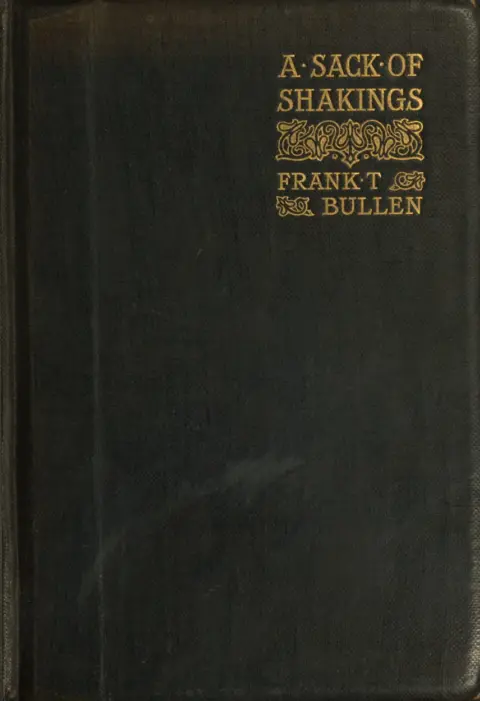
THE CLASSIC COLLECTION · 1901
"A Sack of Shakings" by Frank T. Bullen is a collection of essays written in the early 20th century. The essays draw on the author’s experiences at sea and explore various topics related to the ocean, its creatures, and maritime life. The opening portion introduces readers to an engaging narrative about a school of sperm whales, focusing on themes of family, survival, and the harsh realities of life beneath the waves. The beginning of the work captures a tranquil moment in the Pacific Ocean, where a troop of sperm whales enjoys a peaceful existence until they face an unexpected attack from whalers. As the scene unfolds, it vividly describes the majestic and delicate nature of these creatures, particularly the newly-born calf who becomes orphaned amidst the chaos of destruction. This opening sets the stage for a broader exploration of marine life, touched by the balance between the beauty of nature and the cruelty of survival at sea. Bullen’s descriptive style effectively immerses the reader in the ocean's depths, hinting at the complexities of the ecosystems and the challenges faced by its inhabitants.
Introduction adapted from the source catalogue; source summaries may be automatically generated.
Free to read · English · 103,431 words · No account needed
MAKE TIME FOR A GOOD BOOK
On by default. Untick to stop anonymous reading totals. Each page counts after 10 seconds in view. How this works.
Anonymous counting is on unless you have switched it off.
Still, with all these unpleasantnesses, we worried along in fairly comfortable style, for we had a fresh mess and railway-duff (a plum at every station) every Sunday. Every upper bunk in the fo’c’s’le was leaky, and always remained so; but we rigged up water-sheds that kept us fairly dry during our slumbers. So we fared southward through the fine weather, forgetting, with the lax memory of the sailor for miserable weather, the sloppy days that had passed, and giving no thought to the coming struggle. Gradually we stole out of the trade area, until the paling blue of the sky and the accumulation of torn and feathery cloud-fields warned us of our approach to that stern region where the wild western wind reigns supreme. The trades wavered, fell, and died away. Out from the west, with a rush and a roar, came the cloud-compeller, and eastward we fled before it. An end now to all comfort fore and aft. For she wallowed and grovelled, allowing every sea, however kindly disposed, to leap on board, until the incessant roar of the water from port to starboard dominated our senses even in sleep. A massive breakwater of two-inch kauri planks was fitted across the deck in front of the saloon for the protection of the afterguard, who dwelt behind it as in a stockaded fort. As the weather grew worse, and the sea got into its gigantic stride, our condition became deplorable; for it was a task of great danger to get from the fo’c’s’le to the wheel, impossible to perform without a drenching, and always invested with the risk of being dashed to pieces. We “carried on” recklessly in order to keep her at least ahead of the sea; but at night, when no stars were to be seen, and the compass swung madly through all its thirty-two points, steering was mental and physical torture. In fact, it was only possible to steer at all by the feel of the wind at one’s back, and even then the best helmsman among us could not keep her within two points on each side of her course. We lived in hourly expectation of a catastrophe, and for weeks none of us forward ever left off oilskins and sea-boots even to sleep in. At last, on Easter Sunday, three seas swept on board simultaneously. One launched itself like a Niagara over the stern, and one rose on each side in the waist, until the two black hills of water towered above us for fully twenty feet. Then they leaned toward each other and fell, their enormous weight threatening to crush our decks in as if they had been paper. Nothing could be seen of the hull for a smother of white, except the forecastle-head. When, after what seemed an age, she slowly lifted out of that boiling, yeasty whirl, the breakwater was gone, and so was all the planking of the bulwarks on both sides from poop to forecastle break. Nothing was left but to heave to, and I, for one, firmly believed that we should never get her up into the wind. However, we were bound to try; and watching the smooth (between two sets of seas), the helm was put hard down and the mizen hauled out. Round she came swiftly enough, but just as she presented her broadside to the sea, up rose a monstrous wave. Over, over she went--over until the third ratline of the lee rigging was under water; that is to say, the lee rail was full six feet under the sea. One hideous tumult prevailed, one dazzling glare of foaming water surrounded us; but I doubt whether any of us thought of anything but how long we could hold our breath. Had she been less deeply loaded she must have capsized. As it was, she righted again, and came up into the wind still afloat. But never before or since have I seen a vessel behave like that hove to. We were black and blue with being banged about, our arms strained almost to uselessness by holding on. Beast as she was, the strength of her hull was amazing, or she would have been racked to splinters: for in that awful sea she rolled clean to windward until she filled herself, then canted back again until she lay nearly on her beam-ends; and this she did continually for three days and nights. At the first of the trouble the cabin had been gutted so that neither officers nor passengers had a dry thread, and of course all cooking was impossible. I saw the skipper chasing his sextant (in its box) around the saloon-table, which was just level with the water which was making havoc with everything. And not a man of us for’ard but had some pity to spare for the one woman passenger (going out with her little boy to join her husband), who, we knew, was crouching in the corner of an upper bunk in her cabin, hugging her child to her bosom, and watching with fascinated eyes the sullen wash of the dark water that plunged back and forth across the sodden strip of carpet.
Your reading position is saved on this browser. Take it to another device with a library code. Reading pages adapt to text, rather than matching a printed edition.
Frank Thomas Bullen

Frank Thomas Bullen

Frank Thomas Bullen

Frank Thomas Bullen
BEHIND THE BOOK
This eBook is for the use of anyone anywhere in the United States and most other parts of the world at no cost and with almost no restrictions whatsoever. You may copy it, give it away or re-use it under the terms of the Project Gutenberg License included with this eBook or online at www.gutenberg.org. If you are not located in the United States, you will have to check the laws of the country where you are located before using this eBook. Read the source licence.
The original source file, including credits and licence, is retained by this library. Request an original-format copy at no charge. Please include the book title and Project Gutenberg identifier #63559.
KEEP YOUR CURIOSITY GOING

David Patterson (Spirit) Hatch

David Patterson (Spirit) Hatch

David Patterson (Spirit) Hatch

Ralph Waldo Emerson

Maurice Baring

Oscar Wilde & James McNeill Whistler