
Recollections The Reminiscences of the Busy Life of One Who Has Played the Varied Parts of Sailor, Author & Lecturer
Frank Thomas Bullen
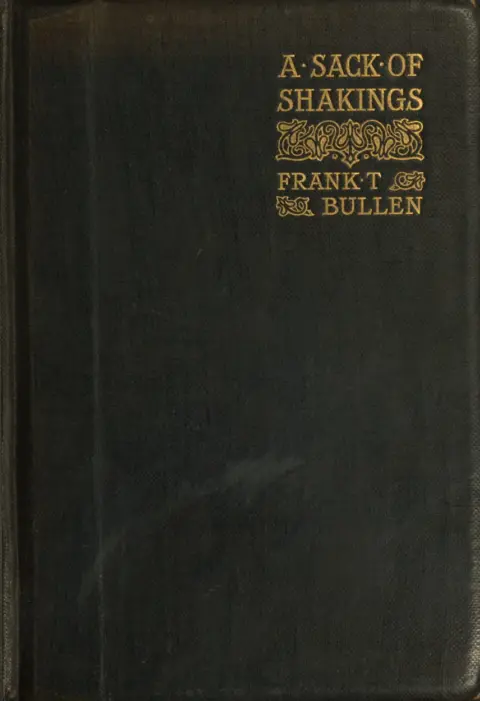
THE CLASSIC COLLECTION · 1901
"A Sack of Shakings" by Frank T. Bullen is a collection of essays written in the early 20th century. The essays draw on the author’s experiences at sea and explore various topics related to the ocean, its creatures, and maritime life. The opening portion introduces readers to an engaging narrative about a school of sperm whales, focusing on themes of family, survival, and the harsh realities of life beneath the waves. The beginning of the work captures a tranquil moment in the Pacific Ocean, where a troop of sperm whales enjoys a peaceful existence until they face an unexpected attack from whalers. As the scene unfolds, it vividly describes the majestic and delicate nature of these creatures, particularly the newly-born calf who becomes orphaned amidst the chaos of destruction. This opening sets the stage for a broader exploration of marine life, touched by the balance between the beauty of nature and the cruelty of survival at sea. Bullen’s descriptive style effectively immerses the reader in the ocean's depths, hinting at the complexities of the ecosystems and the challenges faced by its inhabitants.
Introduction adapted from the source catalogue; source summaries may be automatically generated.
Free to read · English · 103,431 words · No account needed
MAKE TIME FOR A GOOD BOOK
On by default. Untick to stop anonymous reading totals. Each page counts after 10 seconds in view. How this works.
Anonymous counting is on unless you have switched it off.
This was the only occasion upon which I have known a vessel at sea to be visited by so varied a collection of small birds, and certainly the only case I have ever heard of where land birds have flown on board and made themselves at home. When I say at sea, of course I do not mean in a narrow strait like the Channel, where passing vessels must often be visited by migrants crossing to or from the Continent. But when well out in the North Atlantic, certainly to the westward of the Azores, and out of sight of them, I have several times known a number of swallows to fly on board and cling almost like bats to whatever projections they first happened to reach. Exhausted with their long battle against the overmastering winds, faint with hunger and thirst, they had at last reached a resting-place, only to find it so unsuited to all their needs that nothing remained for them to do but die. Earnest attempts were made to induce them to live, but unsuccessfully; and as they never regained strength sufficient to resume their weary journey, they provided a sumptuous meal for the ship’s cat. Even had they been able to make a fresh start, it is hard to imagine that the sense of direction which guides them in their long flight from or to their winter haunts would have enabled them to shape a course from such an utterly unknown base as a ship at sea must necessarily be to them.
While making a passage up the China Sea vessels are often boarded by strange bird visitors, and some of them may be induced to live upon such scanty fare as can be found for them on shipboard. I once witnessed with intense interest a gallant attempt made by a crane to find a rest for her weary wings on board of an old barque in which I was an able seaman. We were two days out from Hong-Kong, bound to Manila, through a strong south-west monsoon. The direction of the wind almost enabled us to lay our course, and therefore the “old man” was cracking on, all the sail being set that she would stagger under close-hauled. Being in ballast, she lay over at an angle that would have alarmed anybody but a yachtsman; but she was a staunch, weatherly old ship, and hung well to windward. It was my wheel from six to eight in the evening, and as I wrestled with it in the attempt to keep the old barky up to her work, I suddenly caught sight of the gaunt form of a crane flapping her heavy wings in dogged fashion to come up with us from to leeward, we making at the time about eight knots an hour. After a long fight the brave bird succeeded in reaching us, and coasted along the lee side, turning her long neck anxiously from side to side as if searching for a favourable spot whereon to alight. Just as she seemed to have made up her mind to come inboard abaft the foresail, a gust of back-draught caught her wide pinions and whirled her away to leeward, about a hundred fathoms at one sweep, while it was evident that she had the utmost difficulty in maintaining her balance. Another long struggle ensued as the gloom of the coming night deepened, and the steady, strenuous wind pressed us onward through the turbulent sea. The weary pilgrim at last succeeded in fetching up to us again, and with a feeling of the keenest satisfaction I saw her work her way to windward, as if instinct warned her that in that way alone she would succeed in reaching a place of rest. Backward and forward along our weather side she sailed twice, searching with anxious eye the whole of our decks, but fearing to trust herself thereon, where so many men were apparently awaiting to entrap her. No, she would not venture, and quite a pang of disappointment and sympathy shot through me as I saw her drift away astern and renew her hopeless efforts to board us on the lee side. At last she came up so closely that I could see the laboured heaving of her breast muscles, and I declare that the expression in her full, dark eyes was almost human in its pathos of despair. She poised herself almost above the rail, the vessel gave a great lee lurch, and down the slopes of the mizen came pouring an eddy of baffled wind. It caught the doomed bird, whirled her over and over as she fought vainly to regain her balance, and at last bore her down so closely to the seething tumult beneath her that a breaking wave lapped her up and she disappeared. All hands had witnessed her brave battle with fate, and quite a buzz of sympathy went up for her in her sad defeat.
Your reading position is saved on this browser. Take it to another device with a library code. Reading pages adapt to text, rather than matching a printed edition.
Frank Thomas Bullen

Frank Thomas Bullen

Frank Thomas Bullen

Frank Thomas Bullen
BEHIND THE BOOK
This eBook is for the use of anyone anywhere in the United States and most other parts of the world at no cost and with almost no restrictions whatsoever. You may copy it, give it away or re-use it under the terms of the Project Gutenberg License included with this eBook or online at www.gutenberg.org. If you are not located in the United States, you will have to check the laws of the country where you are located before using this eBook. Read the source licence.
The original source file, including credits and licence, is retained by this library. Request an original-format copy at no charge. Please include the book title and Project Gutenberg identifier #63559.
KEEP YOUR CURIOSITY GOING

David Patterson (Spirit) Hatch

David Patterson (Spirit) Hatch

David Patterson (Spirit) Hatch

Ralph Waldo Emerson

Maurice Baring

Oscar Wilde & James McNeill Whistler