
Recollections The Reminiscences of the Busy Life of One Who Has Played the Varied Parts of Sailor, Author & Lecturer
Frank Thomas Bullen
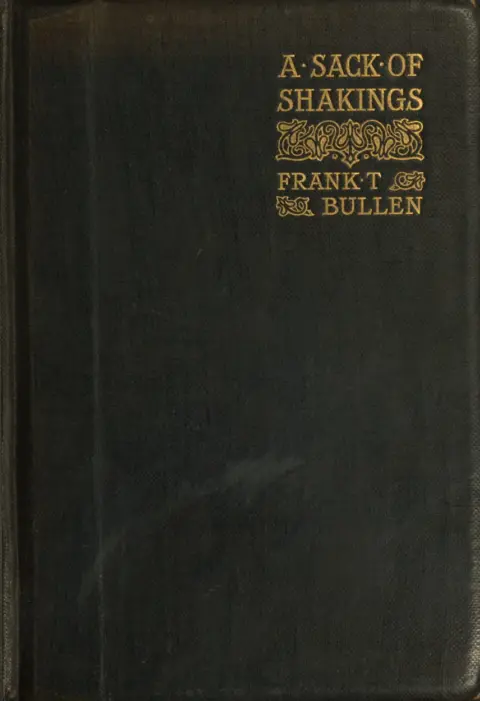
THE CLASSIC COLLECTION · 1901
"A Sack of Shakings" by Frank T. Bullen is a collection of essays written in the early 20th century. The essays draw on the author’s experiences at sea and explore various topics related to the ocean, its creatures, and maritime life. The opening portion introduces readers to an engaging narrative about a school of sperm whales, focusing on themes of family, survival, and the harsh realities of life beneath the waves. The beginning of the work captures a tranquil moment in the Pacific Ocean, where a troop of sperm whales enjoys a peaceful existence until they face an unexpected attack from whalers. As the scene unfolds, it vividly describes the majestic and delicate nature of these creatures, particularly the newly-born calf who becomes orphaned amidst the chaos of destruction. This opening sets the stage for a broader exploration of marine life, touched by the balance between the beauty of nature and the cruelty of survival at sea. Bullen’s descriptive style effectively immerses the reader in the ocean's depths, hinting at the complexities of the ecosystems and the challenges faced by its inhabitants.
Introduction adapted from the source catalogue; source summaries may be automatically generated.
Free to read · English · 103,431 words · No account needed
MAKE TIME FOR A GOOD BOOK
On by default. Untick to stop anonymous reading totals. Each page counts after 10 seconds in view. How this works.
Anonymous counting is on unless you have switched it off.
I sat quite still for some little time, trying to sum up the situation, but the night being very cold, I had to move or get benumbed. Leaving my bag and bed where it was I groped my way into the town, and after about a quarter of an hour’s stumbling along what I afterwards found was the main street, I saw a feeble light. Making for it at once I discovered a man standing at the door of a lowly shanty smoking, the light I had seen proceeding from a tallow candle flickering in the interior. Receiving my salutation with gruff heartiness the man bade me welcome to such shelter as he had, so I lugged my dunnage up and entered. He showed me an ancient squab whereon I might lie, and closing the street door bade me good night, disappearing into some mysterious recess in a far corner. I composed myself for sleep, but the place was simply alive with fleas, which, tasting fresh stranger, gave me a lively time. Before morning I was bitterly envious of the other occupant of the room, who lay on the bare floor in a drunken stupor, impervious to either cold or vermin. At the first gleam of dawn I left, taking a brisk walk until somebody was astir in the place, when I soon got quarters in a boarding-house. Then as early as possible I made for the shipping office, finding to my surprise that the vessel in want of a mate was the ancient relic that had so much amused us as we entered the harbour. After a good deal of searching, the commander of her was found--a bluff, red-faced man with a watery, wandering eye, whose first words betrayed him for a Welshman. He was as anxious to get a mate as I was to get a ship, so we were not long coming to terms--£6 per month. Her name I found was the Amulet, last from Santos, and now awaiting a cargo of coal for St. John, New Brunswick. No sooner had I signed articles than the skipper invited me to drink with him, and instantly became confidential. But as he had already been drinking pretty freely, and even his sober English was no great things, I was not much the wiser for our conference. However, bidding him good day, I went on board and took charge, finding the old rattletrap in a most miserable condition, the second mate in a state of mutiny, and the crew doing just whatever they pleased. I had not been on board an hour before I was in possession of the history of their adventures since leaving England eighteen months before. I found too that I was the fourth mate that voyage, and judging from appearances I thought it unlikely that I should be the last. As soon as he had finished unburdening himself to me, the second mate, who seemed a decent fellow enough, started to pack up, swearing in both Welsh and English that he was finished with her. Of course I had no means of preventing him from going even if I had wished to do so, and away he went. Then I turned my attention to the ship, finding the small crew (seven all told) desperately sullen, but still willing to obey my orders. Oh, but she was a wreck, and so dirty that I hardly knew whether it was worth while attempting to cleanse her. There was abundance of good fresh food though, and one of the men helped the grimy muttering Welsh lad who was supposed to be the cook, so that the meals were at least eatable. According to my orders I was to report progress to the skipper every morning at his hotel, and next morning I paid him a visit. I found him in bed, although it was eleven o’clock, with a bottle of brandy sticking out from under his pillow and quite comfortably drunk. He received my remarks with great gravity, graciously approving of what I had done, and assuring me that he was very ill indeed. I left him so, thinking deeply over my queer position, and returned on board to find the second mate back again in a furious rage at not being able to get at the “old man,” but resigned to going with us to St. John as a passenger. Well, as time went on I managed to get her in some sort of trim, received the cargo on board, bent the sails, and made all ready for sea, the second mate lolling at his ease all day long or in his bunk asleep. Every morning I saw the skipper, always in bed and always drunk. Thus three weeks passed away. When the vessel had been a week ready for sea, during most of which time a steady fair wind for our departure had been blowing, I had a visitor. After a few civil questions he told me he was the agent, and proposed giving the captain one day longer in which to clear out, failing which he would on his own responsibility send the vessel to sea without him. I of course raised no objection, but seized the opportunity to get a few pounds advance of wages which I at once despatched home to my wife. The agent’s threat was effectual, for at noon the next day my commander came on board accompanied by a tugboat which towed us out to sea, although a fair wind was blowing. No sooner had the pilot left us to our own devices than Captain Jones retired to his bunk, and there he remained, his cabin no bad representation of a miniature Malebolge. Details impossible.
Your reading position is saved on this browser. Take it to another device with a library code. Reading pages adapt to text, rather than matching a printed edition.
Frank Thomas Bullen

Frank Thomas Bullen

Frank Thomas Bullen

Frank Thomas Bullen
BEHIND THE BOOK
This eBook is for the use of anyone anywhere in the United States and most other parts of the world at no cost and with almost no restrictions whatsoever. You may copy it, give it away or re-use it under the terms of the Project Gutenberg License included with this eBook or online at www.gutenberg.org. If you are not located in the United States, you will have to check the laws of the country where you are located before using this eBook. Read the source licence.
The original source file, including credits and licence, is retained by this library. Request an original-format copy at no charge. Please include the book title and Project Gutenberg identifier #63559.
KEEP YOUR CURIOSITY GOING

David Patterson (Spirit) Hatch

David Patterson (Spirit) Hatch

David Patterson (Spirit) Hatch

Ralph Waldo Emerson

Maurice Baring

Oscar Wilde & James McNeill Whistler