
Recollections The Reminiscences of the Busy Life of One Who Has Played the Varied Parts of Sailor, Author & Lecturer
Frank Thomas Bullen
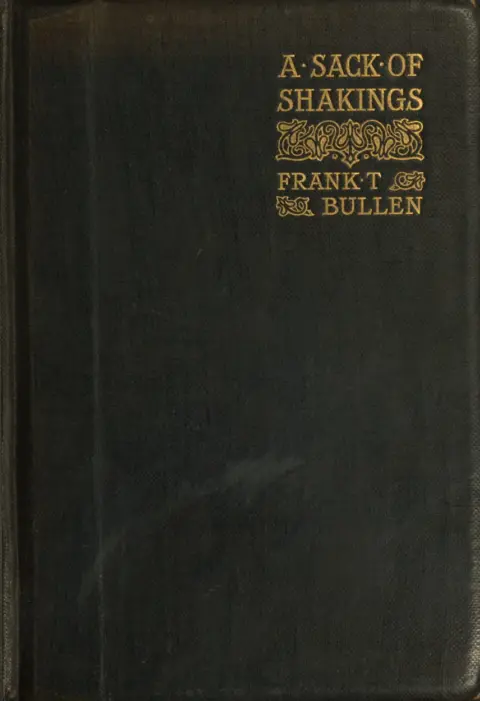
THE CLASSIC COLLECTION · 1901
"A Sack of Shakings" by Frank T. Bullen is a collection of essays written in the early 20th century. The essays draw on the author’s experiences at sea and explore various topics related to the ocean, its creatures, and maritime life. The opening portion introduces readers to an engaging narrative about a school of sperm whales, focusing on themes of family, survival, and the harsh realities of life beneath the waves. The beginning of the work captures a tranquil moment in the Pacific Ocean, where a troop of sperm whales enjoys a peaceful existence until they face an unexpected attack from whalers. As the scene unfolds, it vividly describes the majestic and delicate nature of these creatures, particularly the newly-born calf who becomes orphaned amidst the chaos of destruction. This opening sets the stage for a broader exploration of marine life, touched by the balance between the beauty of nature and the cruelty of survival at sea. Bullen’s descriptive style effectively immerses the reader in the ocean's depths, hinting at the complexities of the ecosystems and the challenges faced by its inhabitants.
Introduction adapted from the source catalogue; source summaries may be automatically generated.
Free to read · English · 103,431 words · No account needed
MAKE TIME FOR A GOOD BOOK
On by default. Untick to stop anonymous reading totals. Each page counts after 10 seconds in view. How this works.
Anonymous counting is on unless you have switched it off.
Then, oh woeful fall! she was sold to the Norwegians, those thrifty mariners who are ever on the look-out for bargains in the way of ships who have seen their best days, and manage to succeed, in ways undreamed of by more lavish nations, in making fortunes out of such poor old battered phantoms of bygone prosperity. Tenacious as the seaman’s memory is for the appearance of any ship in which he has once sailed, it would have been no easy task for any of her former shipmates to recognise the splendid old Lion under her Scandinavian name of the Ganger Rolf, metamorphosed as she was too by the shortening of her tapering spars, the stripping of the yards from the mizen-mast, and the rigging up of what British sailors call the “Norwegian house-flag,” a windmill pump between the main and mizen masts. Thus transformed she began her degraded existence under new masters, crawling to and fro across the Atlantic to Quebec in summer, Pensacola or Doboy in winter, uneasily and spiritless as some gallant hunter dragging a timber waggon in his old age. Unpainted, weather-bleached, and with sails so patched and clouted that they looked like slum washing hung out to dry, she became, like the rest of the “wood-scows,” a thing for the elements to scoff at, and, seen creeping eastward with a deck-load of deals piled six feet high fore and aft above her top-gallant rail, was as pathetic as a pauper funeral. Eight seamen now were all that the thrift of her owners allowed to navigate her, who with the captain, two mates, carpenter, and cook, made up the whole of her crew, exactly the number of the officers she used to carry in her palmy days.
One day when she was discharging in London there came alongside an old seaman, weather-worn and hungry-looking. Something in the build of the old ship caught his eye, and with quivering lips and twitching hands he climbed on board. Round about the deck he quested until, half hidden by a huge pile of lumber, he found the bell and read on it, “Lion, London, 1842.” Then he sat down and covered his face with his hands. Presently he arose and sought the grimy mate purposefully. At an incredibly low wage he obtained the berth of cook,--it was either that or starve, although now he had found his old ship, he felt that he would go for nothing rather than miss another voyage in her. Soon after they sailed for the “fall voyage” to Quebec, making a successful run over, much to the delight of the ancient cook, who was never weary of telling any one who would listen of the feats of sailing performed by the Lion when he was quartermaster of her “way back in the fifties.” Urged by greed, for he was part-owner, and under no fear of the law, the skipper piled upon her such a deck-load of deals that she no longer resembled a ship, she was only comparable to a vast timber stack with three masts. She was hardly clear of Newfoundland on her homeward passage, when one of the most terrible gales of all that terrible winter set in. Snow and sleet and frost-fog, a blinding white whirl of withering cold, assailed her, paralysing the hapless handful of men who vainly strove on their lofty platform to do their duty, exposed fully to all the wrath of that icy tempest. One after one the worn-out sails, like autumn leaves, were stripped from yard and stay; day after day saw the perishing mariners die. The sea froze upon her where it fell, so that now she resembled an iceberg; and though the remnant of the crew tried many times to get at the fastenings of the chains that secured the deck-load so as to send it adrift, they could not. At last only one man was left alive, and he, strangely enough, was the old cook. And while still the gale was at its height, he suddenly seemed to renew all his lost strength. Buckling tight his belt with firm fingers, a new light gleaming in his eyes, he strode aft and seized the long-disused wheel. Standing erect and alert he conned her gravely, getting her well before the wind. Onward she fled, as if knowing the touch of an old friend. Gradually the lean fingers stiffened, the fire died out of the eyes, until, just as the last feeble drops in that brave old heart froze solid, the Lion dashed into a mountainous berg and all her shattered timbers fell apart. Lovely and pleasant had she been in her life, and in her death she was no danger to her wandering sisters.
Your reading position is saved on this browser. Take it to another device with a library code. Reading pages adapt to text, rather than matching a printed edition.
Frank Thomas Bullen

Frank Thomas Bullen

Frank Thomas Bullen

Frank Thomas Bullen
BEHIND THE BOOK
This eBook is for the use of anyone anywhere in the United States and most other parts of the world at no cost and with almost no restrictions whatsoever. You may copy it, give it away or re-use it under the terms of the Project Gutenberg License included with this eBook or online at www.gutenberg.org. If you are not located in the United States, you will have to check the laws of the country where you are located before using this eBook. Read the source licence.
The original source file, including credits and licence, is retained by this library. Request an original-format copy at no charge. Please include the book title and Project Gutenberg identifier #63559.
KEEP YOUR CURIOSITY GOING

David Patterson (Spirit) Hatch

David Patterson (Spirit) Hatch

David Patterson (Spirit) Hatch

Ralph Waldo Emerson

Maurice Baring

Oscar Wilde & James McNeill Whistler