
Recollections The Reminiscences of the Busy Life of One Who Has Played the Varied Parts of Sailor, Author & Lecturer
Frank Thomas Bullen
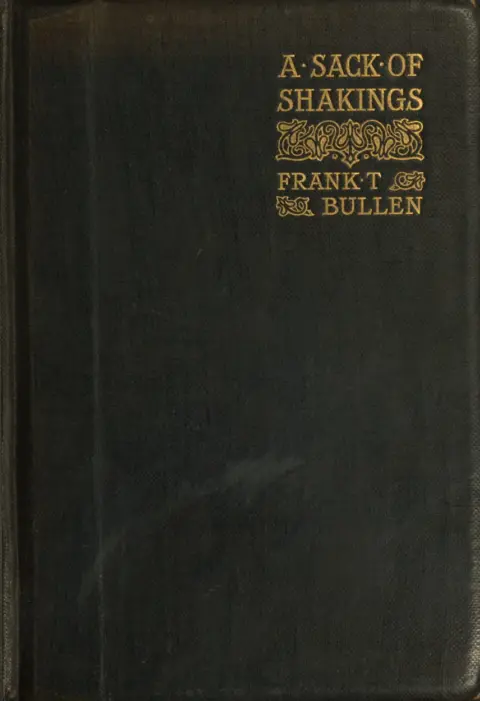
THE CLASSIC COLLECTION · 1901
"A Sack of Shakings" by Frank T. Bullen is a collection of essays written in the early 20th century. The essays draw on the author’s experiences at sea and explore various topics related to the ocean, its creatures, and maritime life. The opening portion introduces readers to an engaging narrative about a school of sperm whales, focusing on themes of family, survival, and the harsh realities of life beneath the waves. The beginning of the work captures a tranquil moment in the Pacific Ocean, where a troop of sperm whales enjoys a peaceful existence until they face an unexpected attack from whalers. As the scene unfolds, it vividly describes the majestic and delicate nature of these creatures, particularly the newly-born calf who becomes orphaned amidst the chaos of destruction. This opening sets the stage for a broader exploration of marine life, touched by the balance between the beauty of nature and the cruelty of survival at sea. Bullen’s descriptive style effectively immerses the reader in the ocean's depths, hinting at the complexities of the ecosystems and the challenges faced by its inhabitants.
Introduction adapted from the source catalogue; source summaries may be automatically generated.
Free to read · English · 103,431 words · No account needed
MAKE TIME FOR A GOOD BOOK
On by default. Untick to stop anonymous reading totals. Each page counts after 10 seconds in view. How this works.
Anonymous counting is on unless you have switched it off.
Evening was just closing in, heralded by that indescribable feeling of refreshment in the torrid air always experienced at sea near the Equator when the sun is about to disappear. The men in the “crow’s nests” were anxiously watching the declining orb, whose disappearance would be the signal for their release from their tedious watch. But to the chagrin of every foremast hand, before the sun had quite reached the horizon, the officer up at the mainmast head, taking a final comprehensive sweep with his glasses all around, raised the thrilling cry of “Blo--o--o--o--w.” And despite the lateness of the hour, in less than ten minutes four boats were being strenuously driven in the direction of the just-sighted whale. Forgetting for awhile their discontent at the prospect before them, the crews toiled vigorously to reach their objective, although not a man of them but would have rejoiced to lose sight of him. It was not so to be. At another time he would probably have been startled by the clang of the oars as they turned in the rowlocks, but now he seemed to have lost his powers of apprehension, allowing us to come up with him and harpoon him with comparative ease. The moment that he felt the prick of the keen iron, all his slothfulness seemed to vanish, and without giving one of the other boats a chance to get fast also, he milled round to windward, and exerting all his vast strength, rushed off into the night that came up to meet us like the opening of some dim portal into the unknown. Some little time was consumed in our preparations for the next stage of our proceedings, during which the darkness came down upon us and shut us in with our prey, blotting out our ship and the other boats from the stinted horizon left to us, as if they had never been. By some oversight no compass was in our boat, and, a rare occurrence in those latitudes, the sky was overcast so that we could not see the stars. Also there was but little wind, our swift transit at the will of the whale alone being responsible for the breeze we felt. On, on we went in silence except for the roar of the parted waters on either hand, and unable to see anything but the spectral gleam ahead whenever the great mammal broke water to spout. Presently the headlong rush through the gloom began to tell upon everybody’s nerves, and we hoped, almost prayed for a slackening of the relentless speed kept up by the monster we had fastened ourselves to. The only man who appeared unmoved was the second mate, who was in charge. He stood in the bows as if carved in stone, one hand grasping his long lance and the other resting on his hip, a stern figure whose only sign of life was his unconscious balancing to the lively motion of the boat. Always a mystery to us of the crew, he seemed much more so now, his inscrutable figure dimly blotched against the gloom ahead, and all our lives in his hand. For a year we had been in daily intercourse with him, yet we felt that we knew no more of the man himself than on the first day of our meeting. A strong, silent man, who never cursed us as the others did, because his lightest word carried more weight than their torrents of blasphemy, and withal a man who came as near the seaman’s ideal of courage, resourcefulness, and tenacity as we could conceive possible. Again and again, as we sped onwards through the dark, each of us after his own fashion analysed that man’s character in a weary purposeless round of confused thought, through the haze of which shot with dread persistence the lurid phrase, “a lost boat.” How long we had thus been driving blindly on none of us could tell--no doubt the time appeared enormously prolonged--but when at last the ease-up came we were all stiff with our long constraint of position. All, that is, but Mr. Neville our chief, who, as if in broad day within a mile of the ship, gave all the necessary orders for the attack. Again we were baffled, for in spite of his unprecedented run the whale began to sound. Down, down he went in hasteless determined fashion, never pausing for an instant, though we kept all the strain on the line that was possible, until the last flake of our 300 fathoms left the tub, slithered through the harpooner’s fingers round the loggerhead, and disappeared. Up flew the boat’s head with a shock that sent us all flying in different directions, then all was silent. Only for a minute. The calm grave tones of Mr. Neville broke the spell by saying, “Make yourselves as comfortable as you can, lads, we can do nothing till daylight but watch for the ship.” We made an almost whispered response, and began our watch. But it was like trying to peer through the walls of an unlit cellar, so closely did the darkness hem us in. Presently down came the rain, followed by much wind, until, notwithstanding the latitude, our teeth chattered with cold. Of course we were in no danger from the sea, for except in the rare hurricanes there is seldom any wind in those regions rising to the force of a gale. But the night was very long. Nor did our miserable anticipations tend to make our hard lot any easier.
Your reading position is saved on this browser. Take it to another device with a library code. Reading pages adapt to text, rather than matching a printed edition.
Frank Thomas Bullen

Frank Thomas Bullen

Frank Thomas Bullen

Frank Thomas Bullen
BEHIND THE BOOK
This eBook is for the use of anyone anywhere in the United States and most other parts of the world at no cost and with almost no restrictions whatsoever. You may copy it, give it away or re-use it under the terms of the Project Gutenberg License included with this eBook or online at www.gutenberg.org. If you are not located in the United States, you will have to check the laws of the country where you are located before using this eBook. Read the source licence.
The original source file, including credits and licence, is retained by this library. Request an original-format copy at no charge. Please include the book title and Project Gutenberg identifier #63559.
KEEP YOUR CURIOSITY GOING

David Patterson (Spirit) Hatch

David Patterson (Spirit) Hatch

David Patterson (Spirit) Hatch

Ralph Waldo Emerson

Maurice Baring

Oscar Wilde & James McNeill Whistler