READ · DISCOVER · ENJOYClassic literature · Always free
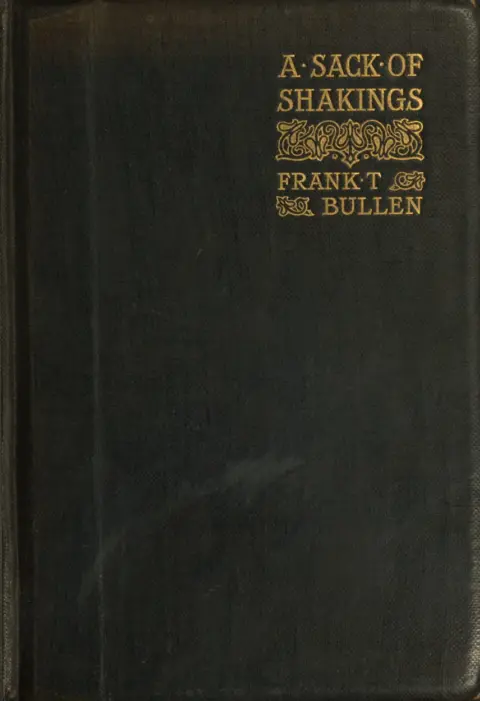
A Sack of Shakings — digital edition cover

THE CLASSIC COLLECTION · 1901

A Sack of Shakings

"A Sack of Shakings" by Frank T. Bullen is a collection of essays written in the early 20th century. The essays draw on the author’s experiences at sea and explore various topics related to the ocean, its creatures, and maritime life. The opening portion introduces readers to an engaging narrative about a school of sperm whales, focusing on themes of family, survival, and the harsh realities of life beneath the waves. The beginning of the work captures a tranquil moment in the Pacific Ocean, where a troop of sperm whales enjoys a peaceful existence until they face an unexpected attack from whalers. As the scene unfolds, it vividly describes the majestic and delicate nature of these creatures, particularly the newly-born calf who becomes orphaned amidst the chaos of destruction. This opening sets the stage for a broader exploration of marine life, touched by the balance between the beauty of nature and the cruelty of survival at sea. Bullen’s descriptive style effectively immerses the reader in the ocean's depths, hinting at the complexities of the ecosystems and the challenges faced by its inhabitants.

Introduction adapted from the source catalogue; source summaries may be automatically generated.

Start reading ↓

Free to read · English · 103,431 words · No account needed

MAKE TIME FOR A GOOD BOOK

A Sack of Shakings

On by default. Untick to stop anonymous reading totals. Each page counts after 10 seconds in view. How this works.

Anonymous counting is on unless you have switched it off.

A Sack of Shakings

Last year it was my pleasant privilege to lay before the readers of the Spectator a few details upon the polity of a battleship, and from the amount of interest shown in that subject, it would seem acceptable to supplement it by a few more details upon the mechanical side. First, then, as to the ship herself. Complaints are often heard of the loss of beauty and ship-like appearance consequent upon the gain of combative strength in these floating monsters. And it cannot be denied that up till a few years ago in our own Navy, and at the present date among the cuirassés of France, the appearance of the vessels made such a complaint well founded--such ships as the Hoche and Charlemagne, for instance, from which it may truly be said that all likeness to a ship has been removed. But in our own Navy there has been witnessed of late years a decided return to the handsome contour of vessels built, not for war, but for the peaceful pursuits of the merchant service. And this has so far been attended by the happiest results. These mighty ships of the Majestic class, on board of one of which I am now writing, have won the unstinted praise of all connected with them. This means a great deal, for there are no more severe critics of the efforts of naval architects than naval officers, as would be naturally expected. In these ships the eye is arrested at once by their beautiful lines, and the absence of any appearance of top-heaviness so painfully evident in ships like the Thunderer, the Dreadnought, and the Admirals. Their spacious freeboard, or height from the water-line to the edge of the upper deck, catches a seaman’s eye at once, for a good freeboard means not only a fairly dry ship, but also plenty of fresh air below, as well as a sense of security in heavy weather. It is not, however, until their testing time comes, in a heavy gale of wind on the wide Atlantic, that their other virtues appear. Then one is never weary of wondering at their splendid stability and freedom from rolling, which makes them unique fighting platforms under the worst weather conditions. They steer perfectly, a range of over three and a half degrees on either side of their course being sufficient to bring down heavy censure upon the quartermaster. They have not Belleville boilers, and so enjoy almost complete immunity from breakdowns, maintaining their speed in a manner that is not approached by any other men-of-war afloat. In addition to great economy of coal usage they have, for a ship of war, very large coal bunkerage. In fact, in this respect their qualifications are so high that there is danger of being disbelieved in giving the plain facts. On a coal consumption of 50 tons per day for all purposes a speed of eight knots per hour can be maintained for forty days. Of course, with each extra knot of speed the coal consumption increases enormously, reaching a maximum of 220 tons a day for a speed of fifteen knots with forced draught. It is necessary to italicise all purposes, for it must always be remembered that there is quite a host of auxiliary engines always at work in these ships for the supply of electric light, ventilation, steering, distilling, &c. And this brings me to a most important detail of the economy of modern ships of war--their utter dependence for efficient working upon modern inventions, all highly complicated, and liable to get out of order. As, for instance, the lighting. It is quite true that the work of the ship can be carried on without electric light, but when one considers the bewildering ramifications of utterly dark passages in the bowels of these huge ships, and remembers how accustomed the workers become to the flood of light given by a host of electric lamps, it needs no active exercise of the imagination to picture the condition of things when that great illumination is replaced by the feeble glimmer of candles or colomb lights. Truly they only punctuate the darkness, they do not dispel it, and work is carried on at great risk because of its necessary haste. Then there is the steering. Under ordinary circumstances one man stands at a baby wheel upon a lofty bridge, whence he has a view from beam to beam of all that is going on, of the surrounding sea. At a touch of his hand the obedient monster of 150 horse-power, far down in the tiller-room aft, responds by exerting its great force upon the rudder, and the ship is handled with ridiculous ease. Use accustoms one to the marvel, and no wonder is ever evinced at the way in which one man can keep that giant of 15,000 tons so steady on her course. But of late we have had an object-lesson upon the difference there is between steering by hand without the intervention of machinery and steering with its aid. In the next water-tight compartment forward of the tiller-room, there are four wheels, each 5 feet in diameter, and of great strength of construction. Some distance in front of these there is an indicator--a brass pointer moving along a horizontal scale marked in degrees. Forward of this again, but about 2 feet to port of it, there is a compass, and how any compass, however buttressed by compensators, can keep its polarity in the midst of such an immense assemblage of iron and steel furniture is almost miraculous. By the side of the compass is a voice-tube communicating with the pilot-bridge forward. To each of the wheels four men are allotted, sixteen in all. A quartermaster watches, with eyes that never remove their gaze, the indicator, which, actuated from the pilot-bridge 300 feet away, tells him how many degrees of helm are needed, and he immediately gives his orders accordingly. One man watches the compass, another attends the voice-tube, listening intently for orders that may come in that way from the officer responsible for the handling of the ship. Two men also watch in the tiller-room for possible complications arising there. Total, twenty-one men for the purpose of steering the ship alone, or a crew equal to that of a sailing-ship of 2000 tons, or the deck hands of a steamship of 6000 tons. Yet this steering crew is only for one watch. Of course, this steering by hand is a last resource. The engines which move the rudder are in duplicate, and there are seven other stations from which they can be worked--viz., one on the upper bridge, one in each of the conning-towers, one at each steering-engine, and two others on different decks in the lower fore-part of the ship. It is certainly true that some of these wheels actuate the same connection, so that one break may disable two, or even three, wheels; but even granting that, there still remains a considerable margin of chances against the possibility of ever being compelled to use the hand steering-gear. Those awful weapons of war, the barbette guns, may also be handled by manual labour, but it is instructive to compare the swift ease with which they, their containing barbettes (each weighing complete 250 tons), their huge cartridges of cordite and 850 lb. shells, are handled by hydraulic power, and the same processes carried out by hand. And so with all other serious operations, such as weighing anchor, hoisting steamboats, &c. The masses of weight to be dealt with are so great that the veriest novice may see at one glance that to be compelled to use hand labour for their manipulation in actual warfare would be equivalent to leaving the ship helpless, at the mercy of another ship of any enemy’s not so situated. Yes, these ships are good, so good that it is a pity they are not better. In the opinion of those best qualified to know, they have still a great deal too much useless top-hamper--nay, worse than useless, because in action its destruction by shell-fire and consequent mass of débris would not only mean the needless loss of many lives, but would pile up a mountain of obstacles in the way of the ship’s efficient working. Also, the amount of unnecessary woodwork with which these vessels are cumbered is very great, constituting a danger so serious that on going into action it would be imperative to put a tremendous strain upon the crew in tearing it from its positions and flinging it overboard. Upper works of course there must be, but they should be reduced to their simplest and most easily removable expression, and on no account should there be, as there now is, any battery that in action would be unworkable, and consequently only so much lumber in the way. Remembering the enormous cost of the flotilla of boats carried by these ships, three of them being steamers of high speed, it comes as somewhat of a shock to learn that upon going into action one of the first things necessary would be to launch them all overboard and let them go secured together so that they might possibly be picked up again, although not easily by the ship to which they belonged. It is only another lurid glimpse of the prospective horror of modern naval warfare. There will be no means of escape in case of defeat and sinking, for nothing will be left to float. Finally, after all criticisms have been made it remains to be said that it is much to be regretted that we have not double the number of these splendid battleships furnished with boilers that can be relied upon as the present boilers can. Other ships of their stamp are being built, but with Belleville boilers, of which the best that can be said is that our most dangerous prospective foe is using them exclusively also. But she, again, is rushing blindly upon certain disaster in the direction of accumulating enormous superstructures which are certain to be destroyed early in any engagement, and being destroyed will leave the ship a helpless wreck. We have shown our wisdom by reducing these dreadfully disabling erections, and shall yet reduce them more. Why not go a step farther, and refuse longer to load our engineers with the horrible incubus of boilers that have not a single workable virtue but that of raising steam quickly, and have every vice that a vehicle for generating steam can possibly possess?

Your reading position is saved on this browser. Take it to another device with a library code. Reading pages adapt to text, rather than matching a printed edition.

More from this author

BEHIND THE WORDS

About Frank Thomas Bullen

Frank Thomas Bullen (1857–1915). Explore Recollections The Reminiscences of the Busy Life of One Who Has Played the Varied Parts of Sailor, Author & Lecturer, “Light Ho, Sir!”, A Whaleman’s Wife and other works in this collection. These books span biography & memoir, children’s books, classic fiction.

Explore this author’s books →

THE READERS’ VERDICT

How did this story stay with you?

Not rated yet
Your rating for A Sack of Shakings

Be the first to share your verdict.

One rating per browser, which you can change or remove. A necessary browser identifier remembers your vote. How ratings work

A GOOD STORY DESERVES COMPANY

Pass this book along.

A great read is even better when it’s shared.

SEND A LITTLE INSPIRATION

Share this book

BEHIND THE BOOK

Edition & source details.

Title
A Sack of Shakings
Author
Frank Thomas Bullen
First publication (Open Library catalogue match)
1901
Digital edition publisher
Project Gutenberg
Gutenberg release date
2020-10-26
Language
English
Source edition imprint
Not stated in source catalogue
Source identifier
Project Gutenberg #63559
Contributors
No additional named contributors in source metadata

Public-domain source & licence

This eBook is for the use of anyone anywhere in the United States and most other parts of the world at no cost and with almost no restrictions whatsoever. You may copy it, give it away or re-use it under the terms of the Project Gutenberg License included with this eBook or online at www.gutenberg.org. If you are not located in the United States, you will have to check the laws of the country where you are located before using this eBook. Read the source licence.

Full source licence and obtaining an original copy

The original source file, including credits and licence, is retained by this library. Request an original-format copy at no charge. Please include the book title and Project Gutenberg identifier #63559.

the full Project Gutenberg License must appear
prominently whenever any copy of a Project Gutenberg work (any work
on which the phrase “Project Gutenberg” appears, or with which the
phrase “Project Gutenberg” is associated) is accessed, displayed,
performed, viewed, copied or distributed:

This eBook is for the use of anyone anywhere in the United States and most
other parts of the world at no cost and with almost no restrictions
whatsoever. You may copy it, give it away or re-use it under the terms
of the Project Gutenberg™ License included with this eBook or online
at www.gutenberg.org. If you
are not located in the United States, you will have to check the laws
of the country where you are located before using this eBook.

1.E.2. If an individual Project Gutenberg electronic work is
derived from texts not protected by U.S. copyright law (does not
contain a notice indicating that it is posted with permission of the
copyright holder), the work can be copied and distributed to anyone in
the United States without paying any fees or charges. If you are
redistributing or providing access to a work with the phrase “Project
Gutenberg” associated with or appearing on the work, you must comply
either with the requirements of paragraphs 1.E.1 through 1.E.7 or
obtain permission for the use of the work and the Project Gutenberg
trademark as set forth in paragraphs 1.E.8 or 1.E.9.

1.E.3. If an individual Project Gutenberg electronic work is posted
with the permission of the copyright holder, your use and distribution
must comply with both paragraphs 1.E.1 through 1.E.7 and any
additional terms imposed by the copyright holder. Additional terms
will be linked to the Project Gutenberg License for all works
posted with the permission of the copyright holder found at the
beginning of this work.

1.E.4. Do not unlink or detach or remove the full Project Gutenberg
License terms from this work, or any files containing a part of this
work or any other work associated with Project Gutenberg.

1.E.5. Do not copy, display, perform, distribute or redistribute this
electronic work, or any part of this electronic work, without
prominently displaying the sentence set forth in paragraph 1.E.1 with
active links or immediate access to the full terms of the Project
Gutenberg License.

1.E.6. You may convert to and distribute this work in any binary,
compressed, marked up, nonproprietary or proprietary form, including
any word processing or hypertext form. However, if you provide access
to or distribute copies of a Project Gutenberg work in a format
other than “Plain Vanilla ASCII” or other format used in the official
version posted on the official Project Gutenberg website
(www.gutenberg.org), you must, at no additional cost, fee or expense
to the user, provide a copy, a means of exporting a copy, or a means
of obtaining a copy upon request, of the work in its original “Plain
Vanilla ASCII” or other form. Any alternate format must include the
full Project Gutenberg License as specified in paragraph 1.E.1.

1.E.7. Do not charge a fee for access to, viewing, displaying,
performing, copying or distributing any Project Gutenberg works
unless you comply with paragraph 1.E.8 or 1.E.9.

1.E.8. You may charge a reasonable fee for copies of or providing
access to or distributing Project Gutenberg electronic works
provided that:

• You pay a royalty fee of 20% of the gross profits you derive from
the use of Project Gutenberg works calculated using the method
you already use to calculate your applicable taxes. The fee is owed
to the owner of the Project Gutenberg trademark, but he has
agreed to donate royalties under this paragraph to the Project
Gutenberg Literary Archive Foundation. Royalty payments must be paid
within 60 days following each date on which you prepare (or are
legally required to prepare) your periodic tax returns. Royalty
payments should be clearly marked as such and sent to the Project
Gutenberg Literary Archive Foundation at the address specified in
Section 4, “Information about donations to the Project Gutenberg
Literary Archive Foundation.”

• You provide a full refund of any money paid by a user who notifies
you in writing (or by e-mail) within 30 days of receipt that s/he
does not agree to the terms of the full Project Gutenberg™
License. You must require such a user to return or destroy all
copies of the works possessed in a physical medium and discontinue
all use of and all access to other copies of Project Gutenberg™
works.

• You provide, in accordance with paragraph 1.F.3, a full refund of
any money paid for a work or a replacement copy, if a defect in the
electronic work is discovered and reported to you within 90 days of
receipt of the work.

• You comply with all other terms of this agreement for free
distribution of Project Gutenberg™ works.


1.E.9. If you wish to charge a fee or distribute a Project
Gutenberg™ electronic work or group of works on different terms than
are set forth in this agreement, you must obtain permission in writing
from the Project Gutenberg Literary Archive Foundation, the manager of
the Project Gutenberg™ trademark. Contact the Foundation as set
forth in Section 3 below.

1.F.

1.F.1. Project Gutenberg volunteers and employees expend considerable
effort to identify, do copyright research on, transcribe and proofread
works not protected by U.S. copyright law in creating the Project
Gutenberg™ collection. Despite these efforts, Project Gutenberg™
electronic works, and the medium on which they may be stored, may
contain “Defects,” such as, but not limited to, incomplete, inaccurate
or corrupt data, transcription errors, a copyright or other
intellectual property infringement, a defective or damaged disk or
other medium, a computer virus, or computer codes that damage or
cannot be read by your equipment.

1.F.2. LIMITED WARRANTY, DISCLAIMER OF DAMAGES - Except for the “Right
of Replacement or Refund” described in paragraph 1.F.3, the Project
Gutenberg Literary Archive Foundation, the owner of the Project
Gutenberg™ trademark, and any other party distributing a Project
Gutenberg™ electronic work under this agreement, disclaim all
liability to you for damages, costs and expenses, including legal
fees. YOU AGREE THAT YOU HAVE NO REMEDIES FOR NEGLIGENCE, STRICT
LIABILITY, BREACH OF WARRANTY OR BREACH OF CONTRACT EXCEPT THOSE
PROVIDED IN PARAGRAPH 1.F.3. YOU AGREE THAT THE FOUNDATION, THE
TRADEMARK OWNER, AND ANY DISTRIBUTOR UNDER THIS AGREEMENT WILL NOT BE
LIABLE TO YOU FOR ACTUAL, DIRECT, INDIRECT, CONSEQUENTIAL, PUNITIVE OR
INCIDENTAL DAMAGES EVEN IF YOU GIVE NOTICE OF THE POSSIBILITY OF SUCH
DAMAGE.

1.F.3. LIMITED RIGHT OF REPLACEMENT OR REFUND - If you discover a
defect in this electronic work within 90 days of receiving it, you can
receive a refund of the money (if any) you paid for it by sending a
written explanation to the person you received the work from. If you
received the work on a physical medium, you must return the medium
with your written explanation. The person or entity that provided you
with the defective work may elect to provide a replacement copy in
lieu of a refund. If you received the work electronically, the person
or entity providing it to you may choose to give you a second
opportunity to receive the work electronically in lieu of a refund. If
the second copy is also defective, you may demand a refund in writing
without further opportunities to fix the problem.

1.F.4. Except for the limited right of replacement or refund set forth
in paragraph 1.F.3, this work is provided to you ‘AS-IS’, WITH NO
OTHER WARRANTIES OF ANY KIND, EXPRESS OR IMPLIED, INCLUDING BUT NOT
LIMITED TO WARRANTIES OF MERCHANTABILITY OR FITNESS FOR ANY PURPOSE.

1.F.5. Some states do not allow disclaimers of certain implied
warranties or the exclusion or limitation of certain types of
damages. If any disclaimer or limitation set forth in this agreement
violates the law of the state applicable to this agreement, the
agreement shall be interpreted to make the maximum disclaimer or
limitation permitted by the applicable state law. The invalidity or
unenforceability of any provision of this agreement shall not void the
remaining provisions.

1.F.6. INDEMNITY - You agree to indemnify and hold the Foundation, the
trademark owner, any agent or employee of the Foundation, anyone
providing copies of Project Gutenberg™ electronic works in
accordance with this agreement, and any volunteers associated with the
production, promotion and distribution of Project Gutenberg™
electronic works, harmless from all liability, costs and expenses,
including legal fees, that arise directly or indirectly from any of
the following which you do or cause to occur: (a) distribution of this
or any Project Gutenberg work, (b) alteration, modification, or
additions or deletions to any Project Gutenberg work, and (c) any
Defect you cause.

Section 2. Information about the Mission of Project Gutenberg

Project Gutenberg is synonymous with the free distribution of
electronic works in formats readable by the widest variety of
computers including obsolete, old, middle-aged and new computers. It
exists because of the efforts of hundreds of volunteers and donations
from people in all walks of life.

Volunteers and financial support to provide volunteers with the
assistance they need are critical to reaching Project Gutenberg’s
goals and ensuring that the Project Gutenberg collection will
remain freely available for generations to come. In 2001, the Project
Gutenberg Literary Archive Foundation was created to provide a secure
and permanent future for Project Gutenberg and future
generations. To learn more about the Project Gutenberg Literary
Archive Foundation and how your efforts and donations can help, see
Sections 3 and 4 and the Foundation information page at www.gutenberg.org.

Section 3. Information about the Project Gutenberg Literary Archive Foundation

The Project Gutenberg Literary Archive Foundation is a non-profit
501(c)(3) educational corporation organized under the laws of the
state of Mississippi and granted tax exempt status by the Internal
Revenue Service. The Foundation’s EIN or federal tax identification
number is 64-6221541. Contributions to the Project Gutenberg Literary
Archive Foundation are tax deductible to the full extent permitted by
U.S. federal laws and your state’s laws.

The Foundation’s business office is located at 41 Watchung Plaza #516,
Montclair NJ 07042, USA, +1 (862) 621-9288. Email contact links and up
to date contact information can be found at the Foundation’s website
and official page at www.gutenberg.org/contact

Section 4. Information about Donations to the Project Gutenberg
Literary Archive Foundation

Project Gutenberg™ depends upon and cannot survive without widespread
public support and donations to carry out its mission of
increasing the number of public domain and licensed works that can be
freely distributed in machine-readable form accessible by the widest
array of equipment including outdated equipment. Many small donations
($1 to $5,000) are particularly important to maintaining tax exempt
status with the IRS.

The Foundation is committed to complying with the laws regulating
charities and charitable donations in all 50 states of the United
States. Compliance requirements are not uniform and it takes a
considerable effort, much paperwork and many fees to meet and keep up
with these requirements. We do not solicit donations in locations
where we have not received written confirmation of compliance. To SEND
DONATIONS or determine the status of compliance for any particular state
visit www.gutenberg.org/donate.

While we cannot and do not solicit contributions from states where we
have not met the solicitation requirements, we know of no prohibition
against accepting unsolicited donations from donors in such states who
approach us with offers to donate.

International donations are gratefully accepted, but we cannot make
any statements concerning tax treatment of donations received from
outside the United States. U.S. laws alone swamp our small staff.

Please check the Project Gutenberg web pages for current donation
methods and addresses. Donations are accepted in a number of other
ways including checks, online payments and credit card donations. To
donate, please visit: www.gutenberg.org/donate.

Section 5. General Information About Project Gutenberg electronic works

Professor Michael S. Hart was the originator of the Project
Gutenberg concept of a library of electronic works that could be
freely shared with anyone. For forty years, he produced and
distributed Project Gutenberg eBooks with only a loose network of
volunteer support.

Project Gutenberg eBooks are often created from several printed
editions, all of which are confirmed as not protected by copyright in
the U.S. unless a copyright notice is included. Thus, we do not
necessarily keep eBooks in compliance with any particular paper
edition.

Most people start at our website which has the main PG search
facility: www.gutenberg.org.

This website includes information about Project Gutenberg,
including how to make donations to the Project Gutenberg Literary
Archive Foundation, how to help produce our new eBooks, and how to
subscribe to our email newsletter to hear about new eBooks.


KEEP YOUR CURIOSITY GOING

Your next chapter awaits.