THE CLASSIC COLLECTION✦Salve Venetia, gleanings from Venetian history; vol. IICLASSIC FREE BOOKS
Salve Venetia, gleanings from Venetian history; vol. II
F. Marion (Francis Marion) Crawford
THE CLASSIC COLLECTION · 1897
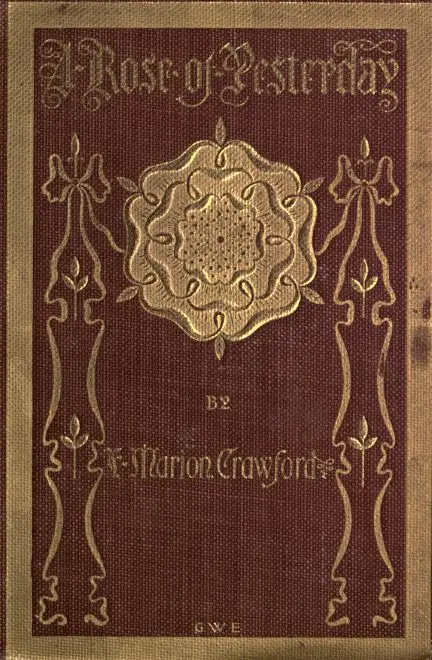
"A Rose of Yesterday" by F. Marion Crawford is a novel written in the late 19th century. The narrative unfolds around the character of Sylvia, who is navigating her feelings towards her guardian, Colonel Wimpole, amidst themes of love, loss, and social expectations. The story explores the complexities of their relationship as Sylvia, an impressionable young woman, grapples with emotions that intertwine affection with the looming specter of age and societal constraints. The opening of the novel introduces Sylvia in a personal moment with Colonel Wimpole, as they discuss an etching depicting a noble knight and the deeper meanings it may hold. Their dialogue hints at Sylvia's infatuation with the ideals of heroism and love, while Colonel Wimpole reflects on his past and the unfulfilled promises rooted in his experiences of war and honor. As the narrative develops, the emotional tension between them is palpable, with themes of unreciprocated love and the weight of societal norms coming into play, especially as Sylvia mistakes Wimpole’s fatherly affection for something more. The delicate balance between youth and age, destiny, and the longing for love sets the stage for a compelling exploration of human relationships and the challenges of defining true passion within societal confines.
Introduction adapted from the source catalogue; source summaries may be automatically generated.
Free to read · English · 52,003 words · No account needed
MAKE TIME FOR A GOOD BOOK
On by default. Untick to stop anonymous reading totals. Each page counts after 10 seconds in view. How this works.
Anonymous counting is on unless you have switched it off.
Just then the colonel turned to her, holding his glass in his hand.
"We must not forget that it is your birthday, my dear," he said, and his natural smile came back. "Rachel," he added, speaking to his sister across the young girl, "let us drink Sylvia's health on her eighteenth birthday."
Miss Wimpole usually took a little thin Moselle with the cold water she drank. She solemnly raised the glass, and inclined her head as she looked first at Sylvia and then at the colonel.
"Thank you," said Sylvia, rather meekly.
Then they all relapsed into silence. The people at the big table talked fast, in low tones, and the clattering of dishes and plates and knives and forks went on steadily and untunefully all around. Sylvia felt lonely in the unindividual atmosphere of the Swiss hotel. She hated the terribly handsome young man, with a mortal hatred, because he made the colonel look old. She could not help seeing him whenever she turned towards Wimpole. At last she spoke softly, looking down at her plate.
"Uncle Richard," she said, to call his attention.
He was not really her uncle, and she almost always called him 'colonel,' half playfully, and because she had hated the suggestion of age that is conveyed by the word 'uncle.' Wimpole turned to her quietly.
"Yes, my dear," he said. "What is it?"
"I suppose I was very foolish to-day, wasn't I?" asked Sylvia, very low indeed, and a bright blush played upon her pretty face.
The colonel was a courteous man, and was also very fond of her.
"A woman need never be wise when she is lovely," he said in his rather old-fashioned way, and he smiled affectionately at the young girl. "It is quite enough if she is good."
But she did not smile. On the contrary, her face became very grave.
"I am in earnest," she said, and she waited a moment before saying more. "I was very foolish," she continued, thoughtfully. "I did not understand--or I did not realize--I don't know. You have been so much to me all my life, and there is nobody like you, of course. It seemed to me--I mean, it seems to me--that is very much like really caring for some one, isn't it? You know what I mean. I can't express it."
"You mean that it is a good deal like love, I suppose," answered the colonel, speaking gravely now. "Yes, I suppose that love is better when people believe each other to be angels. But it is not that sort of thing which makes love what it is."
Your reading position is saved on this browser. Take it to another device with a library code. Reading pages adapt to text, rather than matching a printed edition.
F. Marion (Francis Marion) Crawford
F. Marion (Francis Marion) Crawford

F. Marion (Francis Marion) Crawford

F. Marion (Francis Marion) Crawford
BEHIND THE BOOK
This eBook is for the use of anyone anywhere in the United States and most other parts of the world at no cost and with almost no restrictions whatsoever. You may copy it, give it away or re-use it under the terms of the Project Gutenberg License included with this eBook or online at www.gutenberg.org. If you are not located in the United States, you will have to check the laws of the country where you are located before using this eBook. Read the source licence.
The original source file, including credits and licence, is retained by this library. Request an original-format copy at no charge. Please include the book title and Project Gutenberg identifier #41009.
KEEP YOUR CURIOSITY GOING
Coulson Kernahan

Maurice Baring
Frances Wright
Cécile Tormay

Frederic Jesup Stimson

W. H. P. (William Henry Pope) Jarvis