
Arthur
Eugène Sue
THE CLASSIC COLLECTION · 1898
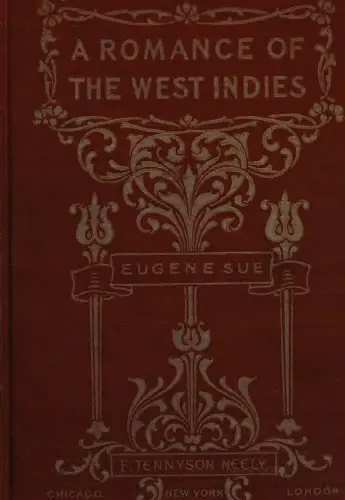
"A Romance of the West Indies" by Eugène Sue is a novel written in the late 19th century. The story begins in 1690, featuring a diverse cast of characters, including a resourceful priest named Father Griffen and a flamboyant adventurer, the Chevalier de Croustillac. The narrative sets off on an adventurous path as the characters navigate plots involving wealth, deception, and mysterious figures, such as the enigmatic Blue Beard, rumored to be a wealthy widow with a dark past. The opening of the novel introduces the protagonist, Father Griffen, who embarks on a sea journey to Martinique aboard the Unicorn, amidst growing tensions in the Caribbean. As the story unfolds, we meet the Chevalier de Croustillac, who cunningly smuggles himself onto the ship, revealing himself as a bold and ambitious man in search of fortune and adventure. Croustillac's interest in the riches of Blue Beard and the complex dynamics aboard the ship set the stage for a thrilling exploration of romance, danger, and intrigue in the West Indies.
Introduction adapted from the source catalogue; source summaries may be automatically generated.
Free to read · English · 115,012 words · No account needed
MAKE TIME FOR A GOOD BOOK
On by default. Untick to stop anonymous reading totals. Each page counts after 10 seconds in view. How this works.
Anonymous counting is on unless you have switched it off.
The chevalier, profoundly moved by the recital of Monmouth, furtively brushed aside his tears, and said, "I understand now what that animal Rutler, with his everlasting dagger, meant by speaking to me of my execution."
"Angela, Angela, my child," exclaimed the duke, lifting his noble countenance bathed in tears, and pressing the young woman to his heart, "how can you ever forgive me the murder of Sidney, my friend, my brother, your only relative, your only protector."
"Alas! have you not replaced him to me, James? I have bewailed his death, believing him killed on the field of battle. Do you believe that my regrets will be greater, now that I know that he sacrificed his life for you--that he did what I would gladly do for you, James, my lover, my husband!"
"Angela! best beloved guardian angel of my life!" cried the duke; "your words cannot assuage the violence of my remorse, but at least you know what religious gratitude I have always had for Sidney, this holy martyr to friendship. What more can I tell you? I passed two days in a state bordering on madness; when I returned to myself I found a letter of Sidney's. He had arranged that I should not receive it until the evening of the day on which he died for me. He explained his pious falsehood; he had not seen King James."
"He had not seen him!" exclaimed Angela.
"No; all that he had said to me was false. So you can understand that I had reason to forever curse the culpable facility with which I had allowed myself to be persuaded. Meanwhile he had died for me; the fable which I had believed in now seemed monstrous folly. No, he had not seen the king! From the depository of my precious stones, he had subtracted wherewith to procure a sum sufficient to gain over one of the officers of the Tower, whom he besought to allow him to see me for the last time. Was this officer in league with Sidney as to the substitution of some one who desired to save me? or was he deceived by the resemblance to such an extent that he suspected nothing. I do not know. The following day, when they went to seek Sidney, he followed the hangman, but he refused to speak for fear his voice would be recognized. The sacrifice was accomplished," said Monmouth, wiping his tears away, which had not ceased to fall during his recital. "I quitted London secretly and went to France under a false name, in order to seek you, Angela. Sidney had given me full power to take her away from the persons to whom he had confided her," said the duke, addressing Croustillac. "Struck by her beauty, her candor, and her other adorable traits, I, believing myself worthy and able to fulfill the last wishes of Sidney in making his adopted child happy, married this angel. We started for the Spanish colonies, where I believed we would be safe. We took the greatest precautions not to be recognized. By chance I encountered an English captain at Cuba whom I had seen at Amsterdam. I believed myself discovered. We left. After a journey of some months, we established ourselves here. In order to divert suspicion, to watch over my wife, and not wishing to be condemned to an imprisonment which would have been fatal to me, I assumed, by turns, the disguises which you are aware of, and I could, with impunity, traverse the island. Thanks to my precious stones, we were able to purchase a number of small vessels, through the good offices of Master Morris, a man of great probity, who knew, without being in the secret, what to think of the pretended widowhoods of my wife. Not only our commercial vessels increased little by little our fortune, which we shall bequeath to our children, but they afford us always a means of flight. The Chameleon was built for this very purpose, and I have sometimes commanded in the guise of a filibuster, and encountered a Spanish pirate, much to the fright of Angela. We were living here very happily, almost peacefully, when I learned that the Chevalier de Crussol, whose life I had once saved, had become the governor of the island. Although he was a man of honor, I feared to tell him who I was. My first idea was to quit Martinique with my wife; but I then learned of the declaration of war from France to England, Spain and Holland, and that certain rumors began to circulate in England as to the miraculous manner in which I had been saved. My partisans were bestirring themselves, it was said. I could expect no justice from William of Orange, and believed myself safer in this colony than anywhere else. I remained, therefore, in spite of the presence of De Crussol, but redoubled my precautions. The pretended widowhoods of my wife, the frequent visits of the filibuster, the Caribbean, and the buccaneer, furnished a collection of facts so incomprehensible that it was impossible to distinguish the truth, which was in our favor. We were, however, much troubled.
Your reading position is saved on this browser. Take it to another device with a library code. Reading pages adapt to text, rather than matching a printed edition.
Eugène Sue
Eugène Sue
Eugène Sue

Eugène Sue
BEHIND THE BOOK
This eBook is for the use of anyone anywhere in the United States and most other parts of the world at no cost and with almost no restrictions whatsoever. You may copy it, give it away or re-use it under the terms of the Project Gutenberg License included with this eBook or online at www.gutenberg.org. If you are not located in the United States, you will have to check the laws of the country where you are located before using this eBook. Read the source licence.
The original source file, including credits and licence, is retained by this library. Request an original-format copy at no charge. Please include the book title and Project Gutenberg identifier #29894.
KEEP YOUR CURIOSITY GOING
Cécile Tormay

Moritz Busch
Coulson Kernahan
John L. Ransom

Maurice Baring
Frances Wright