
Arthur
Eugène Sue
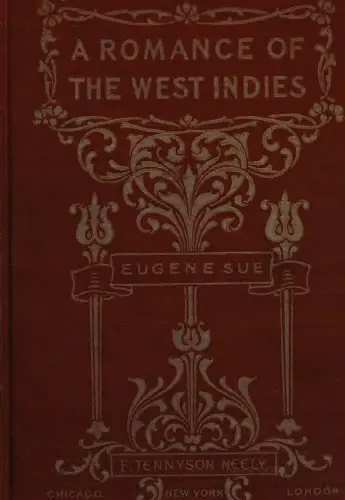
THE CLASSIC COLLECTION · 1898
"A Romance of the West Indies" by Eugène Sue is a novel written in the late 19th century. The story begins in 1690, featuring a diverse cast of characters, including a resourceful priest named Father Griffen and a flamboyant adventurer, the Chevalier de Croustillac. The narrative sets off on an adventurous path as the characters navigate plots involving wealth, deception, and mysterious figures, such as the enigmatic Blue Beard, rumored to be a wealthy widow with a dark past. The opening of the novel introduces the protagonist, Father Griffen, who embarks on a sea journey to Martinique aboard the Unicorn, amidst growing tensions in the Caribbean. As the story unfolds, we meet the Chevalier de Croustillac, who cunningly smuggles himself onto the ship, revealing himself as a bold and ambitious man in search of fortune and adventure. Croustillac's interest in the riches of Blue Beard and the complex dynamics aboard the ship set the stage for a thrilling exploration of romance, danger, and intrigue in the West Indies.
Introduction adapted from the source catalogue; source summaries may be automatically generated.
Free to read · English · 115,012 words · No account needed
MAKE TIME FOR A GOOD BOOK
On by default. Untick to stop anonymous reading totals. Each page counts after 10 seconds in view. How this works.
Anonymous counting is on unless you have switched it off.
"You desire that I explain myself, madame? Oh, that will not take long! First know that, right or wrong, I love you," cried Croustillac, in a burst of tenderness and anger.
"That is to say, that you have boasted to your fellow-travelers that you would marry the rich widow of Devil's Cliff?"
"So be it, madame; on board the Unicorn my language was impertinent, my pretensions absurd, madame; covetous, I admit. But when I spoke thus, when I thought thus, I had not seen you."
"The sight of me, sir, has not inspired you with ideas much more honorable," said Angela severely, still convinced that Croustillac wished to cruelly abuse the position in which he found himself.
"Hear me, madame; I love you truly; that is to say, that I was capable of anything to prove to you my love, absurd and stupid as it appears to you. Yes, I loved you, because my heart told me I did well to love you; because I felt myself better for loving you. You may laugh at this love; I was sufficiently repaid by the happiness it gave me. When you have said, 'Sir, I mock at you, I use you for a plaything, you are a poor devil, I have bestowed charity upon you, and you should be content therewith---- '"
"Sir!"
"When you have said all this, do not think that I was humiliated. No, that hurt me, hurt me much, but I quickly forgot this injury, when I saw that you understood that, poor as I am, I could be touched by something else than money. Then you said to me some kind words, you called me your friend--your friend! After this I would have thrown myself into the fire for you, and that for the sole pleasure of throwing myself into it, for I had nothing more to hope for from you; the time of my folly is past; I see too clearly into my heart not to recognize that I was a kind of mendicant buffoon; I can never have anything in common with a woman as beautiful and as young as you. My only ambition--and this can offend no one--would have been to devote myself to you. But how to have such happiness? I, a vagabond, with nothing but my old sword, my old hat, and my pink hose! Ah! well, by a chance which I at first blessed, Colonel Rutler to-night mistook me for him they call your husband; this mistake might be useful to you. Judge of my joy--I could save the man whom you so passionately loved. I should have preferred to save something else, but I had no time to choose. I risked all, including the everlasting dagger of the colonel. I augmented, by every means possible, his double mistake. You came to my assistance; that is, you buried me in the mud up to the neck, by means of the bagatelles with which you loaded me. It is all the same--I go with all my heart; I am satisfied to do so, and I leave this house without hope of ever seeing you again, with the gallows or prison in prospect, not to count the everlasting dagger of the Dutchman. Ah, well, in spite of all, I repeat, I was content: I said to myself, I know not what awaits me, rope or dungeon; but I am sure Blue Beard will say, 'It is fortunate, very fortunate for us at least, that this eccentric Gascon came here. Poor devil! what has happened to him?' There! that was my ambition. But I did not ask even a regret, a memory--a memory," said the Gascon, moved in spite of himself.
Your reading position is saved on this browser. Take it to another device with a library code. Reading pages adapt to text, rather than matching a printed edition.
Eugène Sue
Eugène Sue
Eugène Sue

Eugène Sue
BEHIND THE BOOK
This eBook is for the use of anyone anywhere in the United States and most other parts of the world at no cost and with almost no restrictions whatsoever. You may copy it, give it away or re-use it under the terms of the Project Gutenberg License included with this eBook or online at www.gutenberg.org. If you are not located in the United States, you will have to check the laws of the country where you are located before using this eBook. Read the source licence.
The original source file, including credits and licence, is retained by this library. Request an original-format copy at no charge. Please include the book title and Project Gutenberg identifier #29894.
KEEP YOUR CURIOSITY GOING
Cécile Tormay

Moritz Busch
Coulson Kernahan
John L. Ransom

Maurice Baring
Frances Wright