THE CLASSIC COLLECTION✦FlaxiusCLASSIC FREE BOOKS
Flaxius
Charles Godfrey Leland
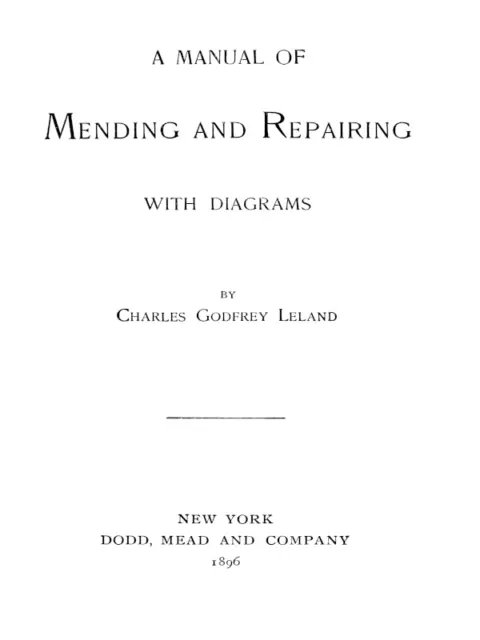
THE CLASSIC COLLECTION · 1896
"A Manual of Mending and Repairing; With Diagrams" by Charles Godfrey Leland is a practical guide on the art of repairing various household items, written in the late 19th century. The book emphasizes that mending is not merely an adjunct to other crafts but is itself an art grounded in scientific principles and chemistry. It tackles a broad range of topics related to mending, from broken china and glass to woodwork and leather, highlighting the importance of skilled repair in everyday life. The opening of the manual establishes the author's assertion that mending should be recognized as a significant craft, detailing how previous literature has inadequately addressed the subject. Leland introduces the foundational materials and methods necessary for effective mending, underscoring the importance of understanding various adhesives and cements. He also discusses the everyday breakages that occur in households and suggests that anyone willing to learn can become skilled in mending and restoring various objects, ultimately proposing that this knowledge can lead to making a practical living. Overall, the manual positions itself as a valuable resource for those interested in sustainable practices and the lost art of mending.
Introduction adapted from the source catalogue; source summaries may be automatically generated.
Free to read · English · 70,402 words · No account needed
MAKE TIME FOR A GOOD BOOK
On by default. Untick to stop anonymous reading totals. Each page counts after 10 seconds in view. How this works.
Anonymous counting is on unless you have switched it off.
These are three separate portions, No. I. being prepared by warming and filtering. The gum-ammoniac is reserved from the others, and added after they are mingled.
A STRONG BASE FOR A CEMENT FOR GLASS, as well as wood or stone, is made by gradually stirring finely sifted wood-ashes into silicate of soda, or strong acid glue, till a syrup-like substance results. In America the best ashes for this purpose are those of the hickory. Perhaps beech wood yields them equally good.
There is a DIAMOND CEMENT which is of special value to attach gems to rings or metal, to make coral or pearl or ivory adhere together, and, in short, for all fine work where a very strong adhesive is required. It is as follows:--
Sturgeon’s bladder 8
Gum-ammoniac 1
Galbanum 1
Spirits of wine 4
The sturgeon’s bladder is cut into small pieces and steeped in the spirits, and the rest, in solution, then added. It must be warmed again when used.
As this cement will bear long exposure to moisture before being at all injured by it, it can be used as a medium for painting on glass, and thereby producing effects very little inferior, either as regards beauty or durability, to glass itself. The experiment can be easily tried, as any chemist can make up the recipe. When finished, the painting can be coated with liquid silicate of soda, which will give it all the property of glass.
A LIME CEMENT FOR GLASS is made as follows:--
Calcined lime 30
Litharge 30
Linseed-oil varnish 5
JEWELLERS’ CEMENT. Extremely strong:--
Fish-glue solution 100
Mastic varnish (pure) 50
The fish-glue must first be dissolved in spirits of wine.
TO JOIN GLASS AND METAL, &c.--Stir slacked and powdered lime in hot glue. This sets as a very hard substance. It can be extensively modified and varied for many substances, and used for painting.
Gum-arabic 50
Sugar 10
Water 50
Oil of turpentine 10
The gum, sugar, and water are first carefully combined, and then the turpentine well stirred with the mixture.
Muriate of lime 2
Gum-arabic 20
Water 25
Not commended by LEHNER, as being too soluble. TO CLOSE BOTTLES:--
Powdered resin 6
Caustic soda 2
Water 10
To be thoroughly mixed and left for several hours. Before using, stir well into it eight to nine parts of calcined plaster of Paris. This will in half-an-hour take firm hold or “set,” and is waterproof. A good filler for cracks.
The reader who desires to be perfectly informed as to glass in all its relations can obtain, by application to J. BAER, Rossmarkt, Frankfort on the Main, Germany, a catalogue which is perhaps the most extensive on the subject ever published.
Your reading position is saved on this browser. Take it to another device with a library code. Reading pages adapt to text, rather than matching a printed edition.
Charles Godfrey Leland
Charles Godfrey Leland
Charles Godfrey Leland
Charles Godfrey Leland
BEHIND THE BOOK
This eBook is for the use of anyone anywhere in the United States and most other parts of the world at no cost and with almost no restrictions whatsoever. You may copy it, give it away or re-use it under the terms of the Project Gutenberg License included with this eBook or online at www.gutenberg.org. If you are not located in the United States, you will have to check the laws of the country where you are located before using this eBook. Read the source licence.
The original source file, including credits and licence, is retained by this library. Request an original-format copy at no charge. Please include the book title and Project Gutenberg identifier #61786.
KEEP YOUR CURIOSITY GOING

Charles G. (Charles Griffith) Ross
Hannah Webster Foster

Emily Lawless
Edwin Hamlin Carr

Charles De Lano Hine
Andrew Ure