THE CLASSIC COLLECTION✦FlaxiusCLASSIC FREE BOOKS
Flaxius
Charles Godfrey Leland
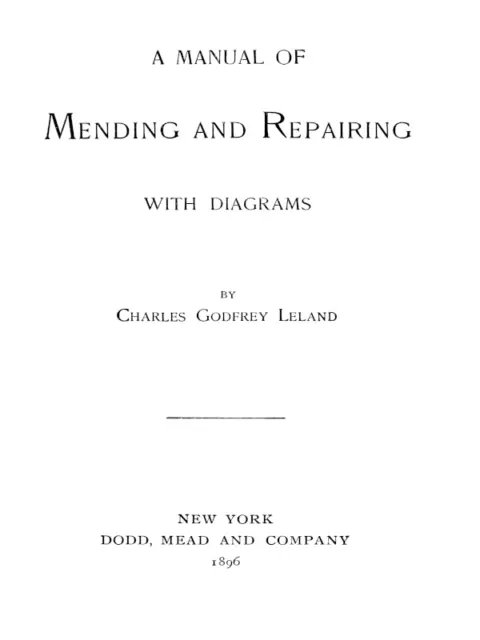
THE CLASSIC COLLECTION · 1896
"A Manual of Mending and Repairing; With Diagrams" by Charles Godfrey Leland is a practical guide on the art of repairing various household items, written in the late 19th century. The book emphasizes that mending is not merely an adjunct to other crafts but is itself an art grounded in scientific principles and chemistry. It tackles a broad range of topics related to mending, from broken china and glass to woodwork and leather, highlighting the importance of skilled repair in everyday life. The opening of the manual establishes the author's assertion that mending should be recognized as a significant craft, detailing how previous literature has inadequately addressed the subject. Leland introduces the foundational materials and methods necessary for effective mending, underscoring the importance of understanding various adhesives and cements. He also discusses the everyday breakages that occur in households and suggests that anyone willing to learn can become skilled in mending and restoring various objects, ultimately proposing that this knowledge can lead to making a practical living. Overall, the manual positions itself as a valuable resource for those interested in sustainable practices and the lost art of mending.
Introduction adapted from the source catalogue; source summaries may be automatically generated.
Free to read · English · 70,402 words · No account needed
MAKE TIME FOR A GOOD BOOK
On by default. Untick to stop anonymous reading totals. Each page counts after 10 seconds in view. How this works.
Anonymous counting is on unless you have switched it off.
CASEINE OR CHEESE.--This in several forms, but chiefly of curd in combination with several substances, but mostly with lime or borax, forms a very valuable cement. It is also combined with strong lye and silicate of soda. It must not, however, be too much depended on as a resistant to water or heat.
BLOOD, generally of oxen or cows, combined with lime, alum, and coal ashes, forms a solid and durable cement.
GLYCERINE forms the basis, with plumbago, &c., of several cements. Like oil, it renders glue flexible and partly waterproof. For chemical details on this subject, vide Das Glycerin, by J. W. Koppe, Leipzig.
GYPSUM is combined with many substances to form cements, some of them of great and peculiar value.
IRON pulverised is the basis of a great number of very durable and
strongly resistant cements.
ALUM may be included among the bases, as it is very important in several compositions, forming a powerful chemical aid. It is excellent as aiding resistance to both moisture and heat. For an exhaustive work on alum consult Die Fabrikation des Alauns, &c., by Frederic Junemann, which should be carefully studied by all who work in cements.
There is a very great number of “indifferent” or minor aids to these, such as sugar, milk, honey, spirits of wine, water, ochre, galbanum, tannin, ammonia, feldspar, plumbago, sulphur, vinegar, salt, zinc (white), umber, bismuth, tin, cadmium, clay, ashes, &c., which are essential in certain combinations.
DEXTRINE, the gum of flour or starch, or Leiokom, much resembles gum-arabic, but is more brittle. Its adhesiveness depends somewhat on the manner in which it is dissolved. “It is,” says LEHNER, “prepared by heating starch which has been moistened with nitric acid; also by warming paste with very much diluted sulphuric acid.”
WAX, including that of bees as well as paraffine, is used in repairs, and forms a part of several cements. On this subject consult Das Wachs, or “Wax and its Technical Applications,” by Ludwig Sedna; Leipzig, 2s. 6d.
Your reading position is saved on this browser. Take it to another device with a library code. Reading pages adapt to text, rather than matching a printed edition.
Charles Godfrey Leland
Charles Godfrey Leland
Charles Godfrey Leland
Charles Godfrey Leland
BEHIND THE BOOK
This eBook is for the use of anyone anywhere in the United States and most other parts of the world at no cost and with almost no restrictions whatsoever. You may copy it, give it away or re-use it under the terms of the Project Gutenberg License included with this eBook or online at www.gutenberg.org. If you are not located in the United States, you will have to check the laws of the country where you are located before using this eBook. Read the source licence.
The original source file, including credits and licence, is retained by this library. Request an original-format copy at no charge. Please include the book title and Project Gutenberg identifier #61786.
KEEP YOUR CURIOSITY GOING

Charles G. (Charles Griffith) Ross
Hannah Webster Foster

Emily Lawless
Edwin Hamlin Carr

Charles De Lano Hine
Andrew Ure