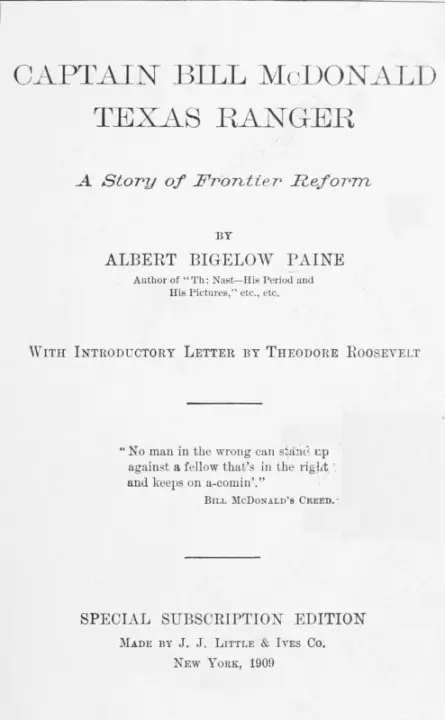
Captain Bill McDonald, Texas Ranger: A Story of Frontier Reform
Albert Bigelow Paine
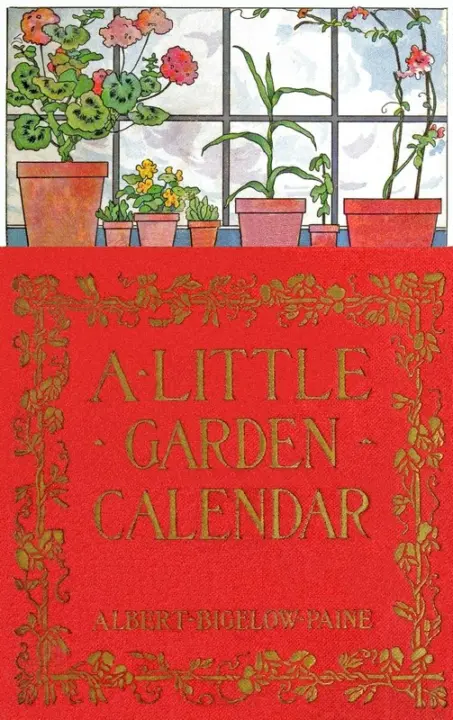
THE CLASSIC COLLECTION · 1905
"A Little Garden Calendar for Boys and Girls" by Albert Bigelow Paine is a children’s educational book written in the early 20th century. The book focuses on gardening as a delightful and engaging activity for young readers, as it narrates the experiences of a little boy named Davy and a little girl named Prue along with their Chief Gardener, who guides them in cultivating a window garden throughout the seasons. The opening of the book introduces Davy and Prue as they express their longing for warmth and the joy of a garden, despite the winter snow. The Chief Gardener encourages their passion for gardening, explaining that they can start a garden in their window, leading to their excitement over choosing seeds and planting. As they fill pots with soil, observe the seeds, and tend to their plants, the story emphasizes the connection between nature and learning, blending simple botany with playful narratives to capture young imaginations. The stage is set for a year-long journey through the garden, filled with wonder, discovery, and valuable lessons about plant life and care.
Introduction adapted from the source catalogue; source summaries may be automatically generated.
Free to read · English · 43,505 words · No account needed
MAKE TIME FOR A GOOD BOOK
On by default. Untick to stop anonymous reading totals. Each page counts after 10 seconds in view. How this works.
Anonymous counting is on unless you have switched it off.
"CLASS in botany will please rise."
Davy and Prue looked up quickly from their little corner by the peach-tree. It was a warm day, and they were resting in what they called their "house," because it was a shut-in nook behind the corn, and with tall sunflowers on the other side. Just now when the Chief Gardener came upon them they were pulling some flowers to pieces and talking about them very earnestly.
"Class in botany please rise," he said again, taking a seat himself on
a bench close by.
"But I can't--it's too warm," said little Prue, "and besides I've got
my lap full of flowers."
"Can't the class in botany sit by the teacher?" asked Davy.
The teacher moved over. Prue gathered her dress into an apron, and presently the children were perched one on each side of the Chief Gardener, who fanned himself with his straw hat, for it was a real July day.
"We've been seeing how many of the parts of a plant we knew," said Davy. "We know all the parts, I guess, but of some plants we can't tell which are which."
"Suppose you name the parts for me," said the Chief Gardener.
"Oh, let me! Let me!" began Prue. "I asked first!"
Davy looked a little disappointed, but waited.
"Very well, suppose you try, Prue."
The little maid was excited.
"Why--why, there's the c'roller and the calyx and the pistil and the
panthers, and--"
The Chief Gardener laughed in spite of himself, and Davy looked rather
shocked.
"She always calls the anthers 'panthers,'" he said, sorrowfully, "and she never will say 'corolla' right."
"And those are not the parts of a plant either," added the Chief Gardener, "but the parts of a flower. A plant is divided into three principal parts. Now, Davy, it's your turn. See if you can tell me what they are."
"Well," began Davy, "the root is one."
"The root is one, Davy; quite right. Now for the others."
"The leaves are another."
"The leaves, yes, the leaves are another."
"And the flower makes three, doesn't it? But then there's the stalk, too. That makes four. There must be four parts."
"There are a great many parts," nodded the Chief Gardener, "but there are only three principal parts--the root, the stem, and the leaf. To a botanist--one who studies plants and how they grow--the flower is only a branch of the stem, and its parts are leaves."
"I suppose that is why rose-petals are called leaves," said little Prue.
"I think it is."
"But--but don't you think a flower ought to be a principal part?"
asked Davy.
Your reading position is saved on this browser. Take it to another device with a library code. Reading pages adapt to text, rather than matching a printed edition.
Albert Bigelow Paine
Albert Bigelow Paine
Albert Bigelow Paine
Albert Bigelow Paine
BEHIND THE BOOK
This eBook is for the use of anyone anywhere in the United States and most other parts of the world at no cost and with almost no restrictions whatsoever. You may copy it, give it away or re-use it under the terms of the Project Gutenberg License included with this eBook or online at www.gutenberg.org. If you are not located in the United States, you will have to check the laws of the country where you are located before using this eBook. Read the source licence.
The original source file, including credits and licence, is retained by this library. Request an original-format copy at no charge. Please include the book title and Project Gutenberg identifier #48063.
KEEP YOUR CURIOSITY GOING

Abby Morton Diaz
Helen Hunt Jackson
Mary Frances Blaisdell
Stuart Dodgson Collingwood

Kate Douglas Smith Wiggin
Hesba Stretton