Botticelli
Henry Bryan Binns
THE CLASSIC COLLECTION · 1905
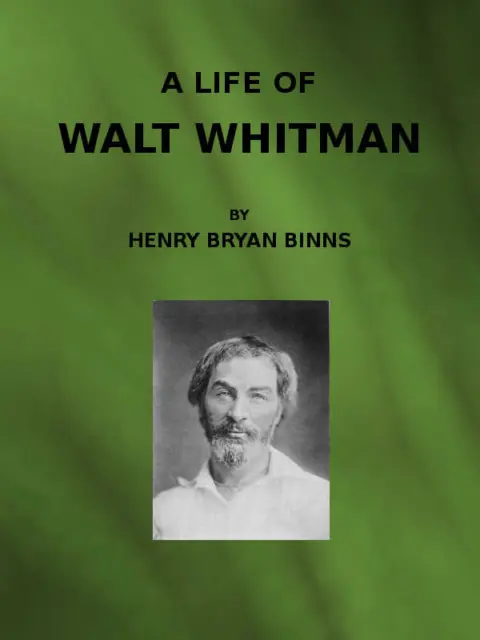
"A Life of Walt Whitman" by Henry Bryan Binns is a biographical study written in the early 20th century. This work delves into the life of the iconic American poet Walt Whitman, exploring his upbringing, his influences, and the context of his literary contributions. It seeks to provide insights into Whitman's character and the philosophy that shaped his poetry without claiming to be a definitive biography. The opening of the narrative introduces Binns's intent to create a personal interpretation of Whitman's life from an English perspective, setting the stage for a comprehensive examination of the poet's complexities. The preface outlines his consideration of Whitman's American roots and hints at the various influences—both personal and historical—on Whitman throughout his life. He acknowledges the challenge of accurately capturing Whitman's essence, arguing that a full understanding requires a grasp of the poet's relationship with his time and his country. Near the beginning, Binns expresses gratitude toward those who aided in the creation of this book and gives an overview of the sources he's drawn from, suggesting a thoughtful and well-researched approach to Whitman's life story.
Introduction adapted from the source catalogue; source summaries may be automatically generated.
Free to read · English · 149,520 words · No account needed
MAKE TIME FOR A GOOD BOOK
On by default. Untick to stop anonymous reading totals. Each page counts after 10 seconds in view. How this works.
Anonymous counting is on unless you have switched it off.
Patent Office, Washington, used as hospital, 194;
ball, 210.
Paternity, redemption of, 127, 241.
Patriotism, W.'s, aroused, 54-5.
Paumànackers, 3.
"Paumanok," nom-de-plume of W., 39.
Peabody, George, 313.
Peace, efforts towards, 185, 188;
need for heroic idea of, 206-9.
Penn, William, 5.
Pension, proposed, 316.
Personal note in L. of G., 158.
Personality, Carpenter's account of W.'s, 268, 306;
the source of power, 169;
W.'s doctrine of, 239-40;
W. retains sense of own, 74;
W.'s, influence of, 30.
Pessimism, Tolstoi's, 295-6;
Morris and Ruskin's, 296.
Pfaff's Restaurant, N.Y., 138-40.
Philadelphia, W. in, 251, 331-5.
See Camden.
Phillips, Wendell, on Lincoln, 191.
Philosophy, W.'s interest in, 60-62.
Phrenological estimate of W.'s character, 67-8.
Pierce, President, 80, 103, 135.
"Pioneers! O Pioneers!" 205.
Pittsburg, W. at, 271.
Plato, 58, 121, 126, 239, 240, 282;
and W., 224, 291-2.
Plotinus, 121.
Poe, E. A., 37, 59, 258, 320;
W. meets, 42.
Poet, W. describes his ideal, 95-7, 103, 117-8, 123-4;
need of the poet for expression, 89-90;
alone realises unity of all, 243;
W. as a, 328-9.
Poets, two orders of, 328-9.
"Poets to Come," 154.
Poetry, W.'s view of, 59-61, 109;
W. reads by the sea, 60;
changes in modern English, 289-290.
Polk, President, 40, 43.
Poor, a menace to Democracy, the very, 240, 310-1.
Pope, A., W. compared with, 151, 289.
Population of America, xxv, 176, 308.
Portraits of W. in 36th year, 66-7;
L. of G. portrait, 110;
"gentle shepherd," 218;
others, 140-1, 148, 230, 257, 331, 338.
See list of illustrations.
Pose, W.'s, 338.
Potter, Dr. J., on W., 229-30.
Prairies, W. and the, 271.
Praise, W.'s love of, 303, 335.
Prayer, W. and, 76.
"Prayer of Columbus," 253;
described, 254-5.
Pre-existence, W.'s doctrine of, 101.
Preface of 1855 used for poems, 116;
omitted, 129;
in selections, 223.
Preface to 1871 ed., 243.
Preface to 2nd Annex, 339.
Pre-Raphaelite Brotherhood, 97.
Price, Mrs. Abby, 139, 219-20.
Price, Miss, qu., 219-20.
Pride, W.'s, 156, 317.
Printer, W. as a, 19-20, 56.
Prisons of the South, 187;
W. visits prisons, 111-2.
Property, W. and private, 240;
rights of, 311.
Prosecution of W. proposed in 1856, 127;
in 1882, 284-5.
"Prostitute, To a Common," 168.
Proudhon, 309.
Publisher, W. as his own, 219, 258, 259, 285, 305.
Punishment, method of, 30.
"Pupil, To a," 169.
Puritanism, W. free from, 19.
Putnam's Monthly, 108.
Quaker traits in W., 112;
W.'s story of a, 334-5.
Quakeresses in hospitals, 195.
Quakers, 121;
on L. I., 4-5;
a crisis among American, 14, 15;
attitude to war, W. and the, 206;
doctrine of Inner Light, 16, 17;
doctrine of revelation, 55;
essential character of their faith, 18;
W.'s relation to, 75-6, 180, 206, 298-9, 301-2;
Williams family and the, 347-8.
Quebec, W. at, 276.
Radical, The (Boston), publishes Mrs. Gilchrist's letters, 225.
"Rain, The voice of the," 330.
Ramsay, A., 290.
Rand and Avery, 283.
Realisation, W.'s power of, 99.
Reality, evil necessary to, 212.
Recitations, W.'s in hospitals, 197.
Redpath, James, 198.
"Redwood Tree, Song of the," 253;
described, 255-6.
Refinement, W. disclaims, 113.
Reformer, The, 349.
Rejected passages, 286.
Religion, W.'s, 18-19, 70-8, 149, 241-4, 254, 299;
and poetry, 61;
new, 339;
importance of, for America, 238, 241.
See Mysticism.
Religious emotion in L. of G., 105-6.
Renaissance in America, xxiv.
"Renfrew, Baron," 173.
Republic, W.'s idea of, 292.
See America.
Your reading position is saved on this browser. Take it to another device with a library code. Reading pages adapt to text, rather than matching a printed edition.
Henry Bryan Binns
BEHIND THE BOOK
This eBook is for the use of anyone anywhere in the United States and most other parts of the world at no cost and with almost no restrictions whatsoever. You may copy it, give it away or re-use it under the terms of the Project Gutenberg License included with this eBook or online at www.gutenberg.org. If you are not located in the United States, you will have to check the laws of the country where you are located before using this eBook. Read the source licence.
The original source file, including credits and licence, is retained by this library. Request an original-format copy at no charge. Please include the book title and Project Gutenberg identifier #56536.
KEEP YOUR CURIOSITY GOING
John L. Ransom

Herman W. Mudgett

Harriet Monroe
Daniel Dulany Addison
Charles Lanman

Harold Rosher