Botticelli
Henry Bryan Binns
THE CLASSIC COLLECTION · 1905
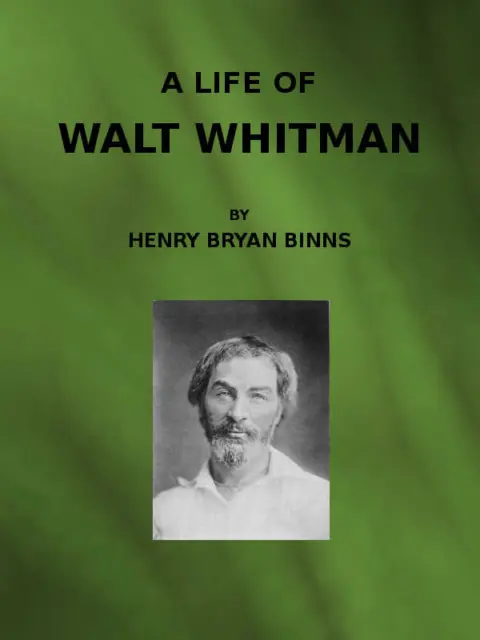
"A Life of Walt Whitman" by Henry Bryan Binns is a biographical study written in the early 20th century. This work delves into the life of the iconic American poet Walt Whitman, exploring his upbringing, his influences, and the context of his literary contributions. It seeks to provide insights into Whitman's character and the philosophy that shaped his poetry without claiming to be a definitive biography. The opening of the narrative introduces Binns's intent to create a personal interpretation of Whitman's life from an English perspective, setting the stage for a comprehensive examination of the poet's complexities. The preface outlines his consideration of Whitman's American roots and hints at the various influences—both personal and historical—on Whitman throughout his life. He acknowledges the challenge of accurately capturing Whitman's essence, arguing that a full understanding requires a grasp of the poet's relationship with his time and his country. Near the beginning, Binns expresses gratitude toward those who aided in the creation of this book and gives an overview of the sources he's drawn from, suggesting a thoughtful and well-researched approach to Whitman's life story.
Introduction adapted from the source catalogue; source summaries may be automatically generated.
Free to read · English · 149,520 words · No account needed
MAKE TIME FOR A GOOD BOOK
On by default. Untick to stop anonymous reading totals. Each page counts after 10 seconds in view. How this works.
Anonymous counting is on unless you have switched it off.
"Music always round me, That," 164-5.
Music, Mrs. Gilchrist and Carpenter's attitude towards, 267;
W. and, 85-6, 320.
Myers, F. W., 224.
Myrtle Avenue, Brooklyn, W. at, 56.
Mysticism and materialism, xxiii;
various forms of, 70, 121;
Whitman's, 69-78, 117-121, 149, 152-67, 254, 298-300;
and nature, 261-2, 339-40;
and oratory, 130-1;
and Quakerism, 180;
and sex, 226;
and war, 180-1, 207-8;
philosophy of, 166-7.
Myths, reverence for, 104.
See Great are the M.
Name, the power of the, 158.
Napoleon, 289.
"Native Moments," 161.
Natural history, W.'s ignorance of, 230, 260-2.
Nature and soul-life, 340;
W.'s love of, 260-2.
Negroes, W. doubts if they are worth cost of war, 186-7;
W. and negro citizenship, 187;
O'Connor and W. disagree about, 191;
W. and negro problem, 235-6.
New Amsterdam. See New York.
New England, W. visits, in 1868, 234.
New Orleans of '48 described, 48-50;
W. goes to, 44, 46-53, 349-50;
reminiscences of, 329.
New World, The (N.Y.), W. and, 33-7.
New York described, 11, 20-22, 80-86, 139-40;
art collections of, 279;
sympathy with South, 24, 178;
attitude towards Lincoln, 175-6;
during war, 185, 206;
W. and, xxvi-viii, 41-2, 64, 111, 245, 266, 270, 280;
W. criticises, 236;
he leaves, 183.
New York Evening Post, W. writes for, 42.
New York Herald, The, 115, 316.
New York Saturday Press, W. and the, 138-9.
New York Sun, W. writes for, 37, 127.
New York Times, 184, 209.
New York Tribune, the, 39, 40, 87, 108, 259, 285;
W.'s poems in, 46.
Newspapers, W. and, 62-3.
Niagara, W. at, 54, 274.
Nibelungenlied, 58, 337.
Nietzsche and Whitman, 213, 293, 296-8.
Nonconformity, W.'s, 99.
North, its interests antagonistic to the South, 24-5;
becomes identified with Federalism, 26;
not united, 176;
idealism of, 177;
and protection, ib.
North American Review, 108.
November Boughs, 329-30, 339.
"Now Finalé to the Shore," 243.
Nurse, W.'s, 326.
"Occupations, Song for," 101.
O'Connor, W. D., W. visits and boards with, 190, 201, 215, 225;
described, 190-1;
and Harlan, 214;
his The Carpenter, 227-9;
W.'s quarrel with, 236, 248, 250, 258;
and Messrs. Osgood, 285;
dies, 326-7, 336.
See also Good Gray Poet.
O'Connor, Mrs., 234, 248.
See also W. D. O'C.
Officials, W.'s dislike of, 306.
Old-age, W.'s view of, 330.
"Old Jim Crow," W. fond of, 303.
Omar Khayyam, 159, 318.
"On the Beach at Night alone," 120.
"Once I passed through a populous City," 51.
Open-air, cure, W. tries, 260;
W.'s love for, 199;
W. writes in the, 101.
See Nature.
"Open Road, Song of the," 116, 119-20.
Opera, W. at, 88, 178.
Optimism, W.'s, 41-2, 91, 151, 200;
false popular, 237-8.
Oratory, W.'s love for, 33;
his conception of, 129-31, 135, 143.
See also Lectures.
Oregon, dispute over boundary of, 43.
Oriental writers, W.'s interest in, 115.
Orsini, 136.
Osgood & Co., 280, 285, 301.
Ossian, 58, 289, 318.
"Our old Feuillage," 150.
"Out of the Cradle," 12, 158, 211, 281.
"Outlines for a Tomb," 313.
"Overmen," doctrine of, 297, 299.
Owen, Robert, 308-9.
Paine, Thomas, xxv, 5, 16, 25, 38.
Painting, W.'s appreciation of, 84, 279-80.
Paley, 62.
Pall Mall Gazette fund, 316.
Pan, W. compared with, 112.
Paralysis, W. begins to suffer from, 232.
See Health.
Parker, T., 143.
Parodi, 85.
Parties, W. outside political, 312.
Passage to India (booklet), 242-244;
poem, 243-4, 249, 266, 287.
Passion, W. and, 161-2, 206.
Passionate element in W., 13, 68.
Past, the, still present, 153, 256.
Your reading position is saved on this browser. Take it to another device with a library code. Reading pages adapt to text, rather than matching a printed edition.
Henry Bryan Binns
BEHIND THE BOOK
This eBook is for the use of anyone anywhere in the United States and most other parts of the world at no cost and with almost no restrictions whatsoever. You may copy it, give it away or re-use it under the terms of the Project Gutenberg License included with this eBook or online at www.gutenberg.org. If you are not located in the United States, you will have to check the laws of the country where you are located before using this eBook. Read the source licence.
The original source file, including credits and licence, is retained by this library. Request an original-format copy at no charge. Please include the book title and Project Gutenberg identifier #56536.
KEEP YOUR CURIOSITY GOING
John L. Ransom

Herman W. Mudgett

Harriet Monroe
Daniel Dulany Addison
Charles Lanman

Harold Rosher