
Botticelli
Henry Bryan Binns
THE CLASSIC COLLECTION · 1905
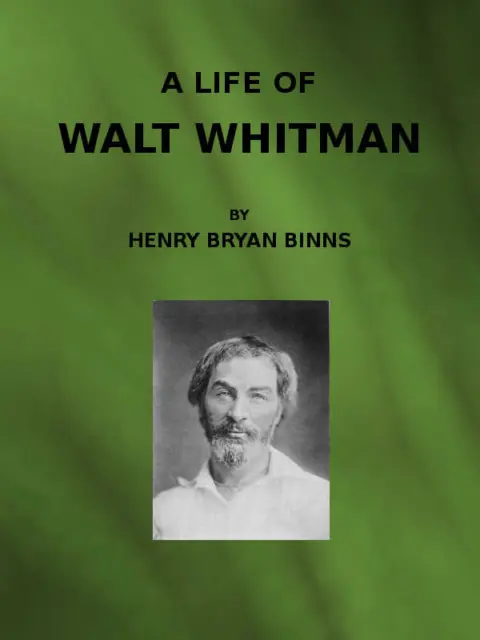
"A Life of Walt Whitman" by Henry Bryan Binns is a biographical study written in the early 20th century. This work delves into the life of the iconic American poet Walt Whitman, exploring his upbringing, his influences, and the context of his literary contributions. It seeks to provide insights into Whitman's character and the philosophy that shaped his poetry without claiming to be a definitive biography. The opening of the narrative introduces Binns's intent to create a personal interpretation of Whitman's life from an English perspective, setting the stage for a comprehensive examination of the poet's complexities. The preface outlines his consideration of Whitman's American roots and hints at the various influences—both personal and historical—on Whitman throughout his life. He acknowledges the challenge of accurately capturing Whitman's essence, arguing that a full understanding requires a grasp of the poet's relationship with his time and his country. Near the beginning, Binns expresses gratitude toward those who aided in the creation of this book and gives an overview of the sources he's drawn from, suggesting a thoughtful and well-researched approach to Whitman's life story.
Introduction adapted from the source catalogue; source summaries may be automatically generated.
Free to read · English · 149,520 words · No account needed
MAKE TIME FOR A GOOD BOOK
On by default. Untick to stop anonymous reading totals. Each page counts after 10 seconds in view. How this works.
Anonymous counting is on unless you have switched it off.
[721] I cannot omit some reference to the brilliant and interesting criticism of Whitman by Mr. George Santayana, especially that contained in his Poetry and Religion, pp. 175-87, etc., though it is somewhat outside my proper field.
Mr. Santayana, if I understand him aright, regards all mysticism as a form of spiritual loafing; he heartily discounts the more primal emotions as being "low" in the scale of evolution, and sets a correspondingly high premium upon all that is subtle and complex. Though he seeks to be just to his victim, his lack of sympathy is clearly evidenced in the cleverly rhetorical but quite unworthy passage (p. 180) wherein Whitman is described as having "wallowed in the stream of his own sensibility, as later, at Camden, in the shallows of his favourite brook". Such phrases may be funny, but I trust the preceding pages have shown that they are not true to the facts of Whitman's life. To reply to Mr. Santayana is obviously beyond my scope; and, even if I could undertake the task, it would entail upon the reader many laborious pages devoted to the study of æsthetic values. For I suspect, that, whichever of us may be right, our difference goes back to the beginning.
[722] Comp. Prose, 426, 439, 457, 474.
[723] L. of G., 488.
[724] L. of G., 433.
[725] Ib., 388.
[726] Ib., 392.
[727] Ib., 399.
[728] Ib., 403 n.
[729] Kennedy, 62; MSS. Berenson, etc.
[730] MSS. Carpenter.
[731] Camden's Compliment.
[732] Donaldson, 101.
[733] Comp. Prose, 508; Kennedy, 35.
[734] In re, 349-51; Comp. Prose, 509.
[735] MSS. Wallace.
[736] "Liberty in Literature," by R. G. I., 1891; Kennedy, 66; In re,
252.
[737] Kennedy, 38, 66.
[738] Whit. Fellowship (Bucke), Memories of W. W.
[739] Cf. Symonds, 3.
[740] "Liberty in Literature."
[741] Bucke, 188.
[742] Kennedy, 67.
[743] Johnston, 27.
[744] In re, 297, 327.
[745] MSS. Wallace.
[746] Donaldson, 91.
[747] Johnston and MSS. Wallace.
[748] MSS. Wallace; Johnston, 85; In re, 425.
[749] News-cutting, 1887.
[750] G. Gilchrist, op. cit.
[751] MSS. Wallace.
[752] Ib.
[753] MSS. Carpenter.
[754] L. of G., 408.
[755] Comp. Prose, 488; cf. L. of G., 402 (to Emp. William I.).
[756] Comp. Prose, 493, 502.
[757] Ib., 524, 525.
[758] L. of G., 414.
[759] L. of G., 422.
[760] Ib., 429.
[761] Ib., 428.
[762] G. Gilchrist, op. cit.
[763] Donaldson, 28; Kennedy, 48.
[764] In re, 413.
[765] Burroughs (a), 53.
[766] Kennedy, 56.
[767] In re, 417.
[768] Ib., 422.
[769] In re, 422 n.
[770] He died soon after Whitman.
[771] In re, 429.
[772] In re, 433, 434.
[773] M. D. Conway; Burroughs (a), 55.
[774] See supra, 230.
[775] Dr. Bucke in Whit. Fellowship.
[776] In re, 437.
[777] MSS. Berenson.
Whitman himself has described his grandmother, Naomi Williams, as belonging to the Quaker Society, but upon inquiry it does not appear that she was ever a member. She was one of seven sisters; her father, Captain John Williams, and his only son, died at sea. He had been part-owner of his vessel, a schooner in the East Indian trade, plying between New York and Florida, and in 1767 he was married at Cold Spring, where his father, Thomas Williams, also a seaman, was living at the same time.
Your reading position is saved on this browser. Take it to another device with a library code. Reading pages adapt to text, rather than matching a printed edition.
Henry Bryan Binns
BEHIND THE BOOK
This eBook is for the use of anyone anywhere in the United States and most other parts of the world at no cost and with almost no restrictions whatsoever. You may copy it, give it away or re-use it under the terms of the Project Gutenberg License included with this eBook or online at www.gutenberg.org. If you are not located in the United States, you will have to check the laws of the country where you are located before using this eBook. Read the source licence.
The original source file, including credits and licence, is retained by this library. Request an original-format copy at no charge. Please include the book title and Project Gutenberg identifier #56536.
KEEP YOUR CURIOSITY GOING
John L. Ransom

Herman W. Mudgett

Harriet Monroe
Daniel Dulany Addison
Charles Lanman

Harold Rosher