Botticelli
Henry Bryan Binns
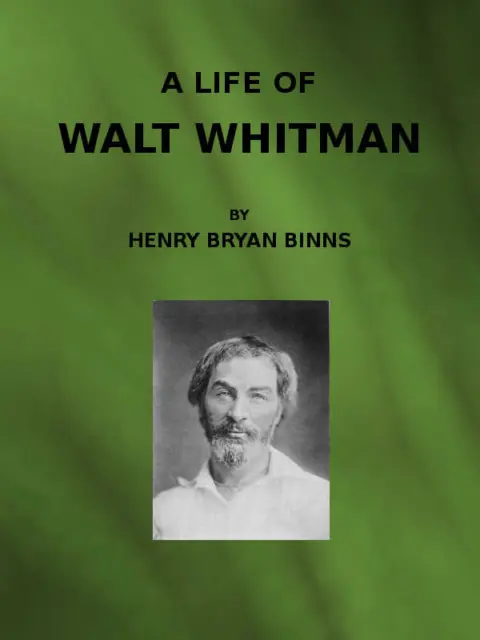
THE CLASSIC COLLECTION · 1905
"A Life of Walt Whitman" by Henry Bryan Binns is a biographical study written in the early 20th century. This work delves into the life of the iconic American poet Walt Whitman, exploring his upbringing, his influences, and the context of his literary contributions. It seeks to provide insights into Whitman's character and the philosophy that shaped his poetry without claiming to be a definitive biography. The opening of the narrative introduces Binns's intent to create a personal interpretation of Whitman's life from an English perspective, setting the stage for a comprehensive examination of the poet's complexities. The preface outlines his consideration of Whitman's American roots and hints at the various influences—both personal and historical—on Whitman throughout his life. He acknowledges the challenge of accurately capturing Whitman's essence, arguing that a full understanding requires a grasp of the poet's relationship with his time and his country. Near the beginning, Binns expresses gratitude toward those who aided in the creation of this book and gives an overview of the sources he's drawn from, suggesting a thoughtful and well-researched approach to Whitman's life story.
Introduction adapted from the source catalogue; source summaries may be automatically generated.
Free to read · English · 149,520 words · No account needed
MAKE TIME FOR A GOOD BOOK
On by default. Untick to stop anonymous reading totals. Each page counts after 10 seconds in view. How this works.
Anonymous counting is on unless you have switched it off.
But come! he would no longer waste the hours in vain reproaches. Walt, after all, understood. He had always understood, and felt the depth of love that sometimes seeks so false an expression in jealousy. Come now, he will live henceforward by the thought and in the unclouded love of his old Walt, once his and his now forever.
Of course, he had not understood Walt, not as these scholars, these writers and poets understood him. But he had been "awful near to him, nights and days". And those letters of his! Sometimes he thought that in the passion of his young plain manhood, he had come nearer, yes, nearer than any other, to that great loving soul. And for my part, I am not sure that he was mistaken.
Meanwhile, in the new cemetery, out along Haddon Avenue beyond the Dominican Convent where dwell the Sisters of the Perpetual Rosary, they had buried the remains of Walt Whitman's body. The hillside above the pool had been covered with folk; and up on the beech-spray over the tomb, the first blue-bird had sung its plaintive-sweet promise of the breaking spring.[775]
In the palm-decked white pavilion, with its open sides, the words of the old poet's Chant of Death had mingled with those of the Christ and of the Buddha, and with the half-choked sentences of living lovers and friends. "I felt as if I had been at the entombment of Christ," writes one; and another murmured, "We are at the summit".
But the last words had been spoken by Ingersoll--"I loved him living, and I love him still".[776]
"To tell you the truth," writes one who knew him intimately, "I have never had the feeling that Walt Whitman was dead. I think of him as still there, capable of writing to me at any time, and my thoughts often turn to him for his friendly sympathy."[777]
It is incredible that any being who has consciously entered upon that life of love which approves itself to the soul as God's own life, can be fundamentally affected by death. What our life is we know not, nor may we speak with any confidence of the nature of the change which we call death; but love we know, and in it, as Ingersoll rightly guessed, is the key to the riddle of mortality.
[705] Bucke, 53 n.
[706] In re, 111.
[707] Ib., 387.
[708] Ib., 119; Kennedy, 31.
[709] In re, 120; Kennedy, 32.
[710] Undated news-cutting.
[711] In re, 119; Kennedy, 58.
[712] Kennedy, 32.
[713] MSS. Carpenter.
[714] Kennedy, 63; Comp. Prose, 511 n.
[715] Johnston, 88.
[716] Cf. Calamus, 29.
[717] Songs before Sunrise, and Blake, a Critical Essay; cf.
Fortnightly, xlii., 170.
[718] Kennedy, 29; Burroughs (a), 54.
[719] MSS. Wallace.
[720] L. of G., 425.
Your reading position is saved on this browser. Take it to another device with a library code. Reading pages adapt to text, rather than matching a printed edition.
Henry Bryan Binns
BEHIND THE BOOK
This eBook is for the use of anyone anywhere in the United States and most other parts of the world at no cost and with almost no restrictions whatsoever. You may copy it, give it away or re-use it under the terms of the Project Gutenberg License included with this eBook or online at www.gutenberg.org. If you are not located in the United States, you will have to check the laws of the country where you are located before using this eBook. Read the source licence.
The original source file, including credits and licence, is retained by this library. Request an original-format copy at no charge. Please include the book title and Project Gutenberg identifier #56536.
KEEP YOUR CURIOSITY GOING
John L. Ransom

Herman W. Mudgett

Harriet Monroe
Daniel Dulany Addison
Charles Lanman

Harold Rosher