Botticelli
Henry Bryan Binns
THE CLASSIC COLLECTION · 1905
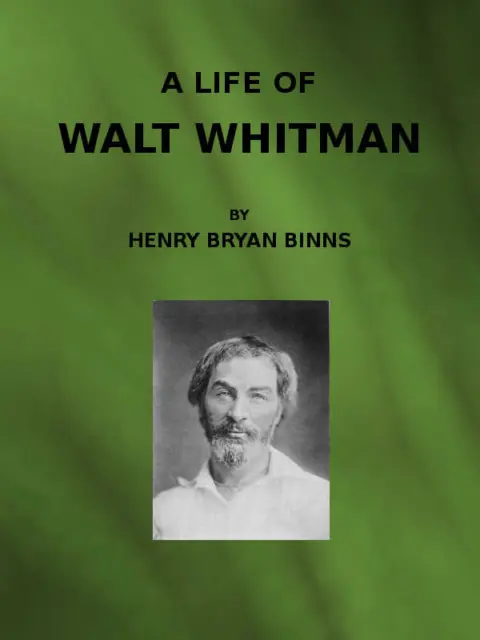
"A Life of Walt Whitman" by Henry Bryan Binns is a biographical study written in the early 20th century. This work delves into the life of the iconic American poet Walt Whitman, exploring his upbringing, his influences, and the context of his literary contributions. It seeks to provide insights into Whitman's character and the philosophy that shaped his poetry without claiming to be a definitive biography. The opening of the narrative introduces Binns's intent to create a personal interpretation of Whitman's life from an English perspective, setting the stage for a comprehensive examination of the poet's complexities. The preface outlines his consideration of Whitman's American roots and hints at the various influences—both personal and historical—on Whitman throughout his life. He acknowledges the challenge of accurately capturing Whitman's essence, arguing that a full understanding requires a grasp of the poet's relationship with his time and his country. Near the beginning, Binns expresses gratitude toward those who aided in the creation of this book and gives an overview of the sources he's drawn from, suggesting a thoughtful and well-researched approach to Whitman's life story.
Introduction adapted from the source catalogue; source summaries may be automatically generated.
Free to read · English · 149,520 words · No account needed
MAKE TIME FOR A GOOD BOOK
On by default. Untick to stop anonymous reading totals. Each page counts after 10 seconds in view. How this works.
Anonymous counting is on unless you have switched it off.
[489] Calamus, 53-55.
[490] Calamus, 18.
[491] Camden, viii., 169-243.
[492] Wound-Dresser, 90.
[493] Calamus, 48.
[494] Ib., 62.
[495] Calamus.
[496] Camden, viii., 235.
[497] In re, 74.
[498] Comp. Prose, 208, 209 n.
[499] Wister's Grant, 130.
[500] L. of G., 359.
[501] Camden, viii., 226 (May, 1868).
[502] Comp. Prose, 197-251
[503] Comp. Prose, 246, 247.
[504] Ib., 200.
[505] In a most characteristic passage, which may be quoted as a specimen of the style of this book, he writes of "the need of powerful native philosophers and orators and bards ... as rallying-points to come in times of danger.... For history is long, long, long. Shift and turn the combinations of the statement as we may, the problem of the future of America is in certain respects as dark as it is vast. Pride, competition, segregation, vicious wilfulness, and license beyond example, brood already upon us.... Flaunt it as we choose, athwart and over the roads of our progress, loom huge uncertainty, and dreadful, threatening gloom. It is useless to deny it. Democracy grows rankly up the thickest, noxious, deadliest plants and fruits of all--brings worse and worse invaders--needs newer, larger, stronger, keener compensations and compellers. Our lands embracing so much (embracing indeed the whole, rejecting none), hold in their breast that flame also [which is] capable of consuming themselves, consuming us all.... We sail a dangerous sea of seething currents, cross and under-currents, vortices--all so dark, untried--and whither shall we turn? It seems as though the Almighty had spread before this nation charts of imperial destinies, dazzling as the sun, yet with many a deep intestine difficulty and human aggregate of cankerous imperfection--saying, lo! the roads, the only plans of development, long and varied with all terrible balks and ebullitions.... Behold the cost, and already specimens of the cost. Thought you, greatness was to ripen for you like a pear? If you would have greatness, know that you must conquer it through ages, centuries--must pay for it with a proportionate price. Yet I have dreamed, merged in that hidden-tangled problem of our fate, whose long unravelling stretches mysteriously through time ... a little or a larger band--a band of brave and true, unprecedented yet--armed and equipped at every point--the members separated, it may be, by different dates and States ... but always one, compact in soul, conscience-serving, God-inculcating, inspired achievers, not only in literature the greatest art, but in all art--a new, undying order, dynasty, from age to age transmitted--a band, a class, at least as fit to cope with current years, our dangers, needs, as those who, for their times, so long, so well, in armour or in cowl, upheld and made illustrious that far back, feudal, priestly world."--Comp. Prose, 246-48; cf. also 202.
[506] Comp. Prose, 221; 207 n.
[507] Comp. Prose, 212.
[508] Ib., 215.
[509] Ib., 211.
[510] Ib., 206.
[511] Comp. Prose, 225.
[512] Ib., 226.
[513] Ib., 227.
[514] Ib., 240, 241.
[515] Comp. Prose, 244.
[516] Ib., 250.
[517] Comp. Prose, 273 n.
[518] L. of G., 315.
[519] Ib., 321, 76.
Your reading position is saved on this browser. Take it to another device with a library code. Reading pages adapt to text, rather than matching a printed edition.
Henry Bryan Binns
BEHIND THE BOOK
This eBook is for the use of anyone anywhere in the United States and most other parts of the world at no cost and with almost no restrictions whatsoever. You may copy it, give it away or re-use it under the terms of the Project Gutenberg License included with this eBook or online at www.gutenberg.org. If you are not located in the United States, you will have to check the laws of the country where you are located before using this eBook. Read the source licence.
The original source file, including credits and licence, is retained by this library. Request an original-format copy at no charge. Please include the book title and Project Gutenberg identifier #56536.
KEEP YOUR CURIOSITY GOING
John L. Ransom

Herman W. Mudgett

Harriet Monroe
Daniel Dulany Addison
Charles Lanman

Harold Rosher