
Botticelli
Henry Bryan Binns
THE CLASSIC COLLECTION · 1905
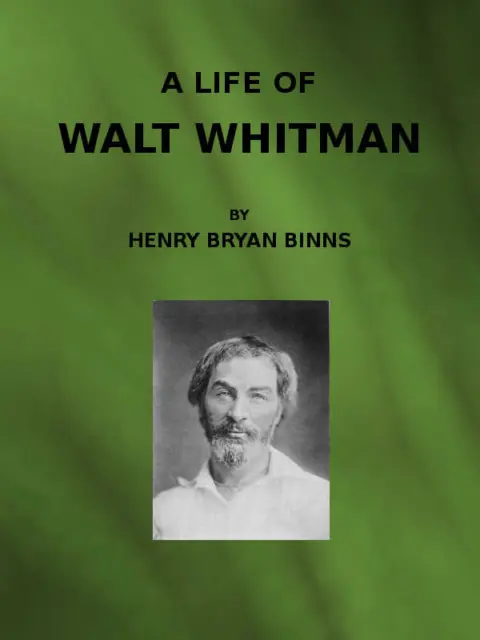
"A Life of Walt Whitman" by Henry Bryan Binns is a biographical study written in the early 20th century. This work delves into the life of the iconic American poet Walt Whitman, exploring his upbringing, his influences, and the context of his literary contributions. It seeks to provide insights into Whitman's character and the philosophy that shaped his poetry without claiming to be a definitive biography. The opening of the narrative introduces Binns's intent to create a personal interpretation of Whitman's life from an English perspective, setting the stage for a comprehensive examination of the poet's complexities. The preface outlines his consideration of Whitman's American roots and hints at the various influences—both personal and historical—on Whitman throughout his life. He acknowledges the challenge of accurately capturing Whitman's essence, arguing that a full understanding requires a grasp of the poet's relationship with his time and his country. Near the beginning, Binns expresses gratitude toward those who aided in the creation of this book and gives an overview of the sources he's drawn from, suggesting a thoughtful and well-researched approach to Whitman's life story.
Introduction adapted from the source catalogue; source summaries may be automatically generated.
Free to read · English · 149,520 words · No account needed
MAKE TIME FOR A GOOD BOOK
On by default. Untick to stop anonymous reading totals. Each page counts after 10 seconds in view. How this works.
Anonymous counting is on unless you have switched it off.
Later the same autumn, old Mrs. Whitman left Brooklyn to live with her son, the colonel, in Camden; a quiet unattractive artisan suburb of Philadelphia. The old lady, now nearly eighty, partially crippled by rheumatism, and a widow for some eighteen years, did not long survive this transplanting. But sorrows came thick upon the Whitmans at this time. And first of all, it was Walt himself who broke down and was house-tied.
[458] Camden, viii., 218.
[459] Notes on Walt Whitman as Poet and Person, 1867.
[460] Poems of W. W., 1868.
[461] See also Preface to Poems of W. W., and Rossetti Papers, 240.
[462] Rossetti Papers, 270, 287, etc.
[463] Symonds, 4; J. A. Symonds, a Biography, by H. R. F. Brown.
[464] Symonds, 158.
[465] Supra, 133 n.
[466] J. A. Symonds, ii., 70; Camden's Compliment, 73.
[467] J. A. Symonds, ii., 15.
[468] Ib., ii., 82.
[469] Ib., ii., 130, 131.
[470] Symonds in Fortnightly Rev., xlii., 459; A. C. S. in ib., 170.
[471] Anne Gilchrist, Her Life and Writings, by H. H. G., 1887; and
In re, 41, 42.
[472] Rossetti Papers, 459, 460.
[473] Bucke, 31.
[474] In re, 72.
[475] Fort. Rev., loc. cit.
[476] In re, 42.
[477] See infra, 264.
[478] In Putnam's Magazine, Jan., 1868.
[479] See supra, 167.
[480] In the Good Gray Poet.
[481] Burroughs, 85.
[482] Potter, op. cit.
[483] See infra, 262.
[484] O'Connor, qu. in Bucke, 62.
[485] Calamus, 21.
[486] MSS. Wallace.
[487] Calamus, 23, gives 1866; but Comp. Prose, 70, throws date back:
see also supra, 210.
[488] Although it has been previously quoted, the following passage from Mr. Burroughs' Birds and Poets gives so graphic a description of Whitman at this time, that I cannot forbear to quote it:--
"I give here a glimpse of him in Washington, on a Pennsylvania Avenue and Navy Yard horse-car, toward the close of the war, one summer day at sundown. The car is crowded and suffocatingly hot, with many passengers on the rear platform, and among them a bearded, florid-faced man, elderly but agile, resting against the dash, by the side of the young conductor, and evidently his intimate friend. The man wears a broad-brim white hat. Among the jam inside near the door, a young Englishwoman, of the working class, with two children, has had trouble all the way with the youngest, a strong, fat, fretful, bright babe of fourteen or fifteen months, who bids fair to worry the mother completely out, besides becoming a howling nuisance to everybody. As the car tugs around Capitol Hill, the young one is more demoniac than ever, and the flushed and perspiring mother is just ready to burst into tears with weariness and vexation. The car stops at the top of the hill to let off most of the rear platform passengers, and the white-hatted man reaches inside, and gently but firmly disengaging the babe from its stifling place in the mother's arms, takes it in his own, and out in the air. The astonished and excited child, partly in fear, partly in satisfaction at the change, stops its screaming, and as the man adjusts it more securely to his breast, plants its chubby hands against him, and pushing off as far as it can, gives a good look squarely in his face; then, as if satisfied, snuggles down with its head on his neck, and in less than a minute, is sound and peacefully asleep without another whimper, utterly fagged out."
Your reading position is saved on this browser. Take it to another device with a library code. Reading pages adapt to text, rather than matching a printed edition.
Henry Bryan Binns
BEHIND THE BOOK
This eBook is for the use of anyone anywhere in the United States and most other parts of the world at no cost and with almost no restrictions whatsoever. You may copy it, give it away or re-use it under the terms of the Project Gutenberg License included with this eBook or online at www.gutenberg.org. If you are not located in the United States, you will have to check the laws of the country where you are located before using this eBook. Read the source licence.
The original source file, including credits and licence, is retained by this library. Request an original-format copy at no charge. Please include the book title and Project Gutenberg identifier #56536.
KEEP YOUR CURIOSITY GOING
John L. Ransom

Herman W. Mudgett

Harriet Monroe
Daniel Dulany Addison
Charles Lanman

Harold Rosher