
Last letters from the living dead man
David Patterson (Spirit) Hatch
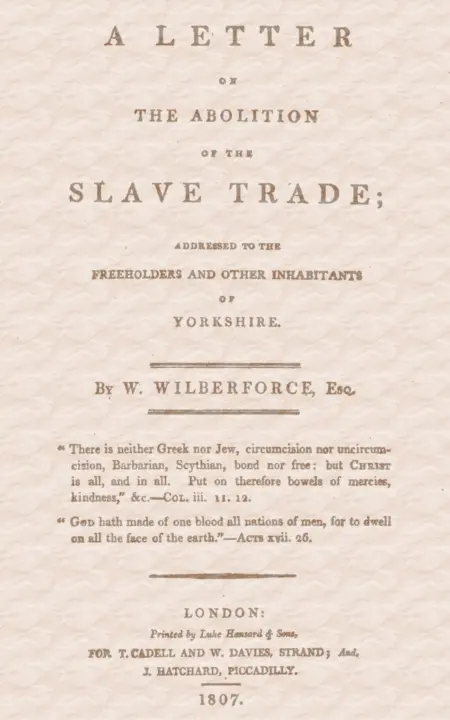
THE CLASSIC COLLECTION · 1807
"A Letter on the Abolition of the Slave Trade" by William Wilberforce is a historical account written in the early 19th century. The work serves as a passionate appeal to the freeholders and inhabitants of Yorkshire, urging them to acknowledge the moral imperative to abolish the slave trade. It predominantly discusses the atrocities and injustices of the slave trade system, aiming to incite action against this brutal practice. The opening portion of the text introduces Wilberforce's enduring quest to advocate for the abolition of the slave trade, a cause he has championed for over fourteen years in Parliament. He reflects on both the moral obligation of his constituents and the historical context of the ongoing discussions surrounding slavery. By expressing his concerns about the fading public awareness of the issue and the recent revival of misconceptions and arguments against abolition, Wilberforce lays the groundwork for a detailed examination of the brutal realities of the slave trade—especially its impacts on Africa—promising to present the facts and arguments that underpin the abolitionist cause. He emphasizes the deep moral responsibility shared by the British public, and the urgent need for collective action to eradicate this "foulest blot" on humanity.
Introduction adapted from the source catalogue; source summaries may be automatically generated.
Free to read · English · 89,339 words · No account needed
MAKE TIME FOR A GOOD BOOK
On by default. Untick to stop anonymous reading totals. Each page counts after 10 seconds in view. How this works.
Anonymous counting is on unless you have switched it off.
“Most of the poor inhabitants of the different towns and villages, being surprized in the night, fell an easy prey.
“Daisy had sent a number of people to plant corn, &c. &c. to supply his army; all these fell into the hands of Sambo Sego; they were afterwards sent in caravans to be sold to the French, on the Senegal.”—(p. 109.)
African Population.
[Sidenote: Winterbottom.]
Winterbottom’s Travels in Africa.—The towns on the seacoast are in general small, and seldom consist of more than forty or fifty houses; but as we advance inland, they become more populous.—(p. 81.)
The villages near the sea coast not only consist of fewer houses than those more inland, but they also shew less neatness and ingenuity in their construction.—(p. 83.)
Teembo, the capital of the Foola kingdom, is computed to contain about 8,000 inhabitants; Laby, the second in size, has about 5,000; and several of those which I have visited in the Soosoo and Mandingo countries, contain from 1 to 2 or 3,000 inhabitants.—(p. 87.)
Domestic Slaves State in Africa.—Travels of Moore, a Factor of African
Company.
[Sidenote: Astley’s Voyages.]
They seldom sell their family Slaves, except for great crimes.—(vol.
iii. p. 242)
Some of them have a good many house Slaves, in which they place a great pride; and these Slaves live so well and easy, that it is hard to know them from their Owners, being often better cloathed; especially the females, who have sometimes coral, amber, and silver necklaces and ornaments to the value of £. 20. or £. 30. sterling.
The author never heard of but one that ever sold a family Slave, except for such crimes as they would have been sold for if they had been free. If one of the family Slaves (where there are many) commits a crime, and the Master sells him for it without the consent of the rest, they will all run away, and be protected in the next kingdom.—(p. 267)
[Sidenote: Winter-]
Winterbottom’s Travels.—Their domestics are in general treated by them with great humanity, and it is not uncommon to see the heir-apparent of a head man sitting down to eat with the meanest of his father’s people, and in no wise distinguished from them by his dress.—(p. 127.)
Captain Wilson, 1783.—The Slaves employed by the Africans live with their Masters, and are so treated as scarcely to be distinguishable from them.
Isaac Parker, 1764.—Dick Ebro’ had many Slaves of his own, whom he employed in cutting wood and fishing, &c. but he treated them always very well.
James Morley, 1760 and 1776.—They treat their Slaves with the greatest kindness, more so than our servants and Slaves in the West Indies.
Your reading position is saved on this browser. Take it to another device with a library code. Reading pages adapt to text, rather than matching a printed edition.
BEHIND THE BOOK
This eBook is for the use of anyone anywhere in the United States and most other parts of the world at no cost and with almost no restrictions whatsoever. You may copy it, give it away or re-use it under the terms of the Project Gutenberg License included with this eBook or online at www.gutenberg.org. If you are not located in the United States, you will have to check the laws of the country where you are located before using this eBook. Read the source licence.
The original source file, including credits and licence, is retained by this library. Request an original-format copy at no charge. Please include the book title and Project Gutenberg identifier #63974.
KEEP YOUR CURIOSITY GOING
David Patterson (Spirit) Hatch

David Patterson (Spirit) Hatch

David Patterson (Spirit) Hatch
Cécile Tormay

Moritz Busch
John L. Ransom