
Last letters from the living dead man
David Patterson (Spirit) Hatch
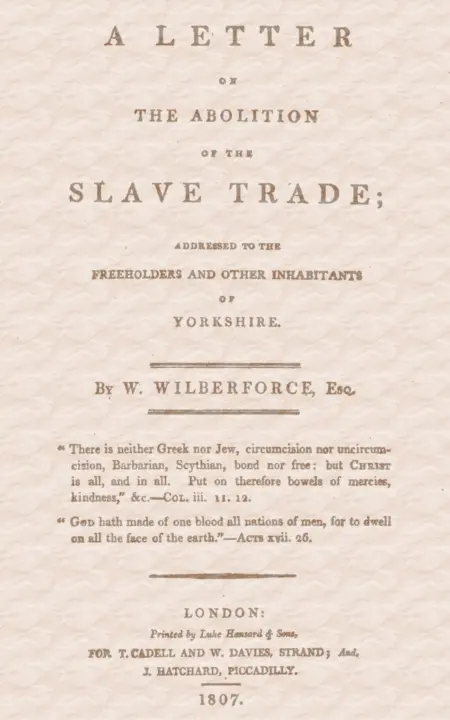
THE CLASSIC COLLECTION · 1807
"A Letter on the Abolition of the Slave Trade" by William Wilberforce is a historical account written in the early 19th century. The work serves as a passionate appeal to the freeholders and inhabitants of Yorkshire, urging them to acknowledge the moral imperative to abolish the slave trade. It predominantly discusses the atrocities and injustices of the slave trade system, aiming to incite action against this brutal practice. The opening portion of the text introduces Wilberforce's enduring quest to advocate for the abolition of the slave trade, a cause he has championed for over fourteen years in Parliament. He reflects on both the moral obligation of his constituents and the historical context of the ongoing discussions surrounding slavery. By expressing his concerns about the fading public awareness of the issue and the recent revival of misconceptions and arguments against abolition, Wilberforce lays the groundwork for a detailed examination of the brutal realities of the slave trade—especially its impacts on Africa—promising to present the facts and arguments that underpin the abolitionist cause. He emphasizes the deep moral responsibility shared by the British public, and the urgent need for collective action to eradicate this "foulest blot" on humanity.
Introduction adapted from the source catalogue; source summaries may be automatically generated.
Free to read · English · 89,339 words · No account needed
MAKE TIME FOR A GOOD BOOK
On by default. Untick to stop anonymous reading totals. Each page counts after 10 seconds in view. How this works.
Anonymous counting is on unless you have switched it off.
[66] Lieutenant Simpson, of the Royal Marines, considered two crimes as almost made on purpose to procure Slaves. These were, adultery, and the removal of Fetiches, (or of charms founded on a notion of witchcraft). As to adultery, he was warned against connecting himself with any woman not pointed out to him, for that the kings kept several, who were sent out to allure the unwary; and that, if found to be connected with these, he would be seized, and made to pay the price of a man Slave. As to fetiches, consisting of pieces of wood, old pitchers, kettles, &c. laid in the path-ways, he was warned to avoid displacing them, for if he should, the natives, who were on the watch, would seize him, and, as before, exact the price of a man Slave. These baits were laid equally for the natives, as the Europeans; but the former were better acquainted with the law, and consequently more circumspect.
James Morley, 1760 and 1776.—On pretence of adultery, he remembers a woman sold. He learnt that this was only a pretence, from her own mouth, for she spake good English, and from the respect with which her husband, king Ephraim, treated her, when he came on board; whereas, in real cases of adultery, they are very desperate.
Sir George Young, 1767, 1768, 1771, 1772.—Has always heard, that the sovereign or chief of a district generally derives a certain profit from the sale of Slaves.
[Sidenote: House of Commons Evidence.]
Henry Hew Dalrymple, Esq. 1779.—All crimes, in the parts of Africa he was in, were punished with slavery.
James Towne, 1760, 1767.—He has repeatedly heard, both from the accused and accusers themselves, and he believes it common on the coast, to impute crimes falsely for the sake of having the accused person sold.
Mode of Warfare, &c.
[Sidenote: Parke.]
The Moors purchase the fire-arms and ammunition from the Europeans in exchange for Negro Slaves, whom they obtain in their predatory excursions.—Parke’s Travels.
“Some neighbouring and rebel Negroes plundered a large village belonging to Daisy (the king), and carried off a number of prisoners.”—(p. 110.)
“They accordingly fell upon two of Daisy’s (the king’s) towns, and carried off the whole of the inhabitants.”—(p. 169.)
“I passed, in the course of this day, the ruins of three towns; the inhabitants of which were all carried away by Daisy, king of Kaarta, on the same day that he took and plundered Yamina.”—(p. 230.)
“Mansang separated the remainder of his army into small detachments, ordered them to over-run the country, and seize on the inhabitants before they had time to escape.
Your reading position is saved on this browser. Take it to another device with a library code. Reading pages adapt to text, rather than matching a printed edition.
BEHIND THE BOOK
This eBook is for the use of anyone anywhere in the United States and most other parts of the world at no cost and with almost no restrictions whatsoever. You may copy it, give it away or re-use it under the terms of the Project Gutenberg License included with this eBook or online at www.gutenberg.org. If you are not located in the United States, you will have to check the laws of the country where you are located before using this eBook. Read the source licence.
The original source file, including credits and licence, is retained by this library. Request an original-format copy at no charge. Please include the book title and Project Gutenberg identifier #63974.
KEEP YOUR CURIOSITY GOING
David Patterson (Spirit) Hatch

David Patterson (Spirit) Hatch

David Patterson (Spirit) Hatch
Cécile Tormay

Moritz Busch
John L. Ransom