
Last letters from the living dead man
David Patterson (Spirit) Hatch
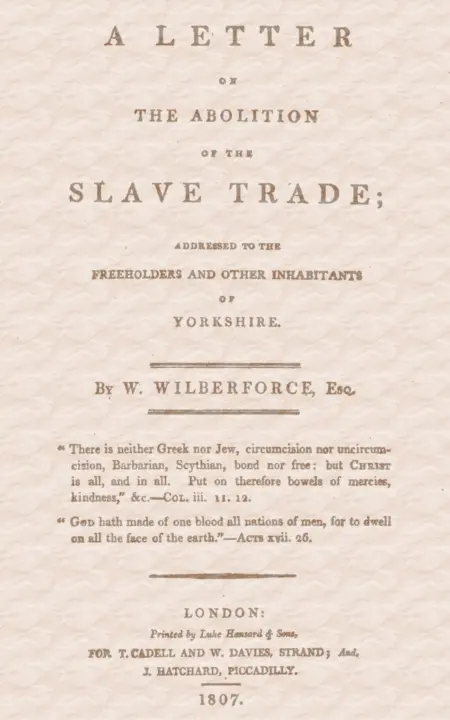
THE CLASSIC COLLECTION · 1807
"A Letter on the Abolition of the Slave Trade" by William Wilberforce is a historical account written in the early 19th century. The work serves as a passionate appeal to the freeholders and inhabitants of Yorkshire, urging them to acknowledge the moral imperative to abolish the slave trade. It predominantly discusses the atrocities and injustices of the slave trade system, aiming to incite action against this brutal practice. The opening portion of the text introduces Wilberforce's enduring quest to advocate for the abolition of the slave trade, a cause he has championed for over fourteen years in Parliament. He reflects on both the moral obligation of his constituents and the historical context of the ongoing discussions surrounding slavery. By expressing his concerns about the fading public awareness of the issue and the recent revival of misconceptions and arguments against abolition, Wilberforce lays the groundwork for a detailed examination of the brutal realities of the slave trade—especially its impacts on Africa—promising to present the facts and arguments that underpin the abolitionist cause. He emphasizes the deep moral responsibility shared by the British public, and the urgent need for collective action to eradicate this "foulest blot" on humanity.
Introduction adapted from the source catalogue; source summaries may be automatically generated.
Free to read · English · 89,339 words · No account needed
MAKE TIME FOR A GOOD BOOK
On by default. Untick to stop anonymous reading totals. Each page counts after 10 seconds in view. How this works.
Anonymous counting is on unless you have switched it off.
Page 141. Ali Sonko had governed the kingdom of Barra for seven years, with all the ability, wisdom, and prudence, of an enlightened European; his physiognomy was regular and agreeable, and there was seen in him that wisdom and experience which generally distinguish the Manding nation. His estimable character was replete with benevolence and energy; all his actions were regulated by wisdom, and every trait in this prince announced him to be a man of a superior kind.
Page 146. Mandings are very active, intelligent, and cunning, in commercial affairs; notwithstanding which, their general character is very hospitable, sociable, and benevolent; their women are also very lively, spirited, good, and agreeable.
Page 306. The Negroes have both taste and ingenuity.
Page 309. The women are always kind; attentive, and complaisant.
Page 313. The Negro race is perhaps the most prolific of all the human species that exist on our globe. Their infancy and youth are singularly happy; the mothers are passionately fond of their children.
Page 314. It ought to be understood, that in the general situation of the Negroes, on their native soil, their life passes without labour, chagrin, or even care.
Page 315. The passing almost the whole of the human life in a nearly equal and permanent state of health, is owing to the moderation the Negroes in general observe in their habits, regimen, and pleasures.
Page 326. These Negroes, whom we call Savages, respect the ashes of their relations, friends, and chiefs.
Page 336. It cannot be denied that the Negroes are extremely clever.
Page 346. Among the Negroes are to be found virtuous and sensible men, who, as well as those of the best education and information in Europe, are susceptible of attachment, respect, delicate conduct, and a noble generosity.
Page 348. These examples of delicacy and friendship are not by any means
rare in Africa.
Page 382. Hospitality is in Africa a general virtue, and misers are
unknown in the country.
Page 412. All that I have said of the Negroes tends to prove that they are in general good men, naturally gentle and benevolent.
Page 413. The Moors are perfidious, cruel, capable of all crimes, and are addicted to every vice; but the Negroes have many naturally good qualities, and their general character does honour to human nature.
The picture I have given of the situation of the Blacks, and of the peaceable, careless, and simple life of these favourites of Nature, is by no means exaggerated.
State of Slaves on Shipboard.
They often disagree in the night about their sleeping-places; the men linked together often fight, when one wants perhaps to obey the calls of nature, and the other is unwilling to go with him.
Your reading position is saved on this browser. Take it to another device with a library code. Reading pages adapt to text, rather than matching a printed edition.
BEHIND THE BOOK
This eBook is for the use of anyone anywhere in the United States and most other parts of the world at no cost and with almost no restrictions whatsoever. You may copy it, give it away or re-use it under the terms of the Project Gutenberg License included with this eBook or online at www.gutenberg.org. If you are not located in the United States, you will have to check the laws of the country where you are located before using this eBook. Read the source licence.
The original source file, including credits and licence, is retained by this library. Request an original-format copy at no charge. Please include the book title and Project Gutenberg identifier #63974.
KEEP YOUR CURIOSITY GOING
David Patterson (Spirit) Hatch

David Patterson (Spirit) Hatch

David Patterson (Spirit) Hatch
Cécile Tormay

Moritz Busch
John L. Ransom