
Last letters from the living dead man
David Patterson (Spirit) Hatch
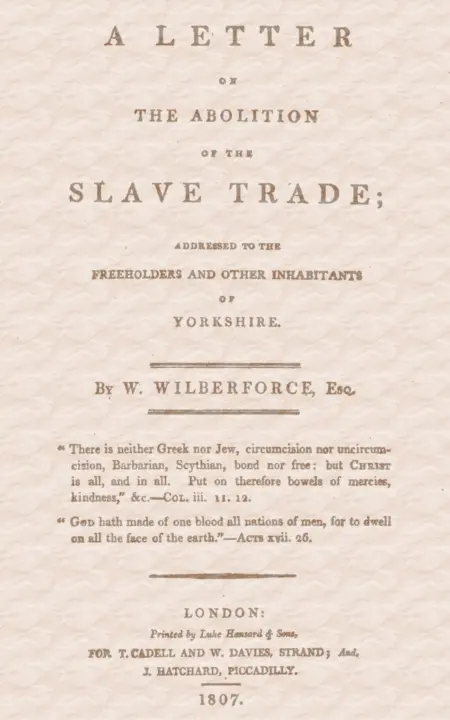
THE CLASSIC COLLECTION · 1807
"A Letter on the Abolition of the Slave Trade" by William Wilberforce is a historical account written in the early 19th century. The work serves as a passionate appeal to the freeholders and inhabitants of Yorkshire, urging them to acknowledge the moral imperative to abolish the slave trade. It predominantly discusses the atrocities and injustices of the slave trade system, aiming to incite action against this brutal practice. The opening portion of the text introduces Wilberforce's enduring quest to advocate for the abolition of the slave trade, a cause he has championed for over fourteen years in Parliament. He reflects on both the moral obligation of his constituents and the historical context of the ongoing discussions surrounding slavery. By expressing his concerns about the fading public awareness of the issue and the recent revival of misconceptions and arguments against abolition, Wilberforce lays the groundwork for a detailed examination of the brutal realities of the slave trade—especially its impacts on Africa—promising to present the facts and arguments that underpin the abolitionist cause. He emphasizes the deep moral responsibility shared by the British public, and the urgent need for collective action to eradicate this "foulest blot" on humanity.
Introduction adapted from the source catalogue; source summaries may be automatically generated.
Free to read · English · 89,339 words · No account needed
MAKE TIME FOR A GOOD BOOK
On by default. Untick to stop anonymous reading totals. Each page counts after 10 seconds in view. How this works.
Anonymous counting is on unless you have switched it off.
Cinnamon plants at St. Thomas, at the sea-side, about twenty feet high; from what he heard, grew inland to a higher size; those on the sea-side he considered only as shrubs. He saw a number of them, and, from the appearance of the bark brought down, concludes there must be a great quantity inland.
Henry Hew Dalrymple, Esq.; in Africa about 1779.—They manufacture cotton cloths, almost equal in the workmanship to those of Europe; they work in gold, silver, and iron remarkably neat, also in wood, and make saddles, bow-cases, scabbards, [Sidenote: Golberey.] grisgris, and other things of leather, with great neatness.
Richard Storey; in Africa, about 1766 to 1770.—He looks upon the natives of the Windward coast to be in general a hospitable, friendly people, always willing to sell what they have, and also to give the best provisions the country affords. The men in general are very active and industrious, and chiefly employed in fishing, and trade with the Europeans; the women chiefly in cultivating rice and other vegetables.
Has every reason to believe, that if there was nobody to purchase Slaves, they would turn themselves to cultivate their ground, and raise rice, &c. to purchase European goods. The quality of African rice is far superior to that of Carolina, bearing one-fourth more water.
Mr. James Kiernan; in Africa from 1775 to 1780; knows the Negroes manufacture cotton, leather, and metals, for they supply Senegal with cloathing, articles of leather, and ornaments of gold and silver; they die some of their cottons very finely, blues and scarlets; believes their consumption of cotton cloths is very considerable.
Africans’ Natural Dispositions—Golberey’s Travels, about 1786.
The Foulhas of the banks of the Senegal are intelligent and industrious; but, by their habitual commerce with the Moors of Zahara, they have become savage and cruel, and our convoys from Galam have more than once experienced their perfidy.
The Mandings are likewise dispersed over the western countries; they are well-informed, graceful, and active, and in their mercantile character, they are as clever as they are indefatigable.
The Jalofs are the finest Negroes of this part of Africa; they are tall, and well made; their features are regular, their physiognomy is open, and inspires confidence; they are honest, hospitable, generous, and faithful; their character is mild, they are inclined to good order and civilization, and possess an evident disposition for benevolent actions.
Vol. ii. page 40. At Senegal I was treated with a cordiality, frankness, and generosity, which will never be obliterated from my memory.
Page 93. Their character is in general, honest and sincere; hospitality is a natural virtue among them.
Your reading position is saved on this browser. Take it to another device with a library code. Reading pages adapt to text, rather than matching a printed edition.
BEHIND THE BOOK
This eBook is for the use of anyone anywhere in the United States and most other parts of the world at no cost and with almost no restrictions whatsoever. You may copy it, give it away or re-use it under the terms of the Project Gutenberg License included with this eBook or online at www.gutenberg.org. If you are not located in the United States, you will have to check the laws of the country where you are located before using this eBook. Read the source licence.
The original source file, including credits and licence, is retained by this library. Request an original-format copy at no charge. Please include the book title and Project Gutenberg identifier #63974.
KEEP YOUR CURIOSITY GOING
David Patterson (Spirit) Hatch

David Patterson (Spirit) Hatch

David Patterson (Spirit) Hatch
Cécile Tormay

Moritz Busch
John L. Ransom