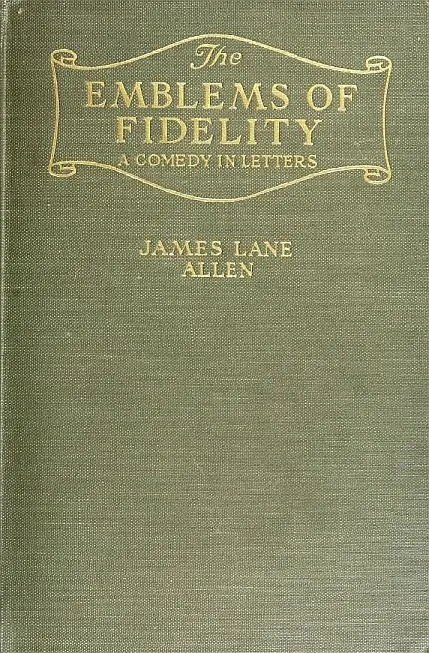
The Emblems of Fidelity: A Comedy in Letters
James Lane Allen
THE CLASSIC COLLECTION · 1894
"A Kentucky Cardinal" by James Lane Allen is a novel written in the late 19th century. The book is set in Kentucky and revolves around the introspective protagonist, Adam Moss, who navigates his complex relationship with nature, his neighbors, and the joys and sorrows of life. The narrative unfolds against the backdrop of the changing seasons, centering particularly around the vivid imagery of the titular cardinal, reflecting themes of beauty, isolation, and the delicate balance between man and nature. At the start of the story, the setting is established on a cold New Year's Day in 1850, introducing the protagonist as he contemplates his solitude and connection to the natural world around him. The opening sections highlight Adam's observations of the birds in his environment, his musings on his relationships with his neighbors—especially the widow Mrs. Walters and the recently deceased Jacob Mariner—and a budding interest in the Cobb family, who are set to become his new neighbors. Adam’s character is depicted as reflective and somewhat melancholic, peppered with humorous interactions with others, especially his imaginative thoughts about the creatures in his surroundings and his desire for a more profound connection with those around him, including Georgiana Cobb, the eldest daughter of the new neighbors. The beginning sets the stage for a rich exploration of themes like love, nature, and the complexities of social interaction in a small town.
Introduction adapted from the source catalogue; source summaries may be automatically generated.
Free to read · English · 20,912 words · No account needed
MAKE TIME FOR A GOOD BOOK
On by default. Untick to stop anonymous reading totals. Each page counts after 10 seconds in view. How this works.
Anonymous counting is on unless you have switched it off.
The strawberry bed is almost under their windows. I had gone out to pick the first dish of the season for breakfast; for while I do not care to eat except to live, I never miss an opportunity of living upon strawberries.
I was stooping down and bending the wet leaves over, so as not
to miss any, when a voice at the window above said, timidly and
playfully,
"Are you the gardener?"
I picked on, turning as red as the berries. Then the voice said
again,
"Old man, are you the gardener?"
Of course a person looking down carelessly on the stooping figure of any man, and seeing nothing but a faded straw hat, and arms and feet and ankles bent together, might easily think him decrepit with age. Some things touch off my temper. But I answered, humbly,
"I am the gardener, madam."
"How much do you ask for your strawberries?"
"The gentleman who owns this place does not sell his strawberries. He gives them away, if he likes people. How much do you ask for your strawberries?"
"What a nice old gentleman! Is he having those picked to give
away?"
"He is having these picked for his breakfast."
"Don't you think he'd like you to give me those, and pick him some
more?"
"I fear not, madam."
"Nevertheless, you might. He'd never know."
"I think he'd find it out."
"You are not afraid of him, are you?"
"I am when he gets mad."
"Does he treat you badly?"
"If he does, I always forgive him."
"He doesn't seem to provide you with very many clothes."
I picked on.
"But you seem nicely fed."
I picked on.
"What is his name, old man? Don't you like to talk?"
"Adam Moss."
"Such a green, cool, soft name! It is like his house and yard and
garden. What does he do?"
"Whatever he pleases."
"You must not be impertinent to me, or I'll tell him. What does
he like?"
"Birds--red-birds. What do you like?"
"Red-birds! How does he catch them? Throw salt on their tails?"
"He is a lover of Nature, madam, and particularly of birds."
"What does he know about birds? Doesn't he care for people?"
"He doesn't think many worth caring for."
"Indeed! And he is perfect, then, is he?"
"He thinks he is nearly as bad as any; but that doesn't make the
rest any better."
"Poor old gentleman! He must have the blues dreadfully. What does he do with his birds? Eat his robins, and stuff his cats, and sell his red-birds in cages?"
"He considers it part of his mission in life to keep them from
being eaten or stuffed or caged."
Your reading position is saved on this browser. Take it to another device with a library code. Reading pages adapt to text, rather than matching a printed edition.
James Lane Allen
James Lane Allen
James Lane Allen
James Lane Allen
BEHIND THE BOOK
This eBook is for the use of anyone anywhere in the United States and most other parts of the world at no cost and with almost no restrictions whatsoever. You may copy it, give it away or re-use it under the terms of the Project Gutenberg License included with this eBook or online at www.gutenberg.org. If you are not located in the United States, you will have to check the laws of the country where you are located before using this eBook. Read the source licence.
The original source file, including credits and licence, is retained by this library. Request an original-format copy at no charge. Please include the book title and Project Gutenberg identifier #11532.
KEEP YOUR CURIOSITY GOING
Coulson Kernahan

Maurice Baring
Frances Wright
Cécile Tormay

Frederic Jesup Stimson

W. H. P. (William Henry Pope) Jarvis