Europe and elsewhere
Mark Twain
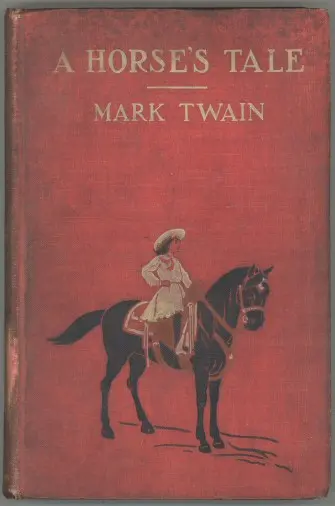
THE CLASSIC COLLECTION · 1906
"A Horse's Tale" by Mark Twain is a novel written during the early 20th century. The story is narrated from the perspective of a horse named Soldier Boy, who serves as the mount for the famous scout Buffalo Bill. Their adventures and interactions with other characters, including General Alison and a spirited little girl named Cathy, form the heart of this tale, as the horse recounts his experiences on the frontier and his relationship with those around him. At the start of the novel, Soldier Boy introduces himself and shares insights into his life with Buffalo Bill. He describes his strength, speed, and intelligence, proudly recounting the many miles they've traveled together on scouting missions. The narrative reveals Soldier Boy's keen observations about his companions and the events unfolding around them, including the arrival of Cathy, an adventurous young girl whose presence quickly charms the entire military garrison. The opening sets the stage for a whimsical and heartwarming adventure filled with humor and insights into the characters' interactions, all while framed by the unique perspective of a horse.
Introduction adapted from the source catalogue; source summaries may be automatically generated.
Free to read · English · 17,998 words · No account needed
MAKE TIME FOR A GOOD BOOK
On by default. Untick to stop anonymous reading totals. Each page counts after 10 seconds in view. How this works.
Anonymous counting is on unless you have switched it off.
“The grandest in the world! There’s no other sport that begins with it. I’ll tell you what I’ve seen, then you can judge. It was my first, and it’s as vivid to me now as it was when I saw it. It was a Sunday afternoon, and beautiful weather, and my uncle, the priest, took me as a reward for being a good boy and because of my own accord and without anybody asking me I had bankrupted my savings-box and given the money to a mission that was civilizing the Chinese and sweetening their lives and softening their hearts with the gentle teachings of our religion, and I wish you could have seen what we saw that day, Thorndike.
“The amphitheatre was packed, from the bull-ring to the highest row—twelve thousand people in one circling mass, one slanting, solid mass—royalties, nobles, clergy, ladies, gentlemen, state officials, generals, admirals, soldiers, sailors, lawyers, thieves, merchants, brokers, cooks, housemaids, scullery-maids, doubtful women, dudes, gamblers, beggars, loafers, tramps, American ladies, gentlemen, preachers, English ladies, gentlemen, preachers, German ditto, French ditto, and so on and so on, all the world represented: Spaniards to admire and praise, foreigners to enjoy and go home and find fault—there they were, one solid, sloping, circling sweep of rippling and flashing color under the downpour of the summer sun—just a garden, a gaudy, gorgeous flower-garden! Children munching oranges, six thousand fans fluttering and glimmering, everybody happy, everybody chatting gayly with their intimates, lovely girl-faces smiling recognition and salutation to other lovely girl-faces, gray old ladies and gentlemen dealing in the like exchanges with each other—ah, such a picture of cheery contentment and glad anticipation! not a mean spirit, nor a sordid soul, nor a sad heart there—ah, Thorndike, I wish I could see it again.
“Suddenly, the martial note of a bugle cleaves the hum and murmur—clear
the ring!
“They clear it. The great gate is flung open, and the procession marches in, splendidly costumed and glittering: the marshals of the day, then the picadores on horseback, then the matadores on foot, each surrounded by his quadrille of chulos. They march to the box of the city fathers, and formally salute. The key is thrown, the bull-gate is unlocked. Another bugle blast—the gate flies open, the bull plunges in, furious, trembling, blinking in the blinding light, and stands there, a magnificent creature, centre of those multitudinous and admiring eyes, brave, ready for battle, his attitude a challenge. He sees his enemy: horsemen sitting motionless, with long spears in rest, upon blindfolded broken-down nags, lean and starved, fit only for sport and sacrifice, then the carrion-heap.
Your reading position is saved on this browser. Take it to another device with a library code. Reading pages adapt to text, rather than matching a printed edition.
BEHIND THE BOOK
This eBook is for the use of anyone anywhere in the United States and most other parts of the world at no cost and with almost no restrictions whatsoever. You may copy it, give it away or re-use it under the terms of the Project Gutenberg License included with this eBook or online at www.gutenberg.org. If you are not located in the United States, you will have to check the laws of the country where you are located before using this eBook. Read the source licence.
The original source file, including credits and licence, is retained by this library. Request an original-format copy at no charge. Please include the book title and Project Gutenberg identifier #1086.
KEEP YOUR CURIOSITY GOING
Coulson Kernahan

Maurice Baring
Frances Wright
Cécile Tormay

Frederic Jesup Stimson

W. H. P. (William Henry Pope) Jarvis