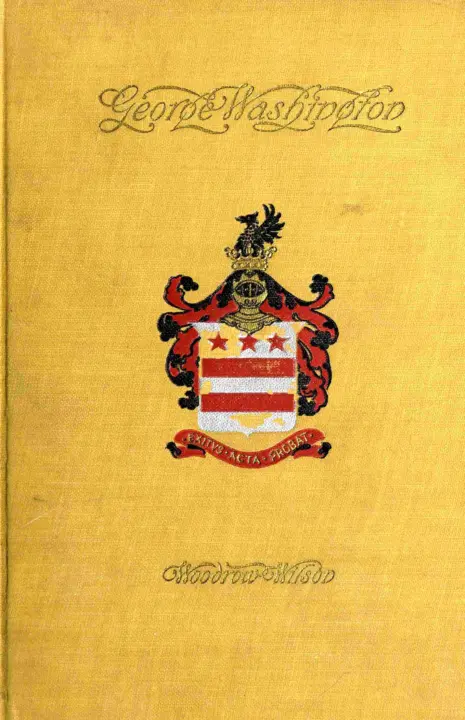
George Washington
Woodrow Wilson
THE CLASSIC COLLECTION · 1901
"A history of the American people, Vol. 2 [of 5]" by Woodrow Wilson is a historical account written in the early 20th century. Centered on the British mainland colonies’ growth from scattered settlements into an emerging nation, it follows imperial rivalry, frontier expansion, commerce, religion, and politics as they converge toward revolution and independence. This volume likely covers the late 17th century through the Revolutionary era, highlighting how colonial society, war, and governance forged a common American direction.
The opening of this volume surveys the colonies from the late 1600s into the 1730s, showing how repeated wars and shared pressures began to knit them together. It contrasts English settlement with French military expansion down the St. Lawrence, Great Lakes, and Mississippi, notes the Iroquois as a decisive barrier, and recounts King William’s War and Queen Anne’s War—raids, failed expeditions, Port Royal’s capture, and the Carolinas’ hard fighting against Spain and native confederacies. Alongside war, it traces trade under the Navigation Acts, the rise and suppression of piracy (including Kidd, Blackbeard, and Bonnet), William Penn’s conciliatory reforms, New Jersey’s shift to royal control, new colleges, and Alexander Spotswood’s forward-looking Virginia governance and Blue Ridge exploration. A long Walpole-era peace brings population growth and diversity (Scots-Irish, Germans, Huguenots), Charleston’s plantation elite, colonial assertiveness (the Zenger acquittal), slave unrest, and the tightening French cordon inland (Crown Point, Niagara, New Orleans). The section closes with James Oglethorpe’s founding of Georgia as a philanthropic, military buffer, deliberately settled by vetted Europeans such as Salzburgers and Highlanders.
Introduction adapted from the source catalogue; source summaries may be automatically generated.
Free to read · English · 73,663 words · No account needed
MAKE TIME FOR A GOOD BOOK
On by default. Untick to stop anonymous reading totals. Each page counts after 10 seconds in view. How this works.
Anonymous counting is on unless you have switched it off.
VIEW OF THE BUILDINGS BELONGING TO HARVARD COLLEGE, CAMBRIDGE, NEW ENGLAND, 1726.—Partial reproduction of the earliest print of Harvard College. What is believed to be the only extant copy of this old engraving is owned by the Massachusetts Historical Society 109
NASSAU HALL, PRINCETON COLLEGE, 1760.—Redrawn from an old print 111
KING’S COLLEGE NEW YORK, 1758.—Redrawn from an old print 112
BENJAMIN FRANKLIN.—From the portrait by Duplessis in the Museum of Fine Arts, Boston, Mass. Facing p. 112
THE BIRTHPLACE OF BENJAMIN FRANKLIN, MILK STREET, BOSTON.—Redrawn from an old print 113
BENJAMIN FRANKLIN.—From an old engraving 115
A PAGE OF “POOR RICHARD’S” ALMANAC.—From an original of this almanac for 1767, in the New York Public Library (Lenox Building) 117
BENJAMIN FRANKLIN IN A COLONIAL DRAWING ROOM.—From a painting by H. C. Christy 119
MRS. BENEDICT ARNOLD AND CHILD.—From the portrait by Sir Thomas Lawrence, in the Historical Society of Pennsylvania 121
FRANKLIN’S OLD BOOK-SHOP, NEXT TO CHRIST’S CHURCH, PHILADELPHIA.—Redrawn from an old print 123
GEORGE GRENVILLE.—From an old print 125
BOUNDARY MONUMENT ON THE ST. CROIX.—From a lithograph by L. Haghe after a sketch by Joseph Bouchette, made in July, 1817, and included in his British Dominions in North America. London, 1832 127
PONTIAC, CHIEF OF THE OTTAWAS.—Redrawn from an old print 129
HENRY BOUQUET.—From a process-plate in New York Public Library (Lenox Building) 131
BOUQUET’S REDOUBT AT PITTSBURG.—Redrawn from an old print 132
PATRICK HENRY.—From an old engraving 133
FACSIMILE OF POSTER PLACED ON THE DOORS OF PUBLIC BUILDINGS.—From Lamb’s History of New York 135
JOHN DICKINSON.—From an old engraving 137
THOMAS HUTCHINSON.—From the painting attributed to Copley, in the Massachusetts Historical Society 138
THOMAS HUTCHINSON’S MANSION, BOSTON.—Redrawn from an old print 139
TABLE OF STAMP CHARGES ON PAPER.—From an original of this broadside, in the Emmet Collection, No. 1802, in the New York Public Library (Lenox Building) 141
LORD ROCKINGHAM.—From an engraving after a painting by Wilson 142
JAMES OTIS.—Redrawn from an old print 144
STAMPS FORCED ON THE COLONIES.—From a photograph of an old document 145
OLD CAPITOL AT WILLIAMSBURG, VIRGINIA.—From a painting by Howard Pyle 147
GEORGE WYTHE.—From a painting by Weir, after Trumbull, in Independence Hall, Philadelphia 149
GEORGE WASHINGTON, 1772.—From a portrait painted in 1772, by C. W. Peale, now owned by General George Washington Custis Lee, of Lexington, Virginia 155
LANDING TROOPS AT BOSTON, 1768.—From a heliotype in Winsor’s Boston, after the engraving by Paul Revere 157
LIST OF NAMES OF THOSE WHO WOULD NOT CONFORM.—This is a page from the North American Almanack for 1770 , published at Boston by Edes and Gill 159
Your reading position is saved on this browser. Take it to another device with a library code. Reading pages adapt to text, rather than matching a printed edition.
Woodrow Wilson
Woodrow Wilson
Woodrow Wilson
Woodrow Wilson
BEHIND THE BOOK
This eBook is for the use of anyone anywhere in the United States and most other parts of the world at no cost and with almost no restrictions whatsoever. You may copy it, give it away or re-use it under the terms of the Project Gutenberg License included with this eBook or online at www.gutenberg.org. If you are not located in the United States, you will have to check the laws of the country where you are located before using this eBook. Read the source licence.
The original source file, including credits and licence, is retained by this library. Request an original-format copy at no charge. Please include the book title and Project Gutenberg identifier #78469.
KEEP YOUR CURIOSITY GOING
Cécile Tormay

Moritz Busch
John L. Ransom
Frances Wright
Cécile Tormay

Mabel Potter Daggett