THE CLASSIC COLLECTION✦An outlaw’s diary: the CommuneCLASSIC FREE BOOKS
An outlaw’s diary: the Commune
Cécile Tormay
THE CLASSIC COLLECTION · 1903
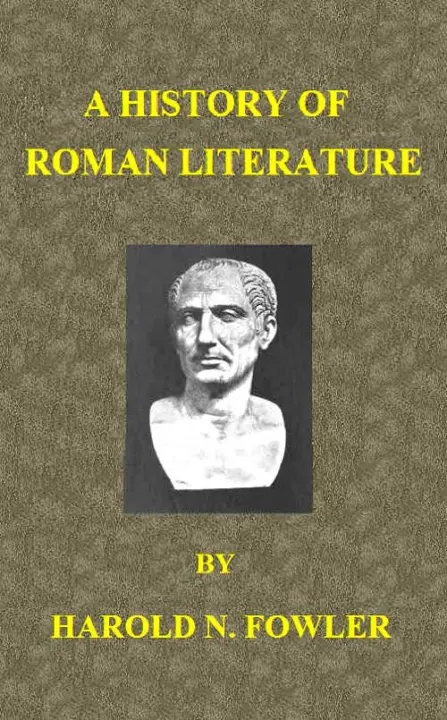
"A History of Roman Literature" by Harold North Fowler is a historical account written in the early 20th century. The book explores the development of Roman literature from its origins during the Republican period through various subsequent eras, detailing key authors and their contributions. It serves as both an educational text for schools and colleges and a reference work about the literary accomplishments of Rome. At the start of the book, the author outlines the significance of Roman literature, noting its roots in Greek literary traditions and its overarching political influence. Fowler discusses the practical character of Roman society, which shaped its literature to reflect political and military concerns rather than pure artistic expression. He introduces key figures, such as Livius Andronicus and Ennius, while also indicating the evolution of literary forms like tragedy and comedy in the context of Roman culture. Through these early chapters, Fowler sets the stage for a comprehensive exploration of the rich tapestry of Roman literary history.
Introduction adapted from the source catalogue; source summaries may be automatically generated.
Free to read · English · 97,375 words · No account needed
MAKE TIME FOR A GOOD BOOK
On by default. Untick to stop anonymous reading totals. Each page counts after 10 seconds in view. How this works.
Anonymous counting is on unless you have switched it off.
[1] Even if this work and some treatises on grammar should be ascribed to a later Ennius, which is not proved, the works of the great poet were sufficiently various.
[2] Ancient customs and men cause the Roman republic to prosper.
[3] Whom no one with the sword could overcome nor by bribing.
[4] This line occurs in a context which is worth translating. “I do not ask gold for myself, and do not you offer me a ransom: not waging the war like hucksters, but like soldiers, with the sword, not with gold, let us strive for our lives. Let us try by our valor whether our mistress Fortune wishes you or me to rule.”
[5] Aulus Gellius, xii, 4.
[6] Quoted by Cicero, De Deor. Nat. II, 35, 89.
[7] Rudens, 160-173.
[8] Persa, 204-224.
[9] Phormio, 784 ff. Translated by M. H. Morgan.
[10] Quoted by Pliny, N. H. xxix, 7, 14.
[11] De Re Rustica, i.
[12] A brief description of some of the feet and metres most frequently used by Roman poets may be useful. These were, with the exception of the Saturnian verse (see p. 7), borrowed, with certain modifications, from the Greek. The most usual feet are the iambus (◡—), the trochee (—◡), the spondee (——), the dactyl (—◡◡), the anapæst (◡◡—), and the choriambus (—◡◡—). The dactylic hexameter consists of six feet, each of which is either a dactyl or a spondee, though the sixth is always a spondee and the fifth almost always a dactyl. An illustration of this is the line from Lucilius,
Maior erat natu; non omnia possumus omnes,
the rhythm of which is retained in this translation:
He was the elder by birth; not all of us all things can compass.
The iambic senarius consists of six iambics, as
Hominem inter vivos quaéritamus mórtuom.
(Plautus, Menæchmi, 240.)
Among the living we do seek a man who’s dead.
This is a common metre in the dialogue parts of dramas. It is one foot longer than the line in English blank verse. The trochaic septenarius, also a common metre in the drama, consists of seven trochees and an additional long syllable. The English line,
Do not lift him from the bracken; leave him lying where he fell
gives an idea of the rhythm.
The elegiac distich consists of an hexameter followed by a so-called pentameter, that is, a line made up of six dactyls or spondees, with the omission of the last half of the third and of the sixth feet. This is illustrated and described by Coleridge in the lines,
In the hexameter rises the fountain’s silvery column. In the pentameter aye falling in melody back.
In the iambic and trochaic metres other feet are often substituted for the iambus and the trochee, but without change of rhythm.
Your reading position is saved on this browser. Take it to another device with a library code. Reading pages adapt to text, rather than matching a printed edition.
BEHIND THE BOOK
This eBook is for the use of anyone anywhere in the United States and most other parts of the world at no cost and with almost no restrictions whatsoever. You may copy it, give it away or re-use it under the terms of the Project Gutenberg License included with this eBook or online at www.gutenberg.org. If you are not located in the United States, you will have to check the laws of the country where you are located before using this eBook. Read the source licence.
The original source file, including credits and licence, is retained by this library. Request an original-format copy at no charge. Please include the book title and Project Gutenberg identifier #44975.
KEEP YOUR CURIOSITY GOING
Cécile Tormay

Moritz Busch
John L. Ransom
Frances Wright
Cécile Tormay

Mabel Potter Daggett