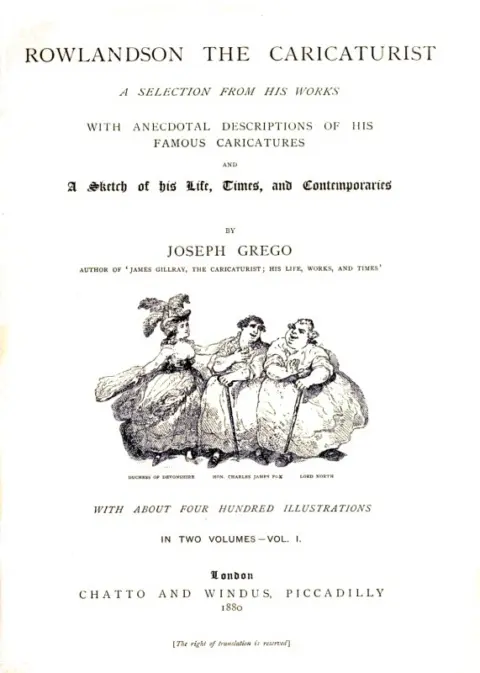
Rowlandson the Caricaturist; a Selection from His Works. Vol. 2
Joseph Grego
THE CLASSIC COLLECTION · 1886
"A History of Parliamentary Elections and Electioneering in the Old Days" by Joseph Grego is a historical account written in the late 19th century. This work explores the evolution of parliamentary elections and the various methods of electioneering in Britain from the time of the Stuarts to the reign of Queen Victoria. The text likely examines the intricate relationships between social classes, political parties, and the electoral process, centering on themes of corruption, representation, and civic engagement. The opening of the book delves into the origins of parliamentary assemblies and the complex rules governing elections, starting from early medieval practices to the formalization of the House of Commons. It highlights the role of key figures and evolving practices, touching upon concepts such as electoral qualifications, bribery, and the increasing power dynamics in electioneering. Grego establishes a historical context that underpins the development of Britain's parliamentary system, setting the stage for the ensuing chapters that promise to detail the vivid and often tumultuous political landscape of earlier centuries.
Introduction adapted from the source catalogue; source summaries may be automatically generated.
Free to read · English · 157,851 words · No account needed
MAKE TIME FOR A GOOD BOOK
On by default. Untick to stop anonymous reading totals. Each page counts after 10 seconds in view. How this works.
Anonymous counting is on unless you have switched it off.
“C. That traitors to th’ Country in a brib’d House of Commons Should give away millions at every summons.
W. Yet some of those givers such beggarly villains As not to be trusted for twice twenty shillings.
C. No wonder that beggars should still be for giving, Who, out of what’s given, do get a good living.
W. Four Knights and a knave, who were burgesses made, For selling their consciences were liberally paid.
C. How base are the souls of such low-priced sinners, Who vote with the country for Drink and for Dinners.
W. ’Tis they that brought on us this scandalous yoke, Of excising our cups, and taxing our smoke.
C. But thanks to the Harlots who made the King dogg’d, For giving no more the Rogues are prorogued.”
(ANDREW MARVELL, 1674: A Dialogue between Two Horses.)
From his “good discourse on parliament,” Mr. Secretary Pepys, by a happy coincidence, straightway betook himself to that palace, where he had the privilege of being well received, and in which, under the Stuarts, more curious scenes were witnessed than falls to the lot of even the average of princely abodes:--
“Thence to Whitehall, where the Parliament was to wait on the King, and they did: and he did think fit to tell them that they might expect to be adjourned at Whitsuntide, and that they might make haste to raise their money: but this, I fear, will displease them, who did expect to sit as long as they pleased.”
A truly regal reception, and a most unceremonious mode of dismissing the “chosen of the people.” The wits of the day thus tersely summed up the situation of affairs:--
“I’ll have a long parliament always to friend, And furnish my treasure as fast as I spend, And if they will not, they shall have an end.”
(A. MARVELL: Royal Resolutions.)
Perhaps the most felicitous sallies were due to the pen of that gifted reprobate, the Earl of Rochester, at times the alter ego of the Merry Monarch, but who finally, after enjoying boundless favour by diverting the king at his own royal expense as often as at that of his subjects, pointed a shaft with too galling a barb, and flitted away from a Court whose vileness he both exposed and shared in equally liberal measure:--
“A parliament of knaves and sots,
Members by name you must not mention,
He keeps in pay, and buys their votes;
Here with a place, there with a pension.
When to give money he can’t cologue ’um,
He doth with scorn prorogue, prorogue ’um.
Your reading position is saved on this browser. Take it to another device with a library code. Reading pages adapt to text, rather than matching a printed edition.
BEHIND THE BOOK
This eBook is for the use of anyone anywhere in the United States and most other parts of the world at no cost and with almost no restrictions whatsoever. You may copy it, give it away or re-use it under the terms of the Project Gutenberg License included with this eBook or online at www.gutenberg.org. If you are not located in the United States, you will have to check the laws of the country where you are located before using this eBook. Read the source licence.
The original source file, including credits and licence, is retained by this library. Request an original-format copy at no charge. Please include the book title and Project Gutenberg identifier #52156.
KEEP YOUR CURIOSITY GOING
Cécile Tormay

Moritz Busch
John L. Ransom
Frances Wright
Cécile Tormay

Mabel Potter Daggett