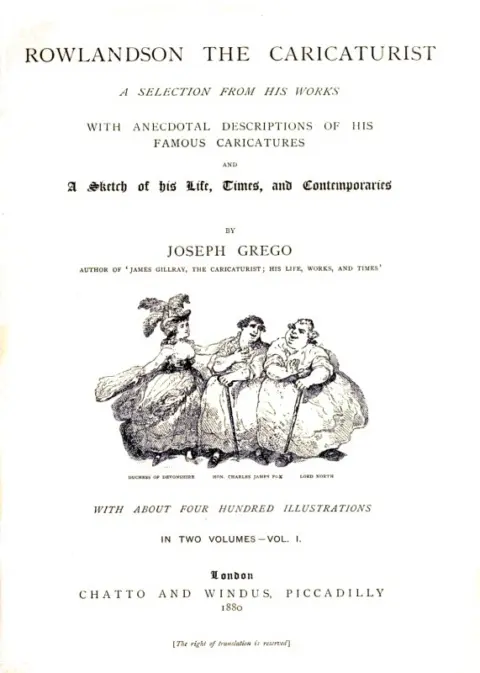
Rowlandson the Caricaturist; a Selection from His Works. Vol. 2
Joseph Grego
THE CLASSIC COLLECTION · 1886
"A History of Parliamentary Elections and Electioneering in the Old Days" by Joseph Grego is a historical account written in the late 19th century. This work explores the evolution of parliamentary elections and the various methods of electioneering in Britain from the time of the Stuarts to the reign of Queen Victoria. The text likely examines the intricate relationships between social classes, political parties, and the electoral process, centering on themes of corruption, representation, and civic engagement. The opening of the book delves into the origins of parliamentary assemblies and the complex rules governing elections, starting from early medieval practices to the formalization of the House of Commons. It highlights the role of key figures and evolving practices, touching upon concepts such as electoral qualifications, bribery, and the increasing power dynamics in electioneering. Grego establishes a historical context that underpins the development of Britain's parliamentary system, setting the stage for the ensuing chapters that promise to detail the vivid and often tumultuous political landscape of earlier centuries.
Introduction adapted from the source catalogue; source summaries may be automatically generated.
Free to read · English · 157,851 words · No account needed
MAKE TIME FOR A GOOD BOOK
On by default. Untick to stop anonymous reading totals. Each page counts after 10 seconds in view. How this works.
Anonymous counting is on unless you have switched it off.
Curiously enough, five weeks after these lines appeared, the poet was likewise gathered to those shades to which he had with sportive venom prematurely consigned his antagonist, in all probability without anticipating the literal fulfilment of his prophecy.
[50] John Wilkes, Radical, 1290; George Cooke, Conservative, 827; Sir W. B. Proctor, the unsuccessful Whig candidate, polled 807 votes.
[51] A less dignified view is taken of the lord mayor’s officious intervention, in the Political Register, 1768, where it states he had degraded, by his personal interference, “the dignity of his office to that of a petty constable;” and in a letter referring to the royal and ministerial favours conferred in return “for his active and spirited behaviour,” the new state official is, in his capacity of merchant-tailor, thus addressed:--
“And now, my lord, as we are brother tailors, how could you be so unkind as not to join eight of us to your right honourable self (nine tailors proverbially making one man), when you were dubbed the other day a Privy Councillor.”
[52] The “cornuted” effect of these peculiarly fashioned wigs, especially when seen from the back, is, perhaps, accountable--with the pun on the parson’s Christian name of Horne--for the quotation engraved above the plate in question,--“Mine horn shall be exalted, like the horn of an Unicorn (Psalm 93).”
[53] The Duke of Grafton was first lord of the treasury, 1767 to 1780.
[54] John Wilkes.
[55] George Fletcher, executed 1746.
[56] Samuel Turner and Sir Robert Ladbrooke were unstable, and a few months later, “ratted” and becoming subservient to Court influence, did their best to betray the liberties of the citizens confided to their championship.
[57] A mark being equivalent to 13s. 4d.
[58] According to the return of 1826 there were three hundred voters.
[59] Sheridan, according to Lord Byron’s dictum, had produced the three best compositions of his age in their respective lines: the best comedy, “The School for Scandal;” the best parliamentary philippic, the “Begum speech” against Warren Hastings; and pronounced the finest funeral oration, the monody on Garrick.
“The pride of the palace, the bower, and the hall, The orator, dramatist, minstrel who ran Through each mode of the lyre and was master of all.”
[60] A necessary qualification, members being, by supposition, expected to reside in the places they represented.
[61] Wilkes’s Address to the Middlesex Electors.
[62] Lord Thurlow, who was frequently twitted by the satirists upon his penchant for the fair sex.
[63] Lord Bute’s secretary, the great dispenser of “back-stairs influence,” afterwards Lord Liverpool.
[64] For the screen of Carlton House Palace, see “Coriolanus addressing the Plebeians,” 1820; p. 338.
Your reading position is saved on this browser. Take it to another device with a library code. Reading pages adapt to text, rather than matching a printed edition.
BEHIND THE BOOK
This eBook is for the use of anyone anywhere in the United States and most other parts of the world at no cost and with almost no restrictions whatsoever. You may copy it, give it away or re-use it under the terms of the Project Gutenberg License included with this eBook or online at www.gutenberg.org. If you are not located in the United States, you will have to check the laws of the country where you are located before using this eBook. Read the source licence.
The original source file, including credits and licence, is retained by this library. Request an original-format copy at no charge. Please include the book title and Project Gutenberg identifier #52156.
KEEP YOUR CURIOSITY GOING
Cécile Tormay

Moritz Busch
John L. Ransom
Frances Wright
Cécile Tormay

Mabel Potter Daggett