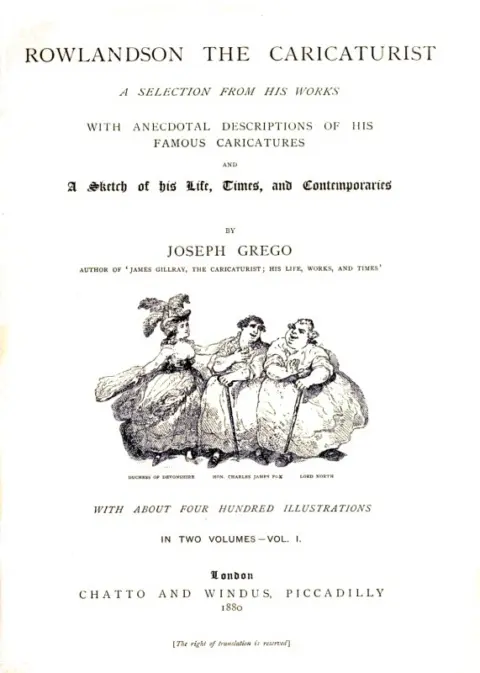
Rowlandson the Caricaturist; a Selection from His Works. Vol. 2
Joseph Grego
THE CLASSIC COLLECTION · 1886
"A History of Parliamentary Elections and Electioneering in the Old Days" by Joseph Grego is a historical account written in the late 19th century. This work explores the evolution of parliamentary elections and the various methods of electioneering in Britain from the time of the Stuarts to the reign of Queen Victoria. The text likely examines the intricate relationships between social classes, political parties, and the electoral process, centering on themes of corruption, representation, and civic engagement. The opening of the book delves into the origins of parliamentary assemblies and the complex rules governing elections, starting from early medieval practices to the formalization of the House of Commons. It highlights the role of key figures and evolving practices, touching upon concepts such as electoral qualifications, bribery, and the increasing power dynamics in electioneering. Grego establishes a historical context that underpins the development of Britain's parliamentary system, setting the stage for the ensuing chapters that promise to detail the vivid and often tumultuous political landscape of earlier centuries.
Introduction adapted from the source catalogue; source summaries may be automatically generated.
Free to read · English · 157,851 words · No account needed
MAKE TIME FOR A GOOD BOOK
On by default. Untick to stop anonymous reading totals. Each page counts after 10 seconds in view. How this works.
Anonymous counting is on unless you have switched it off.
Burdett’s ballad-singers and marrow-bone-and-cleaver men are scattered by the plunging dray-horse from Whitbread’s, and the startled donkey, which bears little Paull, is giving the rider an upset, in which Paull’s famous “Impeachment of the Marquis of Wellesley” is falling to the ground. Last comes Sir Francis Burdett, who, on this occasion, experienced a mortifying defeat in the face of his former triumphs at Brentford; the gay barouche of 1800 and 1804 has given place to an “untaxed cart” with four miserable jackasses; the efforts of a posse of sweeper-boy followers with difficulty extricate this shabby conveyance from the slough. Acting as postillion is the little Corsican, Bonaparte, then but recently elected Emperor of the French. It was at this time one of the theories of Napoleon I., that, after the visionary conquest of England, he would inaugurate a republic, for the presidency of which he declared Sir Francis Burdett to be, in his estimation, the fittest person in England; this opinion, it is believed, was shared by the baronet--an entertaining aspect of the “might-have-beens”! “Liberty and Equality, No Placemen in Parliament, and No Bastilles,” are the watchwords of the party in the condemned cart; all the members wear “Liberty” favours in their hats. Burdett has “The Life of Oliver Cromwell” for consultation ready at hand; behind him is his political preceptor, Horne Tooke, shown in parsonic guise, and Bosville with the “Rights of Man” next his heart. Cobbett appears as the “Radical Drummer,” beating up recruits for Burdett and Paull, with his “Political Register” and “Inflammatory Letters.” “Orator Broad-face, of Swallow Street,” whose mob pleasantries overpowered the veteran Sheridan at Covent Garden, is among the baronet’s enthusiastic supporters.
It was at the Westminster election of 1806 that the excitement culminated. This long and expensive contest was fruitful in incidents. Gillray has produced the most characteristic “View of the Hustings in Covent Garden.” At the time this version appeared, Paull was at the head of the poll; he is shown vigorously denouncing his discomfited antagonist--“Harlequin Sherry” as “the sunk, the lost, the degraded treasurer.” Immediately behind Paull is the Duke of Northumberland, whose son, Lord Percy, had relinquished Westminster after representing it in parliament for one session, that immediately following Fox’s decease; the Duke has “No Coalition” inscribed on his hat, and a “Letter to the Vestry of St. Margaret’s” in his hand. Cobbett, Burdett, and Bosville, wearing favours for Paull, are in the front ranks of his supporters. Sheridan, exhorted to “Pay your Debts, Mr. Treasurer,” is represented as filled with consternation; Whitbread is vainly trying to rally his spirits with his “New Loyal Porter;” Sir Samuel Hood is seemingly ashamed of his colleague, and is chuckling over his confusion. The exchange of personalities between Paull and Sheridan, who was assisted by the notorious “Pickle,” his son Tom, exceeded all that had gone before, and degenerated into “Billingsgate” abuse. Sheridan, with questionable propriety, dwelt more particularly on the descent of his opponent from “tailordom,” and was waggish in allusions to the “ninth part of a man.” Paull complimented Sheridan on “his good taste,” and justified it by referring to the manager of Drury Lane as the “son of a vagabond,” actors being by Act of Parliament classed in that category. Paull was the readier at mob oratory, and Sheridan, “erst the wit of the Commons,” found the hustings a terrible penance; his appearance was the signal for violent uproar, and requests for “renters’ shares” and sums of money owing, and for which it was alleged he was liable. Painfully conscious of his familiar embarrassments, this raillery, in the presence of persons of credit and influence whose support was growing lukewarm, broke down the spirit of the veteran champion of this order of encounter. He had trusted to his well-seasoned experience in mob demonstrations, to his playful wit, apt jocularities, and sarcasms to convert the mob to good humour, and to cajole them with his popular persuasions into a friendly disposition; but he reckoned without allowing for rivalry. Besides the fluent Paull, there was one man in the crowd who fairly compelled “Sherry” to retire abashed; in vain he tried by turns ridicule and denunciation of “hireling ruffians,” the broad-faced orator in the green coat seemed stimulated by these counter-attacks. A comedy was then popular in which a dandy was repeatedly quizzed by inquiries, directed to the various portions of his apparel, of “Who suffers?” This artillery was constantly played upon Sheridan: “Sherry, I see you’ve got a new coat--who suffers?” “Sherry, who suffers for that new hat?” After this the disconcerted treasurer avoided the hustings, and his son Tom, whose cool audacity was proverbial, managed to take his place. Sheridan only gained the election through his coalition with Hood; but the shafts of Cobbett’s “porcupine quills” and the conflict of the hustings rankled in his breast. A dissolution shortly followed, and he lost his seat, which, by precipitating his financial difficulties, ingloriously finished Sheridan’s career.
Your reading position is saved on this browser. Take it to another device with a library code. Reading pages adapt to text, rather than matching a printed edition.
BEHIND THE BOOK
This eBook is for the use of anyone anywhere in the United States and most other parts of the world at no cost and with almost no restrictions whatsoever. You may copy it, give it away or re-use it under the terms of the Project Gutenberg License included with this eBook or online at www.gutenberg.org. If you are not located in the United States, you will have to check the laws of the country where you are located before using this eBook. Read the source licence.
The original source file, including credits and licence, is retained by this library. Request an original-format copy at no charge. Please include the book title and Project Gutenberg identifier #52156.
KEEP YOUR CURIOSITY GOING
Cécile Tormay

Moritz Busch
John L. Ransom
Frances Wright
Cécile Tormay

Mabel Potter Daggett