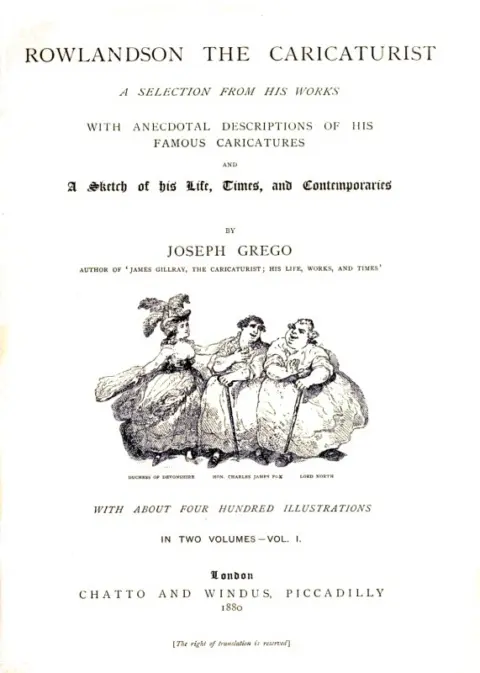
Rowlandson the Caricaturist; a Selection from His Works. Vol. 2
Joseph Grego
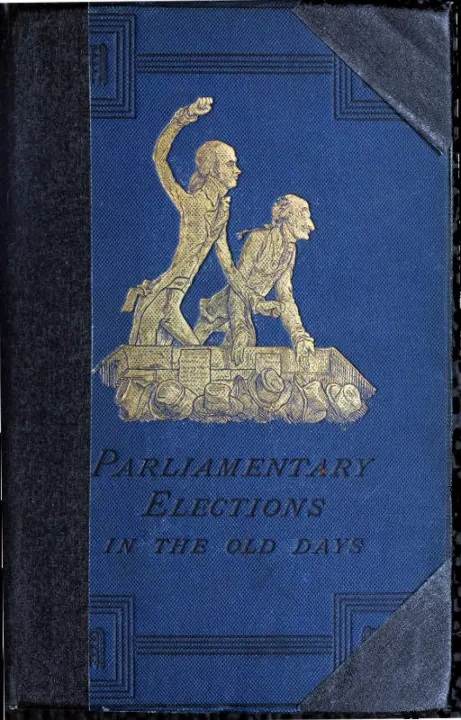
THE CLASSIC COLLECTION · 1886
"A History of Parliamentary Elections and Electioneering in the Old Days" by Joseph Grego is a historical account written in the late 19th century. This work explores the evolution of parliamentary elections and the various methods of electioneering in Britain from the time of the Stuarts to the reign of Queen Victoria. The text likely examines the intricate relationships between social classes, political parties, and the electoral process, centering on themes of corruption, representation, and civic engagement. The opening of the book delves into the origins of parliamentary assemblies and the complex rules governing elections, starting from early medieval practices to the formalization of the House of Commons. It highlights the role of key figures and evolving practices, touching upon concepts such as electoral qualifications, bribery, and the increasing power dynamics in electioneering. Grego establishes a historical context that underpins the development of Britain's parliamentary system, setting the stage for the ensuing chapters that promise to detail the vivid and often tumultuous political landscape of earlier centuries.
Introduction adapted from the source catalogue; source summaries may be automatically generated.
Free to read · English · 157,851 words · No account needed
MAKE TIME FOR A GOOD BOOK
On by default. Untick to stop anonymous reading totals. Each page counts after 10 seconds in view. How this works.
Anonymous counting is on unless you have switched it off.
The parliament of 1614 refused to grant supplies until grievances were redressed; James dismissed them, and imprisoned several members. This short session was known as the “Addled Parliament.” The “Long Parliament” assembled in 1640, and the House of Peers was abolished by it in 1649; and later on, a Peer sat in the Commons. This parliament, proving intractable, was dissolved by Cromwell in 1653. Under Charles II., with the restoration of monarchy, the Peers temporal resumed their functions, and in 1661 the Lords spiritual were allowed to resume their seats, and the Act for triennial parliaments was unwisely set aside by the Commons. The relations between the Crown and the Commons were again becoming strained in 1667, when an Act excluding Roman Catholics from sitting in either House was forced through the legislature. From this point the narrative of electioneering incidents may commence, the more appropriately since it was at this time there arose the institution of the familiar party distinctions of Whig and Tory.
The orders for the attendance of members and the Speaker were somewhat curious; for instance, among the orders in parliament regulating procedure, the following are noteworthy:--
Feb. 14, 1606.--The House to assemble at eight o’clock, and enter into the great business at nine.
May 13, 1614.--The House to meet at seven o’clock in the morning, and begin to read bills at ten.
Feb. 15, 1620.--The Speaker not to move his hat until the third
congée.
Nov. 12, 1640.--Those who go out of the House in a confused manner before the Speaker to forfeit 10s.
May 1, 1641.--All the members that come after eight to pay 1s., and those that do not come the whole day to pay 5s.
April 19, 1642.--Those who do not come to prayers to pay 1s.
Feb. 14, 1643.--Such members as come after nine o’clock to pay
1s. to the poor.
March 21, 1647.--The Speaker to leave the chair at twelve
o’clock.
May 31, 1659.--The Speaker to take the chair constantly every
morning by eight o’clock.
April 8, 1670.--The back door in the Speaker’s chamber to be
nailed up during the session.
March 23, 1693.--No member to take tobacco into the gallery, or to the table, sitting at committees.
Feb. 11, 1695.--No news-letter writer to presume to meddle with the debates, or disperse any in their papers.
Orders touching motions for leave into the country:--
Feb. 13, 1620.--No member shall go out of town without open
motion and licence in the House.
March 28, 1664.--The penalty of £10 to be paid by every knight,
and £5 by every citizen, etc., who shall make default in
attending.
Nov. 6, 1666.--To be sent for in custody of the serjeant.
Your reading position is saved on this browser. Take it to another device with a library code. Reading pages adapt to text, rather than matching a printed edition.
BEHIND THE BOOK
This eBook is for the use of anyone anywhere in the United States and most other parts of the world at no cost and with almost no restrictions whatsoever. You may copy it, give it away or re-use it under the terms of the Project Gutenberg License included with this eBook or online at www.gutenberg.org. If you are not located in the United States, you will have to check the laws of the country where you are located before using this eBook. Read the source licence.
The original source file, including credits and licence, is retained by this library. Request an original-format copy at no charge. Please include the book title and Project Gutenberg identifier #52156.
KEEP YOUR CURIOSITY GOING
Cécile Tormay

Moritz Busch
John L. Ransom
Frances Wright
Cécile Tormay

Mabel Potter Daggett