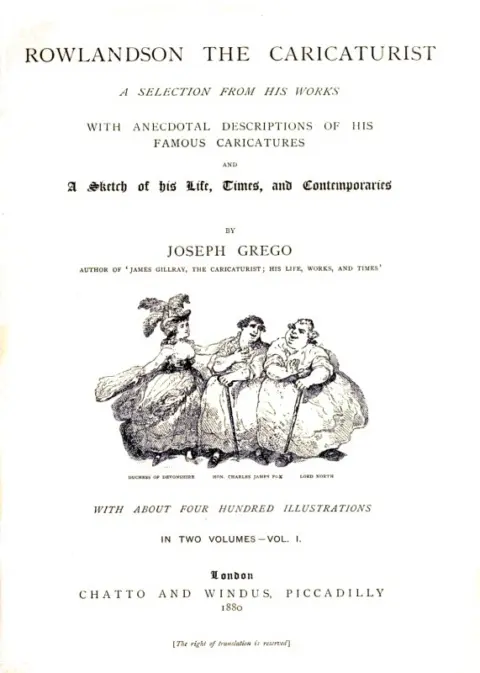
Rowlandson the Caricaturist; a Selection from His Works. Vol. 2
Joseph Grego
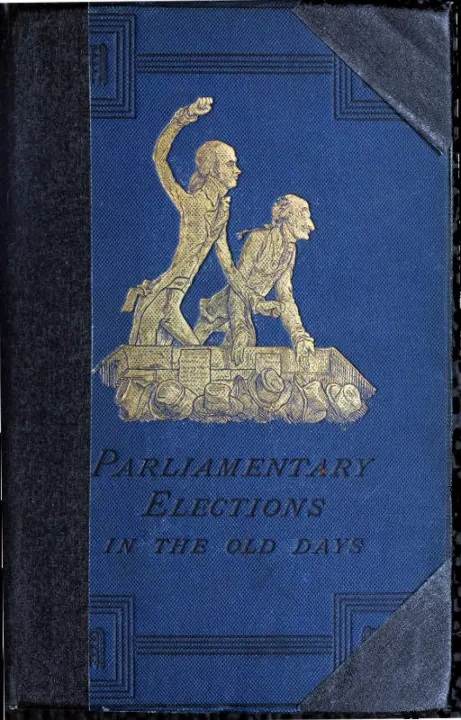
THE CLASSIC COLLECTION · 1886
"A History of Parliamentary Elections and Electioneering in the Old Days" by Joseph Grego is a historical account written in the late 19th century. This work explores the evolution of parliamentary elections and the various methods of electioneering in Britain from the time of the Stuarts to the reign of Queen Victoria. The text likely examines the intricate relationships between social classes, political parties, and the electoral process, centering on themes of corruption, representation, and civic engagement. The opening of the book delves into the origins of parliamentary assemblies and the complex rules governing elections, starting from early medieval practices to the formalization of the House of Commons. It highlights the role of key figures and evolving practices, touching upon concepts such as electoral qualifications, bribery, and the increasing power dynamics in electioneering. Grego establishes a historical context that underpins the development of Britain's parliamentary system, setting the stage for the ensuing chapters that promise to detail the vivid and often tumultuous political landscape of earlier centuries.
Introduction adapted from the source catalogue; source summaries may be automatically generated.
Free to read · English · 157,851 words · No account needed
MAKE TIME FOR A GOOD BOOK
On by default. Untick to stop anonymous reading totals. Each page counts after 10 seconds in view. How this works.
Anonymous counting is on unless you have switched it off.
“It is confidently repeated, that while a certain party of gentlemen were assembled together, in order to consult about vindicating themselves against Mr. Foot’s appeal, the ghost of Mr. Clarke appeared, and behaved in a most gross and insulting manner to the whole committee, which so terrified them all, that they have been very ill ever since, and it is thought some will not recover.”
Considerable interest attaches to the struggle in question, which made Wilkes a hero for a while. It was a time of trial as regarded the inviolability of the constitution. The ministers, safe in their bought majority in the Commons, ready to vote mechanically, seemed utterly callous as to the consequences of those infractions they were making on national liberties, presumably secured on an unassailable basis. The more impartial-minded of the people began to dread the attempted revival of despotic and irresponsible government and of those evils which had been guarded against by great exertions, firmness, and no slight sacrifices in the past. The spirit of resistance was abroad, and ministers for their own purposes disguised by every means the true condition of affairs from the head of the State. As the violation of popular liberties recalled the struggles which marked the later Stuart era, so were the means taken to resist these encroachments compared to the conduct of the people and their tribunes under the same trying circumstances. Petitions and remonstrances began to make ministers tremble lest the sympathies of the throne might be turned to their proper channel, the people.
Another election for Middlesex occurred in 1769, vice Wilkes; the results were that Wilkes was returned at the head of the poll, while his opponent (with a quarter of his votes) was declared duly elected. On the subject of Colonel Luttrell’s admission to the House much was said which must have been unpalatable to the Court. The Oxford Magazine printed a list of those members who were so patriotically inclined as to resist this brazen violation of the constitution, as “the Minority who voted 1148 in preference to 296;” while those members who servilely voted for the right of the ministers to impose a defeated candidate on the Commons were described as “the Majority who preferred 296 to 1143.” A list is given of these placemen, pensioners, and courtiers, with particulars against their respective names which account for their lack of principle, all being in receipt of State patronage, or emolument of one kind or another, sufficient to prove that self-interest was their guiding principle, and that their consciences were closed by the greed of preferment. The despotic action enforced by the administration, in defiance of the principles of the constitution,--a common practice in the reign of George III.,--provoked a very pertinent disquisition upon the potentiality of the bulwark of popular rights. The great Lord Bacon, somewhere talking of the power of parliaments, says, there is nothing which a parliament cannot do; and he had reason. A parliament can revive or abrogate old laws, and make new ones; settle the succession to the Crown; impose taxes; establish forms of religion; naturalize foreigners; dissolve marriages; legitimate bastards; attaint a man of treason, etc. Lord Bolingbroke, indeed, is of a different opinion, and affirms there is something which a parliament cannot do: it cannot annul the constitution; and that if it should attempt to annul the constitution, the whole body of the people would have a right to resist it. It is natural, too, to think that Lord Bacon limited the power of parliament, great as he believed it, to those things which do not imply a physical impossibility. Modern ministers, however, have shown that a parliament is able, at least in appearance, to effect even such impossibilities. Sir Robert Walpole was wont to boast that he had “trained his fellows,” as he called his venal majority in the House of Commons, “in such a manner, and brought them to such exact discipline, that were he to desire them to vote Jesus Christ a Gildon” (i.e. the head of an infidel sect, Gildon being a deistical writer in Walpole’s day) “he was sure of their compliance.” The ministry then in office (the Grafton administration), as will appear by the list referred to above, had assumed a power no less arbitrary and equally unreasonable, by persuading their servile majority to vote in defiance of the constitution on the question of Colonel Luttrell’s qualifications to sit in the Commons--that the 296 suffrages (recorded for Luttrell) were preferable to the 1143 polled for Wilkes.
Your reading position is saved on this browser. Take it to another device with a library code. Reading pages adapt to text, rather than matching a printed edition.
BEHIND THE BOOK
This eBook is for the use of anyone anywhere in the United States and most other parts of the world at no cost and with almost no restrictions whatsoever. You may copy it, give it away or re-use it under the terms of the Project Gutenberg License included with this eBook or online at www.gutenberg.org. If you are not located in the United States, you will have to check the laws of the country where you are located before using this eBook. Read the source licence.
The original source file, including credits and licence, is retained by this library. Request an original-format copy at no charge. Please include the book title and Project Gutenberg identifier #52156.
KEEP YOUR CURIOSITY GOING
Cécile Tormay

Moritz Busch
John L. Ransom
Frances Wright
Cécile Tormay

Mabel Potter Daggett